
The court forms are blank boxes. They don't tell you how to fill them in correctly.
You've found the equitable distribution inventory affidavit on nccourts.gov — the form that asks you to list every asset, every debt, every pension balance. And you've discovered the problem: it doesn't tell you how to classify an inheritance you deposited into a joint account. It doesn't tell you how to calculate the marital portion of a TSERS pension using coverture math. And it doesn't warn you that filing for absolute divorce before preserving your equitable distribution claim permanently extinguishes your right to the marital home, every retirement dollar, and spousal support — forever.
Meanwhile, a family law attorney in Wake County charges $250–$550 an hour. A $5,000 retainer buys you roughly twelve hours. Three of those hours get spent organising the same bank statements and tax returns you could have sorted yourself — if someone had told you what the categories were and why they mattered.
You don't need someone to fill in the affidavit for you. You need to understand the numbers before you write them down.
The Equitable Distribution Navigation System
This is a complete, step-by-step guide to dividing money and property in a North Carolina divorce — built for the specific rules that make this state different from every other. It is not legal representation and it does not file your papers. It is the classification, valuation, and sequencing intelligence that the blank forms leave out.
At its core is the Equitable Distribution Navigation System — a structured method that walks you from "I have a pile of bank statements and no idea what's marital vs. separate" to a clean, defensible asset-and-debt inventory that meets the court's standard under N.C.G.S. § 50-20. It handles the part everyone gets wrong: tracing commingled funds using North Carolina's source-of-funds rule, calculating a home equity buyout that accounts for refinancing costs and Free Trader Agreements, applying the coverture fraction to split TSERS and LGERS pensions, classifying divisible property changes that happened after separation, and building an alimony estimate using the sixteen statutory factors that North Carolina judges actually weigh.
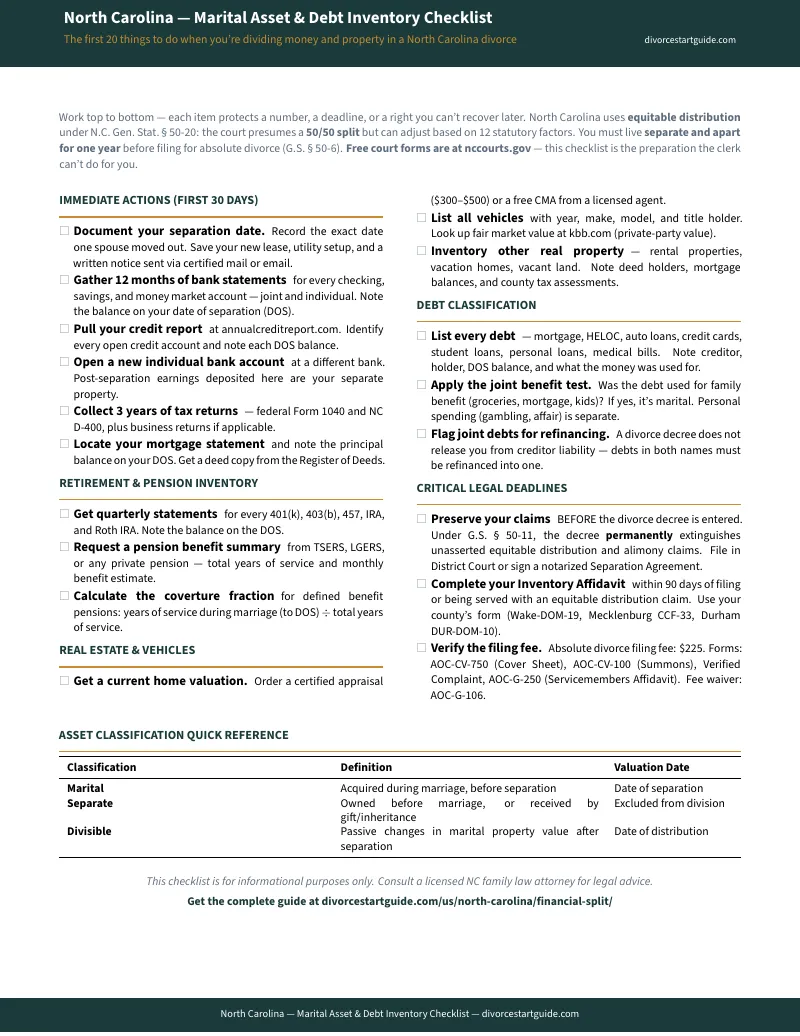
What's inside — the 18-chapter guide, 10 standalone worksheets, and the free checklist
- Marital vs. Separate Property Classification — the source-of-funds tracing method and worksheet that turns commingled accounts into documented separate-property claims. Because depositing an inheritance into a joint account creates a legal presumption of gift — unless you can trace it back to its original source with clear evidence.
- The "Absolute Cliff" Safety Net — a day-by-day action plan built around North Carolina's most dangerous deadline. Under G.S. § 50-11, the absolute divorce decree permanently bars property and alimony claims. The guide maps exactly when to file your equitable distribution claim or execute a notarized Separation Agreement and Property Settlement so nothing slips past the cliff.
- The Family Home Decision Framework — sell, buyout, or exclusive use? The worksheet calculates net equity after mortgage balance, liens, and transaction costs. It covers the buyout formula, the refinance-into-one-name requirement, the quitclaim deed process, and the Free Trader Agreement you need to purchase property during the mandatory one-year separation without creating a new marital interest for your spouse.
- The Pension & Retirement Division Method — coverture fraction math for TSERS, LGERS, and other defined-benefit state pensions. The step-by-step QDRO process for 401(k)s. IRC § 1041 tax-free IRA transfers. And the offset strategy for trading retirement claims against home equity when one spouse wants the house and the other wants the pension.
- The Spousal Support Estimator — North Carolina has no formula for alimony. Post-separation support uses an income-need calculation; permanent alimony weighs sixteen statutory factors. The guide maps your situation against both, explains the absolute adultery bar (dependent spouse) and mandatory award (supporting spouse), and covers the lump-sum buyout strategy.
- The Debt & Credit Allocation System — the "joint benefit test" for classifying debts as marital or separate, the critical distinction between what a divorce decree orders and what creditors can still enforce against you, and the indemnification clauses your separation agreement needs to actually protect you.
- Business Valuation & Hidden Assets — when appreciation on a pre-marital business becomes marital property, the three standard valuation approaches (asset-based, market, and income/DCF), and the red-flag audit for spotting dissipation through sudden withdrawals, transfers to family, or inflated business expenses.
- Tax Chapter & Post-Decree Execution — IRC § 1041 tax-free transfers, the hidden tax basis trap (a $50,000 brokerage account with a $5,000 basis is not worth $50,000), the primary residence capital gains exclusion, post-2018 alimony tax rules, and every deed transfer, title change, and beneficiary update that must happen after the settlement is signed.
Who this is for
The spouse quietly gathering records during the mandatory one-year separation — trying to figure out what's marital and what they brought into the marriage. The person staring at an equitable distribution inventory affidavit and a stack of bank statements with no idea how to connect the two. The state employee wondering how their TSERS pension gets divided. The homemaker calculating whether they can afford to keep the house after refinancing. The cooperative couple who want to reach a fair deal through mediation without spending $20,000 on attorneys — but need the math to prove the deal is actually fair. And the spouse who already has an attorney, but wants to stop paying $400 an hour for document organisation they can handle themselves.
Why not just use the free resources?
Because the free resources give you forms, not calculations. The nccourts.gov self-help page provides the equitable distribution inventory affidavit — blank fields with no instructions on how to trace a commingled inheritance, calculate a home equity buyout, or figure out the marital portion of a pension. Law firm blogs explain equitable distribution in academic terms designed to funnel you toward a $5,000 retainer. The national DIY platforms — 3StepDivorce at $299, LegalZoom's packages — are built around generic templates that don't reference North Carolina's divisible property rules, the Free Trader Agreement, or the specific TSERS/LGERS pension division procedures.
This guide fills the gap between blank court forms and a $10,000 attorney retainer. It gives you the classification system, the calculations, and the step-by-step sequence that none of the free tools provide.
An honest guarantee
Work through the Equitable Distribution Navigation System. If the guide doesn't make your financial split clearer and better organised than any blank form or free article could — email us within 30 days for a full refund. The risk of trying it is a fraction of one attorney billable hour. The risk of guessing on your asset division is measured in years of financial consequences.
For — less than fifteen minutes of attorney time — you get the classification system, the tracing worksheets, the coverture math, and the day-by-day timeline that the free forms leave out.
Stop staring at blank affidavit boxes. Get the guide, build your inventory, and walk into your equitable distribution negotiation with the numbers already done.