You survived a year of separation. Don't let a filing error undo it.
North Carolina makes you wait 365 days before you can file for absolute divorce. You've done the hard part — living apart, managing two households, watching the calendar. Now you need to file correctly through the eCourts Odyssey platform, serve your spouse properly, and get the judgment signed without triggering the statutory trap that permanently destroys your property and alimony claims.
The state gives you free blank forms. What it doesn't give you is the sequence — which forms to file, how to format them for the electronic system, what to do when the clerk rejects your submission, how to handle the 30-day response window, or how to protect your rights under G.S. § 50-11 before the judge signs.
The Clerk-Approval Filing System
The North Carolina Divorce Filing Process Guide is a step-by-step operational blueprint that maps every stage from separation verification through signed judgment. It's built around the eCourts Odyssey platform that all 100 North Carolina counties now use, with specific formatting requirements, filing codes, and rejection troubleshooting that generic divorce sites can't provide.
This isn't a form generator. You don't need one — the court forms are free. What you need is the process layer that turns blank templates into an accepted filing: the right documents, in the right format, uploaded in the right order, with the right cover sheets, so the clerk signs off instead of sending you a generic rejection notice.
What's Inside
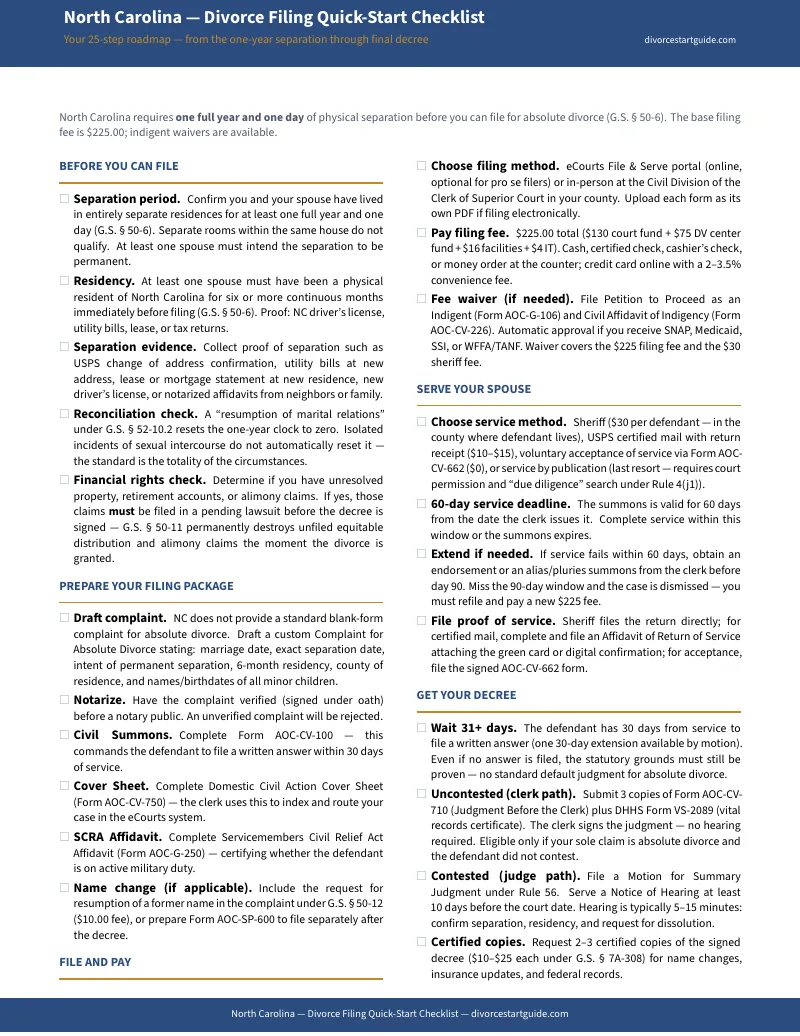
- Separation period verification worksheet — confirm your one-year-and-one-day separation satisfies G.S. § 50-6, understand what counts as "living separate and apart," and know exactly how a single night of reconciliation resets the entire clock
- eCourts Odyssey filing walkthrough — account registration, correct filing codes, document upload requirements, and a troubleshooting checklist for the most common rejection reasons that waste your $225 filing fee
- Filing package assembly guide — the exact forms you need (Complaint, Civil Summons, Domestic Civil Action Cover Sheet), how to format each one for electronic submission, and the specific errors that trigger clerk rejections
- Service of process tracker — sheriff service, certified mail, acceptance of service, proof-of-service filing, and the 60-day summons validation period
- Clerk-signed judgment pathway — how to qualify for a judgment by the clerk under G.S. § 50-10(e) instead of waiting months for a judge hearing, including the eligibility checklist and exact paperwork
- G.S. § 50-11 forfeiture diagnostic — the claims you permanently lose the moment the divorce is granted (equitable distribution, alimony), with a category-by-category checklist so you can identify what needs to be filed before the deadline passes
- Indigency fee waiver worksheet — step-by-step instructions for Form AOC-G-106, including income thresholds and the documentation the clerk reviews
- Attorney red-flag checklist — the specific situations where you should stop the DIY process and consult a family law attorney to protect your interests
- 6 standalone printable worksheets — separation date evidence log, filing package assembly checklist, service of process tracker, post-filing deadline calendar, financial rights diagnostic, and name restoration update tracker. Print each one separately and bring it to the courthouse or keep it with your case file
Who This Is For
- You're approaching or past the one-year separation mark and want to file for absolute divorce without hiring an attorney for a straightforward, uncontested case
- You've looked at the state's free divorce packet and have no idea what to do with the blank forms — what order to file them in, how to upload them to eCourts, or what happens after you submit
- You're worried about making a mistake that costs you your $225 filing fee or, worse, permanently destroys your property and support claims under the § 50-11 forfeiture rule
- You've already been rejected by the eCourts system and need to figure out what went wrong before resubmitting
Why the Free Divorce Packet Isn't Enough
The North Carolina Judicial Branch publishes blank forms. Legal Aid of North Carolina offers a video walkthrough and instructional packet. Both are genuinely helpful starting points — and both stop short of the operational detail you need to actually get your filing accepted.
The free packet doesn't explain what filing codes to select in Odyssey. It doesn't tell you that uploading multiple pages as a single PDF instead of separate documents triggers a rejection. It doesn't walk you through the 30-day response window or explain how to request entry of default when your spouse doesn't respond. And it doesn't warn you — clearly, with a diagnostic checklist — that the moment the judge signs your decree, every unfiled claim for property division and alimony is gone forever.
National platforms like Hello Divorce ($100+), 3 Step Divorce ($299), and LegalZoom ($150–$2,000+) focus on document generation. They build your forms for you. But they don't know what the Wake County clerk looks for, how the Odyssey platform handles file uploads, or what the specific formatting requirements are for North Carolina's electronic filing system. The guide fills that gap for a fraction of the cost — for the price of a lunch, not a legal retainer.
Satisfaction Guarantee
If the guide doesn't give you what you need to navigate your filing with confidence, email us and we'll make it right. No hoops, no hassle.
Get Started
Download the free Quick-Start Checklist to see the filing steps at a glance. When you're ready for the full process walkthrough — eCourts troubleshooting, the clerk-signed judgment pathway, the § 50-11 forfeiture diagnostic, and every worksheet — get the complete guide for .