
The NC Custody Navigation System — Because Blank Court Forms Don't Tell You What to Write
North Carolina forces you to live apart for a full year before you can file for divorce. During that year, you still need a custody arrangement — and the decisions you make in those first weeks can follow you into court.
Agree to let your spouse keep the kids "temporarily" while you find housing, and six months later a judge may call that the established routine and refuse to change it. Agree to "joint legal custody" without defining decision-making protocols, and your co-parent enrolls your child in a different school without consulting you. Skip mediation preparation and walk into a two-hour session where a court mediator pressures you into signing terms you did not fully understand.
The county clerk's office has the forms. Wake County's File-It-Yourself Domestic Packet is free to download. But by law, court staff cannot help you fill them in, explain what terms to include, or tell you how the schedule you choose affects your child support calculation. That gap between free blank forms and a $300-per-hour attorney is where most parents get stuck.
The North Carolina Child Custody & Parenting Plan Guide is a complete NC Custody Navigation System: the exact sequence from initial separation through mandatory mediation to a finalized court order, with parenting schedule templates, court preparation worksheets, and child support calculations built specifically for North Carolina law — not adapted from a national template with the state name changed.
What You Get
The Guide (17 Chapters)
How Custody Works Separately from Divorce — custody can be filed in District Court immediately after physical separation. You do not need to wait for the one-year period. But equitable distribution and alimony claims must be filed before the divorce is finalized or you lose them permanently. The guide lays out every deadline so nothing falls through the cracks.
Legal Custody vs. Physical Custody Explained — joint legal custody means shared decision-making on education, healthcare, religion, and extracurriculars. Joint physical custody does not require a 50/50 split. The guide defines every custody type with comparison tables so you know exactly what you are agreeing to.
The Best-Interests Standard — North Carolina judges have broad discretion under N.C.G.S. § 50-13.2. The guide walks through every factor judges evaluate: primary caregiver history, home stability, each parent's mental and physical health, domestic violence history, and the child's own wishes. Each factor includes a self-assessment prompt so you can document your strengths before mediation or court.
The Step-by-Step Court Process — from filing a custody complaint (Civil Summons AOC-CV-100, Domestic Civil Action Cover Sheet AOC-CV-750) through the mandatory Custody and Visitation Mediation Program to the final custody order. Every form number, every filing fee, every procedural deadline mapped in sequence.
Mandatory Mediation Preparation — the state requires mediation before a trial date is scheduled. The guide covers the orientation session, the confidential negotiation session, what proposals to bring, how the mediator operates, and how to request a waiver for domestic violence, substance abuse, or long-distance hardship.
Parenting Schedule Templates — five schedule models built for North Carolina families: alternating weekends with midweek visits, the 2-2-3 rotation, alternating weeks, long-distance arrangements, and age-specific variations for children under three. Each schedule includes sample drafting language, transition logistics, and a note on how overnight counts affect child support calculations.
How Your Schedule Affects Child Support — North Carolina uses Worksheet A (primary custody) or Worksheet B (joint/shared custody, triggered at 123+ overnights per year). The guide explains the math: gross income inputs, healthcare and childcare cost adjustments, and the overnight thresholds that shift your case between worksheets.
Private Agreements Without Court — how to draft a legally binding custody arrangement inside a notarized Separation Agreement during the waiting year, and how to later convert it into an enforceable consent decree.
Modifications, Emergencies, and High-Conflict Protections — proving a "substantial change in circumstances" to modify an existing order, filing for emergency ex parte custody when a child is at risk, and using a Parenting Coordinator under N.C.G.S. § 50-91 to resolve ongoing disputes without returning to court.
When You Need Professional Help — attorney fee ranges by region ($200/hour in rural counties to $550+ in Charlotte and Raleigh), when to handle things yourself vs. when to hire help, and how to use the guide to reduce billable hours by arriving prepared.
Printable Worksheets & Reference Cards (9 Standalone PDFs)
- Parenting Plan Drafting Worksheet — fill-in sections for basic info, current routine audit, proposed weekly schedule, holiday rotation, decision-making authority, logistics, and overnight count
- Caregiving Documentation Worksheet — weekly log to track daily caregiving activities, appointments, overnight counts, and notes for building your best-interests record
- Mediation Preparation Checklist — documents to bring, proposals to prepare, and space for alternative schedule options before your mandatory mediation session
- Holiday Rotation Planner — fill-in holiday schedule (odd/even years, transition times) plus summer vacation plan
- Parenting Schedule Comparison — side-by-side comparison of common NC custody schedules by child's age (infants through teenagers, long-distance, and high-conflict)
- Child Support Worksheet Guide — which worksheet applies (A, B, or C), income inclusions/exclusions, and how Worksheet B adjusts for shared custody
- NC Court Forms Quick Reference — every AOC form number, purpose, and fee in filing order
- Cost Summary — filing fees, free court programs, professional rates, and a DIY budget worksheet
- Safety Resources Card — emergency hotlines, NC-specific DV resources, legal steps, and an evidence documentation checklist
The Free Starter Checklist
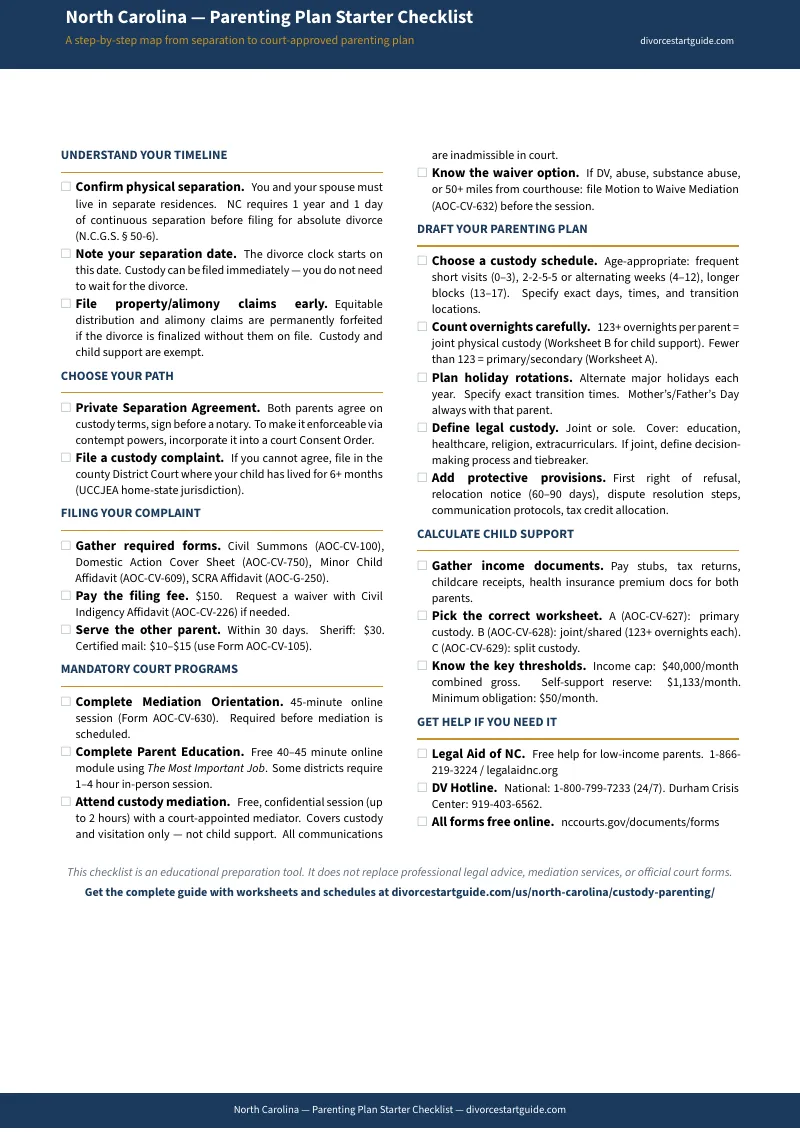
Not ready for the full guide? Download the North Carolina Parenting Plan Starter Checklist — a one-page overview of custody basics, the key NC court forms, and a quick-start checklist for building your parenting plan. Free, instant download, no credit card.
Who This Is For
- Parents in the separation year — you are living apart, need a custody arrangement now, and cannot wait for the divorce to be final. The guide covers voluntary agreements, court filings, and everything in between.
- Self-representing parents (pro se) — you downloaded the county's File-It-Yourself packet and found blank forms with no instructions. The guide provides the sequencing, term definitions, and drafting language those packets leave out.
- Parents preparing for mandatory mediation — you received a court order to attend the Custody and Visitation Mediation Program and have no idea what to propose. The guide gives you schedule templates and a preparation workbook to walk in with a clear plan.
- Parents working with an attorney — using the guide to pre-draft your schedule and organize your goals before your first consultation, so you spend attorney time reviewing your plan instead of explaining basics at $300+ per hour.
- Parents modifying an existing order — circumstances changed and you need to prove a "substantial change" to the court. The guide covers the modification standard, the required forms, and how to draft revised terms.
Why Not Free Resources?
North Carolina's court website provides blank forms and administrative instructions — but court staff are legally prohibited from helping you fill them in or advising you on what terms to include. Legal Aid of North Carolina offers free self-help clinics and recorded webinars, but staffing constraints mean they cannot provide individual representation for standard custody cases. Nolo's national guides cost $25–$50 but don't address NC's mandatory 12-month separation period, the state's specific mediation program, or county-level procedural differences. Custody X Change builds excellent calendars at $6/month but doesn't guide you through the filing process or explain how overnights affect your support calculation. OurFamilyWizard charges $110–$300 per parent per year for co-parenting communication but provides no upfront legal navigation.
The guide fills the gap: NC-specific law, court procedures, schedule templates, and worksheets in one printable document — without the $5,000–$30,000 retainer.
30-Day Guarantee
If the guide doesn't give you a clearer understanding of North Carolina's custody process and a workable parenting plan, email [email protected] within 30 days for a full refund. No questions, no forms, no waiting period.
— Less Than One Hour of Attorney Time
A family law attorney in North Carolina charges $200–$550 per hour. A basic retainer starts at $3,000–$5,000. A contested custody case can cost $15,000–$30,000 in total legal fees. This guide costs less than a single hour of professional time and covers the procedural groundwork that most of those billable hours are spent explaining.
Download includes the full 17-chapter guide, 9 standalone printable worksheets and reference cards, and the quick-start checklist — 11 PDFs total. Instant access. Use them at the kitchen table, in mediation prep, or at your attorney's office.