New Jersey Gives You Every Divorce Form for Free. Nobody Tells You How to File Them Through JEDS Without Getting Rejected.
The New Jersey Courts Self-Help Resource Center, Legal Services of New Jersey (LSNJ), and the state judiciary's website at njcourts.gov all publish free divorce forms. Complaint, Summons, Confidential Litigant Information Sheet, CDR Alternatives Certification, Insurance Coverage Certification — every document you need to initiate a case is available at no cost.
What none of them provide is the filing sequence. Which document goes first on the JEDS portal? Why does the clerk reject your packet when you combine everything into one PDF? How do you serve your spouse within the 60-day deadline? What happens when they don't respond within 35 days? How do you get your divorce finalized "on the papers" under Directive #01-25 without a court hearing? The clerk's office can hand you the blank forms. They are legally prohibited from telling you what to do with them.
Meanwhile, LSNJ's self-help kit was last fully updated in 2019/2023 and doesn't cover the current JEDS electronic filing procedures. National document-generation platforms charge $299 to fill out the same free forms through a questionnaire — then leave you stranded when it's time to upload them, serve your spouse, or navigate the Case Information Statement. The forms aren't the hard part. The sequence is.
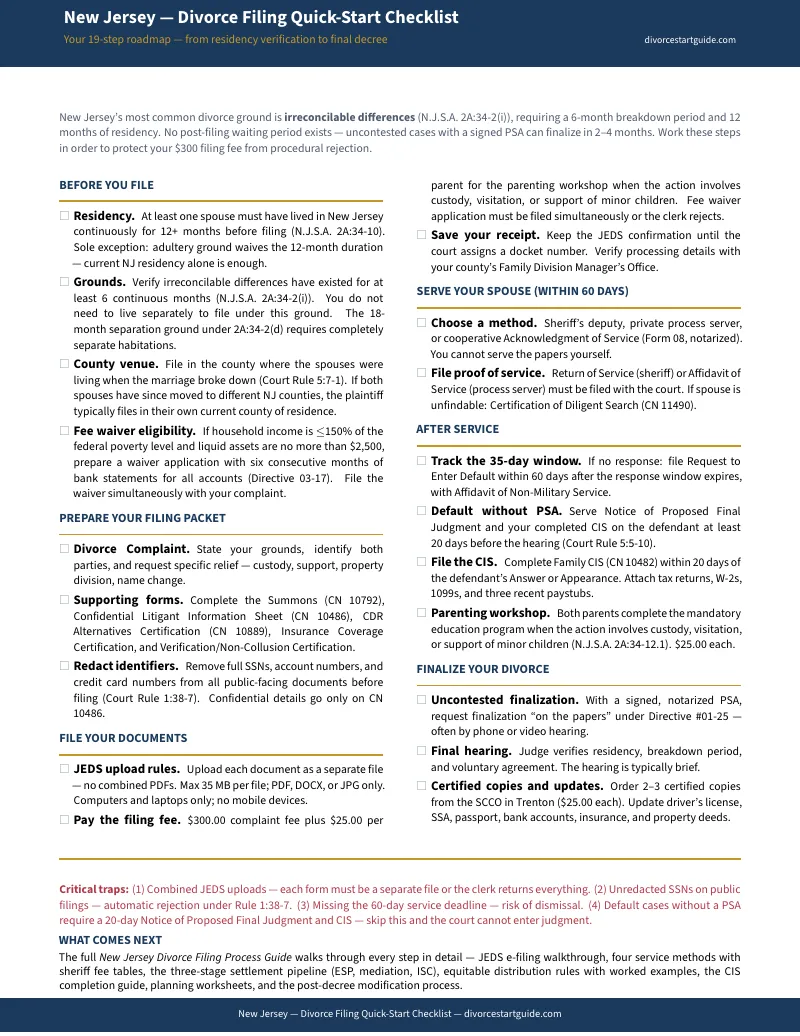
The JEDS Filing Sequence Map
This guide is not forms, not legal advice, and not a document-generation service. It's the chronological filing sequence New Jersey's court system doesn't publish: what to file, in what order, through which portal, at which decision point — whether your spouse cooperates, ignores the papers, or contests the terms.
Every chapter is built around New Jersey's actual statutes (N.J.S.A. 2A:34-2 through 2A:34-23.1), the Rules Governing the Courts (Part V, Family Part), and current Administrative Directives — not generic divorce content recycled from a national template. The guide covers what makes New Jersey's system different: the JEDS vs. eCourts portal distinction that rejects self-represented filers who use the wrong system, Rule 1:38-7 redaction requirements that the clerk enforces on every page, the six-document initial filing packet where each form must be uploaded separately, the three-stage contested settlement pipeline (ESP → Economic Mediation → Intensive Settlement Conference), and Directive #01-25 that lets uncontested cases finalize without a hearing.
What You Get
The Complete Filing Process Guide
A 14-chapter guide plus built-in worksheets covering every step from residency verification through post-decree tasks:
- The JEDS Filing Sequence Map — the exact chronological order for New Jersey's electronic system: confirm 12-month residency under N.J.S.A. 2A:34-10, identify the correct county venue, select your ground, prepare your six-document filing packet, navigate the JEDS upload process (one document per submission — not one combined PDF), pay or waive the $300 filing fee, serve your spouse within 60 days, and track the case through to final judgment
- Three-Path Decision Tree — your case follows one of three tracks depending on your spouse's response: the uncontested path with a signed PSA (finalized "on the papers" under Directive #01-25, typically 2–4 months), the default path when your spouse doesn't respond within 35 days, and the contested track through the ESP/mediation/ISC pipeline. Each path mapped with the specific paperwork and deadlines at every stage
- JEDS Upload Checklist and Rejection Prevention — New Jersey clerks return filings for technical errors that are entirely avoidable. The guide covers the most common rejection triggers: combining multiple documents into a single PDF, filing through eCourts instead of JEDS, failing to redact personal identifiers under Rule 1:38-7, missing required certifications, and incomplete fields on the Confidential Litigant Information Sheet
- Service of Process Playbook — four methods for formally serving divorce papers on your spouse within the 60-day deadline: voluntary Acknowledgment of Service (free, cooperative), county sheriff delivery ($30–$75), private process server ($50–$150), and certified mail with return receipt under restrictive circumstances. Includes proof-of-service filing requirements and the service-by-publication process when a spouse can't be located
- Case Information Statement Prep Worksheet — the Family Part CIS (Form CN 10482) is a comprehensive sworn financial disclosure due within 20 days of the defendant's answer. It requires detailed documentation of income, expenses, assets, liabilities, and your marital standard of living. The worksheet organizes your tax returns, pay stubs, W-2s, and bank statements into the exact format the form requires — so you gather records once, not three times
- Fee Waiver Walkthrough — if your household income is at or below 150% of the Federal Poverty Level and liquid assets are under $2,500, you can eliminate the $300 filing fee. The guide walks through Fee Waiver Form CN 11208 step by step: what financial documentation to compile (six months of bank statements, two months of income records), how to submit the waiver with your initial filing packet, and what to do if the waiver is denied
- Property Settlement Agreement Structure Guide — for an uncontested divorce, a signed and notarized PSA is what lets you skip the courtroom. The guide covers the essential PSA sections: asset division under New Jersey's equitable distribution standard, debt allocation, alimony considerations, child support calculations, and custody/parenting time arrangements
- Post-Decree Task Checklist — name changes, insurance updates, retirement account QDROs, tax filing implications, certified copies of the final judgment, and how to use the Post-Judgment Motion Packet (Form CN 10483) if circumstances change later
Quick-Start Checklist (Free Tier)
A printable one-page process map covering the entire New Jersey divorce sequence — from confirming 12-month residency through finalization. Includes all three case paths, key deadlines, JEDS filing reminders, and the service-of-process timeline.
Who This Is For
- You and your spouse agree on most or all terms and want to handle the filing without a $7,000–$30,000 New Jersey family law retainer
- You've been served with divorce papers and need to understand the 35-day response window before a default judgment locks in your spouse's proposed terms
- You tried filing through JEDS and the clerk returned your papers — documents combined into one PDF, wrong portal, redaction failures under Rule 1:38-7, or missing certifications
- You qualify for a fee waiver and need step-by-step instructions for Form CN 11208, including the income thresholds and required documentation
- You want to understand the full process before deciding whether to go pro se or hire a New Jersey family law attorney
Why Free Court Forms and $299 Document Services Don't Solve This
New Jersey's Self-Help Resource Center and LSNJ provide every form you need, free of charge. But court clerks are legally barred from explaining the filing sequence, the deadlines, or what to do when your spouse doesn't respond. LSNJ's digital guide was last fully updated years ago and doesn't cover current JEDS procedures. And neither resource walks you through the Case Information Statement, the service-of-process deadline, or the default judgment track.
National document-preparation platforms ($299 flat fee, or $84/month for four months) charge you to fill out those same free forms through a questionnaire. They generate static completed documents. They don't explain that each New Jersey document must be uploaded as a separate file through JEDS, not eCourts. They don't cover the redaction requirements that get unredacted filings rejected. They don't walk you through service of process or the contested settlement pipeline. And none of them explain how to finalize your case "on the papers" under Directive #01-25.
Subscription legal services ($40–$99/month) provide generic templates without New Jersey-specific JEDS instructions. If your uncontested case takes three months — common once the service logistics, CIS exchange, and court scheduling are factored in — that's $120–$297 in recurring fees for a case that can resolve without a single court appearance.
This guide costs — less than a single hour of the $250–$500/hour attorney billing rate in New Jersey. One purchase, instant download, no subscription, no recurring fee. You keep it for your entire case.
100% Satisfaction Guarantee
If the guide doesn't give you a clear path through New Jersey's divorce filing process, email [email protected] and we'll make it right — no hoops, no time limit.
— Less Than One Hour of Attorney Time
A typical New Jersey family law attorney bills $250–$500 per hour. A full-service retainer runs $7,000–$30,000 depending on complexity. This guide gives you the complete JEDS filing sequence, rejection prevention, service-of-process playbook, CIS prep worksheet, and fee waiver instructions for a fraction of one billable hour — and you keep it for your entire case.