Nebraska's free court forms ask for your final numbers. They don't tell you how to calculate them.
You've found the forms on the Nebraska Supreme Court Self-Help Center — the Complaint for Dissolution, the property statement, the settlement agreement pages. And you've discovered the problem: the state gives you blank boxes for asset values, debt allocations, and spousal support figures. But it doesn't tell you how to trace separate property through a commingled bank account using the Stava source-of-funds test. It doesn't tell you how to calculate the marital share of your NPERS pension. And the self-help packets explicitly exclude cases involving pensions, real estate, or alimony — leaving most couples with no guidance on their actual financial situation.
Meanwhile, a family law attorney in Omaha or Lincoln charges $250–$300 an hour. A $3,500 retainer buys you roughly thirteen hours. Three of those hours go to organising your bank statements and tax returns into categories their paralegal can process. That's over $800 in administrative work you could have done yourself — if someone had told you what the categories were.
You don't need someone to fill in the forms for you. You need to know what the numbers mean before you write them down.
The Nebraska Equitable Split Navigation System
This is a complete, step-by-step guide to dividing money and property in a Nebraska divorce — built for the specific rules that make Nebraska different from every other state. It is not legal representation and it does not file your papers. It is the calculation and sequencing intelligence that the blank forms leave out.
At its core is the Equitable Split Navigation System — a structured method that walks you from "I have a pile of bank statements and no idea what's marital vs. separate" to a clean, defensible asset-and-debt inventory that meets the court's "just and reasonable" standard under Neb. Rev. Stat. § 42-365. It handles the part everyone gets wrong: tracing commingled funds with the Stephens active appreciation rule and Stava source-of-funds test, calculating a home equity buyout that accounts for refinancing costs and deferred-sale triggers, dividing NPERS pensions and 401(k)s without triggering tax penalties, and building a spousal support case using the discretionary factors Nebraska judges actually evaluate.
What's inside — the 15-chapter guide, worksheets, and the free checklist
- Marital vs. Separate Property Classification — the three-step framework (classify, value, divide) established by the Nebraska Supreme Court, plus the Separate Property Tracing Ledger that turns commingled accounts into documented separate-property claims. Because depositing an inheritance into a joint account can destroy its separate status — unless you can trace it with documentation courts accept.
- The Commingling Trap — Nebraska's two key doctrines explained in plain language: the Stephens active appreciation rule (if marital effort increased a separate asset's value, the appreciation becomes marital) and the Stava source-of-funds test for tracing mixed accounts. Most people don't know these rules exist until their spouse's attorney uses them.
- The Family Home Decision Framework + Home Equity Buyout Calculator — five pathways: immediate sale, spousal buyout and refinance, temporary occupancy, deferred sale, or continued co-ownership. The worksheet calculates net equity after mortgage balance, HELOCs, liens, and estimated transaction costs.
- The Pension & Retirement Division Method + QDRO Action Tracker — the QDRO process for 401(k) and employer plans, the Nebraska Spousal Pension Rights Act, and NPERS-specific administrative rules for school employees, state patrol, and judges' pensions. Includes the present-value-buyout vs. deferred-distribution comparison.
- The Spousal Support Estimator + Spousal Budget Worksheet — Nebraska has no formula for alimony. This chapter maps the three types (Temporary, Rehabilitative, Permanent) against the statutory factors judges actually evaluate under § 42-365. The budget worksheet builds your monthly income-and-expense case.
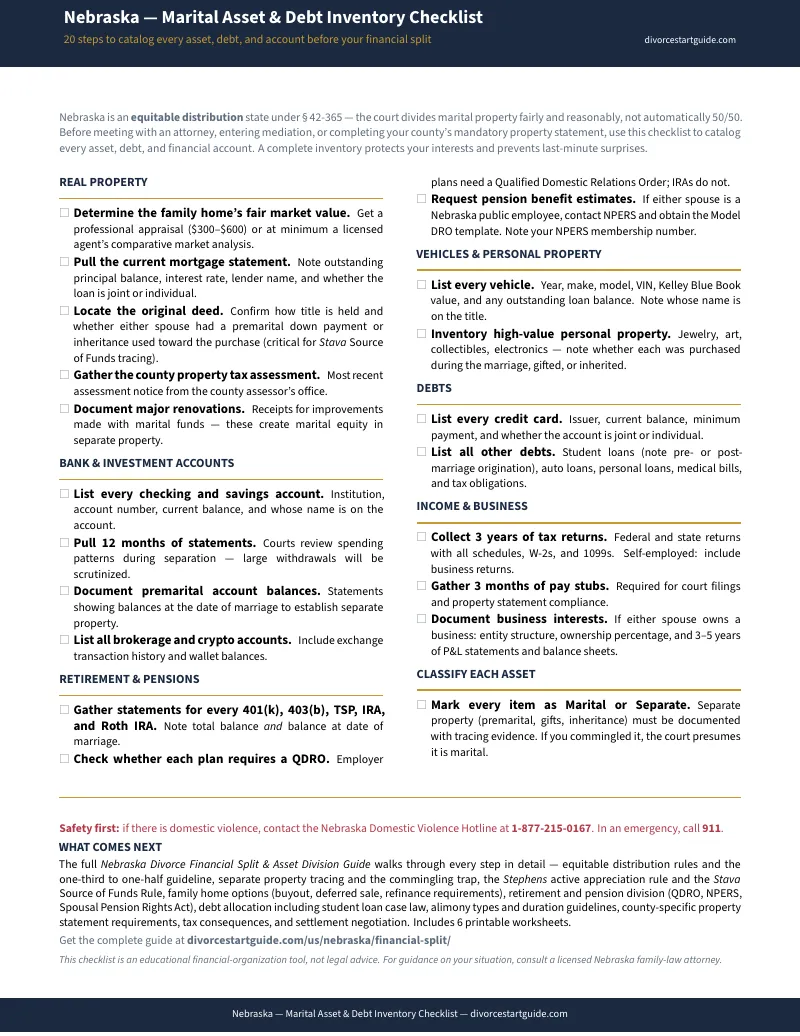
- The Debt Allocation Method + Marital Asset and Debt Inventory — marital debt presumption, the critical difference between what the court orders and what creditors can still enforce, and Nebraska's distinctive approach to student loan debt.
- Financial Disclosure Document Checklist — exactly which documents to gather (tax returns, pay stubs, bank statements, retirement statements), organised by the categories Lancaster and Sarpy county courts require in their property statement deadlines.
- Tax-Safe Division Rules — IRC §1041 tax-free transfers, the hidden cost basis trap ($40,000 in cash vs. $40,000 in a traditional 401(k) are not the same after-tax value), primary residence capital gains exclusions, and post-2018 alimony tax neutrality.
- Business and Farm Division — valuation standards, personal vs. commercial goodwill, the double-dipping problem, and agricultural holdings specific to Nebraska's farm economy.
- Hidden Assets and Discovery Tools — common concealment tactics, Nebraska discovery mechanisms (interrogatories, document requests, subpoenas), and court penalties for hiding assets.
- Property Settlement Agreements — how to draft a settlement the court will accept, the "unconscionability" standard that can get your agreement rejected, and the six-month waiting period before the decree becomes final for remarriage.
Who this is for
The spouse quietly gathering records before filing. The person staring at a blank property statement form and a stack of bank statements with no idea how to connect the two. The state employee wondering how their NPERS pension gets divided — and whether the present-value buyout or deferred distribution is smarter. The homeowner calculating whether they can afford to keep the house after refinancing out their spouse's name. The couple who want to reach a fair deal through mediation without spending $8,000 on attorneys — but need the math to prove the deal is actually fair. And the spouse with an attorney, who wants to stop paying $275 an hour for document organisation they can handle themselves.
Why not just use the free resources?
Because the free resources give you forms, not calculations. The Nebraska Supreme Court Self-Help Center provides blank form packets for unrepresented litigants — but explicitly excludes cases involving pensions, real estate, or alimony. Legal Aid of Nebraska publishes helpful handbooks, but they define legal terms, not calculation methods, and they're income-restricted. Neither tells you how to apply the Stava source-of-funds test, estimate a home equity buyout, or figure out whether taking the retirement account or the house gives you a better after-tax position.
The premium local options — Untie Online at $299–$499, or a family law firm at $3,500 or more in retainers — are excellent resources. But there's a structural gap between free blank forms and a $299 software subscription. This guide fills that gap: the classification system, the calculation methods, and the printable worksheets you need to build a complete financial picture before you spend a dollar on professional services.
An honest guarantee
Work through the Equitable Split Navigation System. If the guide doesn't make your financial split clearer and better organised than any blank form or free article could — email us within 30 days for a full refund. The risk of trying it is a fraction of one attorney billable hour. The risk of guessing on your asset division is measured in years of financial consequences.
For — less than ten minutes of an Omaha attorney's time — you get the classification system, the tracing worksheets, the QDRO process, and the step-by-step sequence that the free forms leave out.
Stop staring at blank boxes. Get the guide, build your inventory, and walk into your divorce with the numbers already done.