The Forms Are Free. The Rejection at the Clerk's Window Isn't.
You're on courts.mt.gov downloading Montana's official dissolution forms — MP-112, MP-400, MP-500 — and the state gives you every one for free. What the state doesn't give you is a sequence. Which form gets filed first. What goes to the clerk and what gets served on your spouse but never filed. Why the Declaration of Disclosure (MP-510) must be exchanged before you can finalize anything. And what happens when the clerk slides your entire packet back across the counter because you left a field blank instead of writing "N/A."
Three out of five family law cases in Montana are filed without a lawyer. Most of those filers spend weeks retracing their steps — re-filing rejected paperwork, discovering that service of process has strict rules they didn't know existed, or learning that the Automatic Economic Restraining Order froze accounts they needed to pay rent.
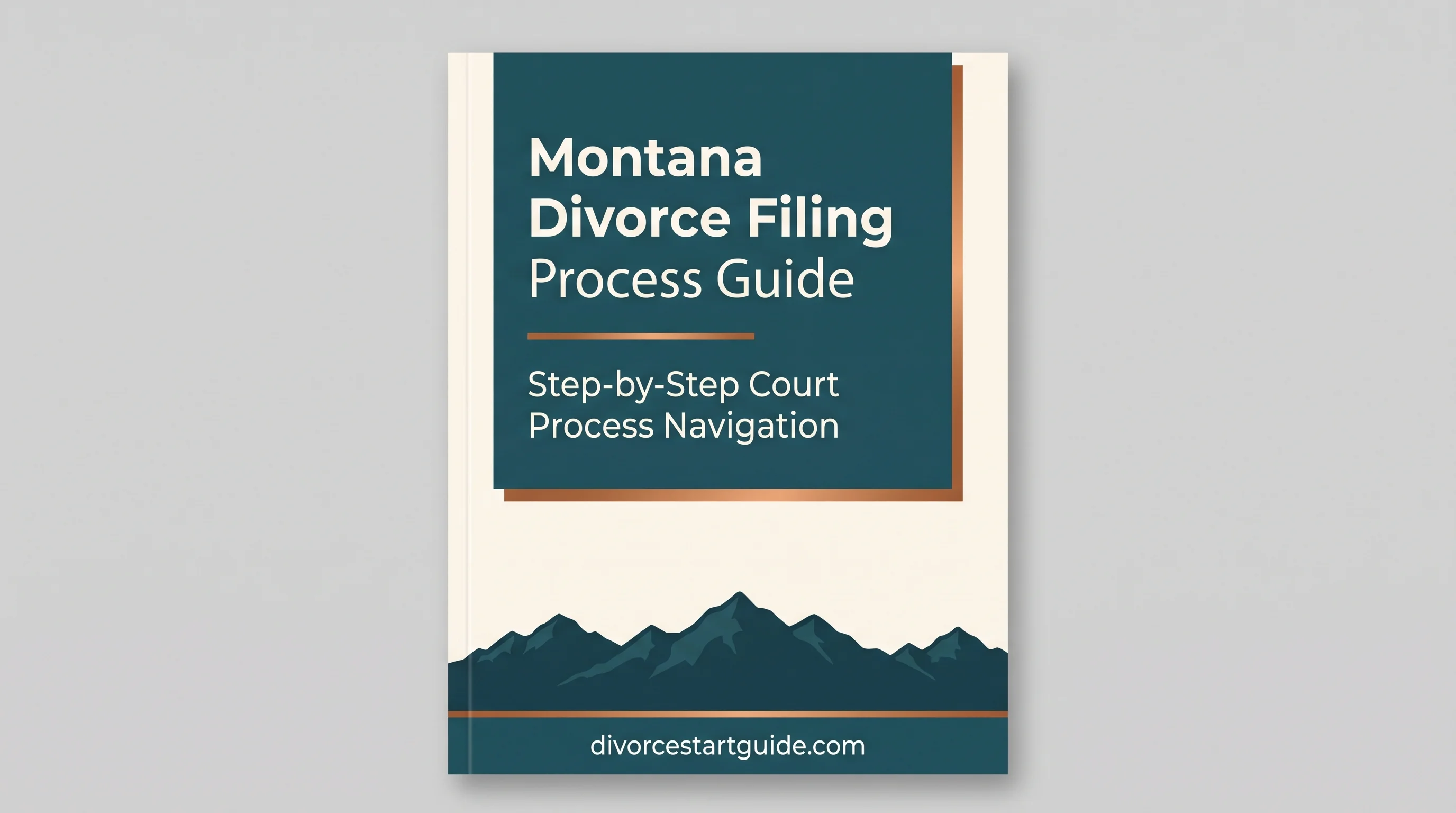
The Court Process Navigator bridges the gap between blank court forms and a $5,000 attorney retainer. It maps the complete Montana dissolution sequence — from verifying your 90-day residency through filing the Notice of Entry of Decree — into a chronological, plain-language walkthrough with checklists, worksheets, and decision guides at every stage.
What's Inside: 53-Page Guide + 6 Standalone Worksheets
- Chronological Process Map (17 Chapters) — every phase of a Montana dissolution in the order the court actually processes it. Not alphabetical form lists — a step-by-step sequence showing what to prepare, when to file, who to serve, and which procedural traps stall cases at each stage.
- Four Filing-Path Decision Guide — which pathway fits your case: Individual Petition, Joint Petition (Co-Petitioners), Summary Dissolution, or Default. Each path has different forms, different service requirements, and different timelines. The guide walks you through the eligibility criteria and trade-offs so you choose before you file.
- Service of Process Flowcharts + Service Tracking Log — Montana law prohibits you from serving your own spouse. The guide explains three valid methods (Sheriff service, Notice and Acknowledgment, and Publication), with step-by-step instructions, cost breakdowns, and the exact forms required for each. The standalone service-log.pdf tracks every attempt so you have a record when filing proof of service.
- AERO Compliance Guide — the Automatic Economic Restraining Order takes effect the moment your spouse is served. The guide explains what it prohibits (selling assets, changing insurance, transferring property), what daily expenses are still permitted, and how to request a court modification if the AERO creates financial hardship.
- Property & Debt Inventory Worksheet — Montana is an "all-property" state where courts can divide everything either spouse owns. The standalone property-debt-inventory.pdf helps you organize assets, debts, and ownership before completing the Proposed Property Distribution (MP-500).
- Child Support Preparation Worksheet — if you have minor children, the court requires a proposed Parenting Plan (MP-300) and a child support calculation. The standalone child-support-prep.pdf collects the income inputs, parenting time data, and expense figures you need before running Montana's online calculator.
- Filing Fees & Fee Waiver Reference — the standard $200 filing fee breakdown, respondent costs, judgment fees, and certified copy fees — all on one printable sheet. Includes the fee waiver process: what the Statement of Inability to Pay covers and what it doesn't.
- Deadline Timeline Tracker — every critical deadline from filing through the 30-day appeal window, on one page. Fill in dates as each milestone completes so you never miss the 21-day response window or the 45-day parenting education deadline.
- Post-Decree Checklist — name changes, updating government IDs, dividing financial accounts, transferring retirement assets via QDRO, insurance updates, and tax filing considerations — the steps most guides skip after the final hearing.
- DV Safety Planning Chapter — guidance for filing when safety is a concern. Covers confidential filing procedures, how to serve papers without revealing your address, protective orders in dissolution cases, and when to set aside the pro se approach entirely.
- AI Disclosure Compliance — Missoula and Yellowstone District Courts now require litigants to disclose AI-generated content in court filings. The guide explains what triggers this requirement and how to comply, so your case isn't thrown out over a disclosure violation.
Who This Is For
- Pro se filers who need the process, not just the forms — you've found the free forms on courts.mt.gov. This guide tells you which ones apply to your situation, the order they get filed in, and the procedural steps between them that the forms don't explain.
- Cooperative couples filing jointly — you agree on everything and want the fastest, cheapest path. The guide maps the Joint Petition process from MP-115/116 through final decree, eliminating service of process entirely.
- Respondents who just got served — you have 21 days to file a Response (MP-201) before the court can enter a default judgment. The guide explains your options, the response process, and what happens if you don't file.
- Parents navigating custody and support — the child-related requirements add significant complexity. The guide covers parenting plans, child support calculations, UCCJEA jurisdiction, and the CSSD notice requirement when children receive public assistance.
- People mid-process who got stuck — filed three months ago and hit a wall at service of process? Mediation ordered but you don't know how to prepare? The guide is organized chronologically — find your current stage and pick up from there.
Why Not Just Use Free Court Forms?
Use them — they're required. This guide doesn't replace the free forms. It prepares you for them.
The gap on every court self-help page is the same: they give you blank forms and a list of instructions written by lawyers for lawyers. They don't explain that the MP-510 gets served on your spouse but not filed with the clerk. They don't tell you that the Notice and Acknowledgment method requires a 21-day waiting period before you can try other service methods. They don't warn you that skipping the CSSD notice when children receive Medicaid can stall your entire case.
If you're considering an online document-preparation service like 3StepDivorce ($299) or Hello Divorce ($400+), this guide works as the preparation layer. Those services generate forms through a questionnaire — but they don't cover Montana's county-specific local rules, the AERO's daily-expense exceptions, or the new AI disclosure mandates in Missoula and Yellowstone. Organize with this guide first, and you'll move through any service faster, with fewer revisions.
Satisfaction Guarantee
If the guide doesn't help you navigate your Montana dissolution process, email us for a full refund. No hoops, no deadlines.
Get the Full Guide — or Start With the Free Checklist
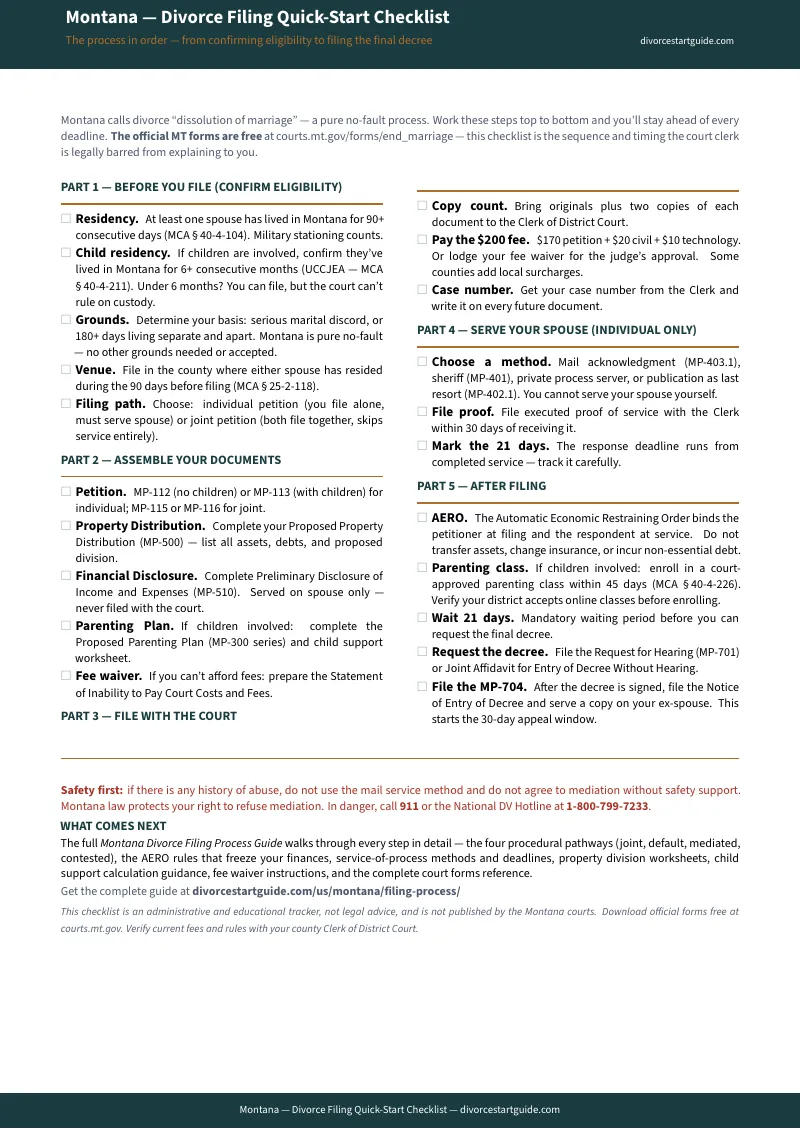
The free checklist gives you a quick-start overview of the Montana dissolution sequence — residency requirements, filing paths, key form numbers, and the first steps to take. The full toolkit gives you the 53-page chronological walkthrough plus 6 standalone worksheets you can print and bring to the courthouse: property inventory, service tracking log, deadline timeline, child support prep, fee schedule, and post-decree checklist.
For , you get a process-navigation system that would take 40+ hours to piece together from courts.mt.gov, Montana Law Help, legal blogs, and county courthouse websites — organized into one step-by-step walkthrough built specifically for Montana's rules.