The Self-Help Center Handed You a Blank MP-300 and Said "We Cannot Tell You What to Write." The 21-Day Clock Is Already Running. And Every Scheduling Decision You Make Will Determine Your Child Support Payment for Years.
You walked into the courthouse expecting help with your parenting plan. The Self-Help Center gave you a stack of blank forms — the MP-300 Proposed Parenting Plan, the MP-300-B Holiday Schedule supplement, the child support worksheets — and said, in almost exactly these words: "We cannot offer legal advice or help you fill these out."
You looked at the MP-300. It asks you to propose a "residential schedule" with specific days, times, and transition arrangements for every week, every holiday, every school break. It asks you to allocate "decision-making authority" — the Montana term for what other states call legal custody. It asks you to describe your dispute resolution method, your travel notification rules, and your communication protocols. Every box is blank. No examples. No sample language. No indication of what "good" looks like.
You went online. One site says a 2-2-3 schedule works best for toddlers. Another recommends alternating weeks for school-age children. A third mentions something called the "110-day threshold" that apparently determines whether your child support is calculated under Worksheet A or Worksheet B — but doesn't explain how a single overnight can shift your payment by hundreds of dollars per month. A fourth refers to "legal custody" and "physical custody" — terms Montana courts stopped using years ago.
Here is the reality: Montana provides free court forms for parenting plans — and then legally prohibits every person in the courthouse from helping you complete them. Every Self-Help Law Center in the state (Helena, Missoula, Great Falls, Kalispell, Billings, Bozeman) will hand you blank forms and refuse to suggest scheduling language. Every state website publishes raw statutes and offers no drafting instructions. And every family law attorney will explain how complicated this is — at $250 to $300 per hour.
The Montana Child Custody & Parenting Plan Guide is the Court-Ready Drafting System — the step-by-step drafting manual that the Self-Help Center is legally prohibited from giving you. Not a generic custody overview with "Montana" in the header. A 14-chapter, Montana-specific guide with pre-worded residential schedules, holiday rotation templates, transition scripts, and the 110-day parenting-time worksheets that show you exactly how your schedule affects your child support calculation — built for Montana's unique Melson-style formula, Montana court forms, and Montana filing procedures.
What's Inside the Court-Ready Drafting System
A 14-chapter guide with 3 appendices, the Parenting Plan Starter Checklist, and 7 standalone worksheets — covering every stage from understanding Montana custody terminology through filing a court-ready parenting plan, built specifically for Montana statutes, district court procedures, and the MP-300 form structure:
Montana Custody Terminology Decoded
Montana replaced "custody" and "visitation" with "parenting plans" and "parenting time" — but every national legal website, every Google result, and most parents still use the old terms. This chapter maps the translation: "legal custody" is now "decision-making authority." "Physical custody" is your "residential schedule." "Visitation" is "parenting time." When you sit down with the MP-300, you will know exactly what each section is asking for and why Montana uses different language from the state your sister went through last year.
Best-Interest Factors: What the Judge Actually Evaluates
Under MCA § 40-4-212, Montana judges evaluate specific statutory factors to determine what serves your child's best interests. This is not an abstract legal standard — it is a checklist the judge works through, point by point. The guide breaks down each factor in plain language: the wishes of both parents, the child's existing relationships, continuity of care, any history of abuse or chemical dependency, and the willingness of each parent to facilitate the other's relationship with the child. That last factor matters more than most parents realize — judges penalize gatekeeping.
Building Your Residential Schedule
The MP-300 asks for a "residential schedule" specifying where the child lives on every day of the year. This chapter gives you pre-worded schedule templates for the most common arrangements: alternating weeks, the 2-2-3 rotation, the 3-4-4-3, and long-distance schedules for parents who live more than 100 miles apart. Each template includes the exact transition language (pickup and drop-off locations, times, who drives) that prevents the vague phrasing judges reject and co-parents exploit. Every template is already formatted for the MP-300.
Age-Specific Scheduling That Develops With Your Child
A schedule that works for a two-year-old fails a ten-year-old. This chapter covers age-appropriate arrangements: shorter, more frequent exchanges for infants and toddlers who need attachment continuity; school-week structures for elementary-age children; and flexibility provisions for teenagers with their own activities, friendships, and opinions. The guide shows you how to build step-up language directly into your parenting plan so the schedule evolves without returning to court.
Holiday Scheduling That Overrides the Weekly Rotation
The MP-300-B supplement asks you to specify your holiday, vacation, and special occasion schedule — and it must cleanly override your standard weekly rotation or you will spend every Thanksgiving arguing about whose "week" it is. The guide provides alternating-year holiday templates covering Thanksgiving, Christmas Eve, Christmas Day, New Year's, spring break, summer vacation, and Montana-specific breaks like the MEA-MFT teacher convention. Each template specifies exact transition times so there is no room for interpretation.
The 110-Day Threshold and Child Support
This is the chapter that saves you the most money. Montana uses a Melson-style child support formula with a critical threshold: if the non-residential parent has the child for 110 days or fewer per year, the standard Worksheet A applies. Cross that threshold, and the shared-parenting Worksheet B kicks in — an offset calculation that can reduce the support payment by hundreds of dollars per month. A "day" is defined as the majority of a 24-hour period. The guide includes a parenting-time tracking worksheet that counts your actual overnights under any proposed schedule so you can see exactly where you land before you sign anything.
Filing Process: From Petition Through Final Order
Whether you are filing a Petition for Dissolution with children, a standalone Petition for Parenting Plan (unmarried parents), or a Joint Petition, this chapter walks you through every procedural step. Filing fees. Service of process requirements. The respondent's 21-day deadline. Mandatory parenting education enrollment (petitioner within 45 days, respondent within 45 days of service). Temporary orders. Mediation. The final hearing. Default judgment rules for parents who miss the response deadline. Every form number, every timeline, every courthouse filing sequence.
Mediation and Parenting Education Requirements
Montana judges routinely order mediation before scheduling a hearing in contested cases. This chapter covers what mediation is, what it costs, the free and low-cost options through the Montana Family Transition Project (MLSA), the domestic violence exemption, and how to prepare a structured proposal that puts you in the strongest negotiating position. It also covers the mandatory parenting education requirement — which courses are approved, including the free UpToParents.org option, and how to file your completion certificate.
Relocation: The 30-Day Notice Rule
Planning to move — or received notice that your co-parent is? Montana requires a 30-day written notice before any relocation, and the other parent has 21 days to file an objection. Miss either deadline and the consequences are severe: the relocating parent may proceed unchallenged, or the objecting parent loses the right to contest. The guide covers the notice requirements, the court's balancing test between a parent's right to travel and the child's stability, and how to draft long-distance parenting schedules that survive judicial scrutiny.
Modification, Enforcement, and Emergency Orders
Circumstances change. The guide covers the legal standard for modifying a parenting plan under MCA § 40-4-219 (you must prove a substantial change in circumstances), the six-month vexatious-filing presumption, enforcement remedies when a co-parent violates the existing order, and Montana's emergency "affidavit practice" for situations where a child's safety is at immediate risk. Each section includes the specific forms and filing procedures.
Professional Referrals: When to Stop Self-Drafting
This guide handles cooperative, moderate-conflict, and standard contested cases. But some situations require professional help: allegations of serious abuse or chemical dependency, complex financial assets, supervised-only parenting time requests, or relocation disputes with a hostile co-parent. This chapter is honest about where the guide's scope ends and provides referral frameworks for finding Montana family law attorneys, mediators, and the Montana Legal Services Association for income-qualifying parents.
Who This Guide Is For
- The parent staring at a blank MP-300 form — the court gave you the form but no one will tell you what to write in it. The guide gives you pre-worded residential schedules, transition protocols, and dispute resolution clauses that you can adapt to your family's situation and transfer directly into the form.
- The parent who just got served and has 21 days to respond — the clock started when you were handed the summons. You need to file a written response and your own proposed parenting plan before the deadline or risk a default judgment based entirely on the other parent's proposal. The guide gives you the complete response sequence.
- The cooperative parents who want to file together — you and your co-parent agree on most things but need to document your arrangement in the precise language Montana courts require. Verbal agreements are not enforceable. The guide shows you how to file a Joint Petition with a parenting plan the judge will approve on the first attempt.
- The unmarried parent establishing parenting rights — without a court-ordered parenting plan, both parents have equal, unstructured rights to the child. Either parent can legally withhold the child and law enforcement cannot intervene. The guide covers the standalone Petition for Parenting Plan process for parents who were never married.
- The parent navigating the 110-day child support threshold — you have heard that your parenting schedule affects your child support payment but you do not understand how. The guide includes tracking worksheets that count your actual parenting days under any proposed schedule and show you how each arrangement maps to Worksheet A or Worksheet B.
- The parent preparing for mediation — the judge ordered mediation and you want to walk in with a structured proposal instead of winging it. The guide's mediation preparation worksheets help you organize your priorities, boundary limits, and proposed schedules before you sit across the table from your co-parent.
Why Free Resources Leave You Stranded
The forms exist for free. The instructions do not. Here is what actually happens when you try to build a parenting plan using free Montana sources:
- Self-Help Law Centers give you forms and legally cannot help you complete them. Helena, Missoula, Great Falls, Kalispell, Billings, and Bozeman all staff Self-Help Centers with trained personnel. Every one of them is legally prohibited from suggesting scheduling language, recommending specific arrangements, or helping you draft your MP-300 proposal. They hand you blank forms and a phone number for the county bar association.
- National platforms miss the Montana-specific rules that determine your outcome. Custody X Change, Hello Divorce, and LegalZoom offer clean interfaces and general advice. They also miss Montana's unique Melson-style child support formula, gloss over the 110-day threshold that determines which worksheet applies, and use "custody" and "visitation" terminology that does not appear on a single Montana court form. A parenting plan drafted with out-of-state terminology gets questioned by the judge.
- Co-parenting apps solve scheduling, not drafting. OurFamilyWizard, TalkingParents, and AppClose charge $72 to $299 per year for calendar tools, expense tracking, and secure messaging. They help you manage a parenting plan after it exists. They do not help you draft the plan itself, navigate the filing process, or understand how your schedule choices affect your child support calculation.
- Attorney blogs explain the complexity to justify their retainers. Local Montana family law firms publish accurate articles about best-interest factors and the parenting plan process. Every article is designed to convince you the process is so risky you need to hire them at $250 to $300 per hour. For high-conflict cases, that may be true. For the majority of cases where parents can cooperate, the filing process is sequential, documented, and manageable.
Free resources give you blank forms and a warning not to make mistakes. The Court-Ready Drafting System gives you the actual scheduling language, transition scripts, and filing sequence that the Self-Help Center is legally prohibited from providing.
— Less Than One Hour With a Montana Family Law Attorney
A single consultation with a Montana family law attorney costs $250 to $300 per hour. A retainer for full representation runs $2,500 to $10,000. National divorce platforms charge $299 to $1,999 for document automation that misses Montana's unique child support formula. Co-parenting subscription apps charge $72 to $299 per year — every year — for scheduling tools that do not help you draft the plan itself. This guide costs less than one hour of professional legal time and gives you the complete Montana-specific drafting system — every schedule template, every transition script, every filing procedure, and the 110-day tracking worksheets that show you exactly how your schedule affects your child support.
Your download includes 9 PDFs: the complete 14-chapter guide with 3 appendices (Montana court forms reference, the Melson formula explained, and a glossary of Montana family law terms), the standalone Montana Parenting Plan Starter Checklist, and 7 printable worksheets — the Parenting Plan Drafting Worksheet (MP-300 prep), the Overnight Counting Worksheet (110-day threshold calculator), the Mediation Preparation Worksheet, the Holiday Rotation Planner (MP-300-B prep), the Schedule Comparison sheet, the Best-Interest Documentation Log (13 statutory factors), and the Filing Timeline Tracker. Instant download, no account required.
Money-back guarantee, no time limit. If the guide does not give you clarity on what to write in your parenting plan and confidence that your proposal will meet Montana court standards, email us for a full refund. No questions asked.
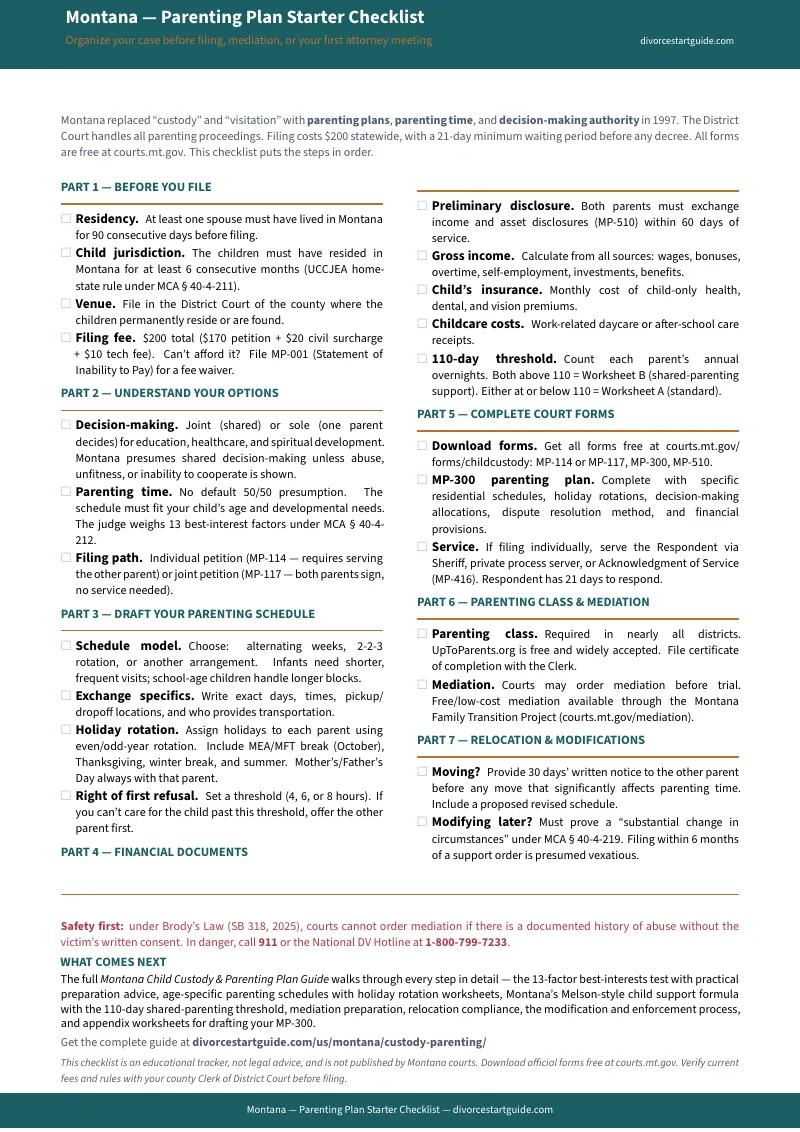
Not ready for the full guide? Download the free Montana Parenting Plan Starter Checklist — a 20-item checklist covering the essential elements every Montana parenting plan must include, the key deadlines, and the filing sequence. It is enough to understand what you are facing and organize your first steps.
Nobody prepared you for this. The courthouse will not explain the forms. Your co-parent's attorney knows every rule you do not. The 21-day clock does not pause while you figure it out. This guide puts every Montana-specific step, every schedule template, and every filing deadline into one system so you can stop searching and start drafting a parenting plan that protects your time with your child.