Minnesota Hands You the Forms. Nobody Hands You the Process.
Every official dissolution form in Minnesota is free at mncourts.gov. The Petition for Dissolution (DIV802), the Summons, the Joint Petition, the Marital Termination Agreement, the parenting plans — all free. The state even offers an interactive "Guide & File" portal that walks you through the questions. You do not need to pay $299 to $999 for an online service to populate the state's own PDFs.
But here is what the free forms do not include: a sequence. A timeline. A map that tells you which document goes first, what happens after service, how to prepare for the ICMC hearing, or how to handle the quiet three-week gap between filing and your first court date when you have no idea if you did something wrong. The court clerk will accept your paperwork — or reject it — but they are legally prohibited from telling you how to fill it out, which track applies to your situation, or what comes next.
This is the Dissolution Process Navigator — the chronological roadmap that sits between you and the Minnesota court system.
What's Inside
- Four-Pathway Filing Map — Minnesota offers four distinct filing routes (Summary Dissolution, Joint Petition without children, Joint Petition with children, and Sole Petition), each with different paperwork, costs, and timelines. The guide walks you through the criteria for each route so you pick the right one on the first try, instead of discovering three weeks in that you filed the wrong packet.
- County-by-County Fee and Filing Reference — filing fees range from $380 to $425 depending on which District Court you file in. Hennepin County requires digital exhibit submission through MNDES. Ramsey accepts paper, email, or digital. Rural counties rotate traveling judicial officers. The guide maps these differences so you are not blindsided at the counter.
- Service of Process Walkthrough — you cannot serve your own spouse, and a single technical error invalidates service. The guide covers every legal method — personal service by a sheriff or professional process server, service by any adult over 18 who is not party to the case, waiver of service for cooperative spouses, and service by alternate means when your spouse cannot be found. Each method includes a step-by-step checklist and the exact affidavit you need to file afterward, and the printable Service of Process Tracker logs every attempt.
- ICMC Preparation Checklist — the Initial Case Management Conference is your first meeting with the judge, typically scheduled within about 30 days of filing. Most pro se filers walk in unprepared. The printable checklist maps directly to the court's ICMC Data Sheet, showing you exactly what the judge expects to see and how to organize your financial information, custody proposals, and outstanding issues before you walk into the courtroom.
- Early Neutral Evaluation Primer — Minnesota uses a dispute-resolution system called Early Neutral Evaluation (ENE), available in two tracks: Social ENE for custody and parenting time, and Financial ENE for property, debts, and support. Most pro se filers have never heard of ENE before the court orders it. The guide explains how each track works, what to prepare, and how evaluators' advisory opinions shape settlement negotiations.
- Default Dissolution Timeline — if your spouse does not file an Answer within 30 days of service, you can move for a default. But default does not mean automatic — the judge must still review your proposed terms. The guide maps every step from the 30-day deadline through the default hearing, including the specific documents you file and the findings the court must make.
- Financial Disclosure Organizer & Marital Property Classification Worksheet — the MTA is the settlement document that divides property, assigns debts, and (if children are involved) sets custody, parenting time, and child support. These two printable worksheets help you inventory every asset and debt, classify each item as marital or non-marital property under Minn. Stat. § 518.58, and draft terms that the court will accept without sending you back to rewrite.
- Fee Waiver Eligibility Walkthrough — if your household income is at or below 125% of the Federal Poverty Level, or you receive public assistance (MFIP, SNAP, SSI), you may qualify for an In Forma Pauperis waiver under Minn. Stat. § 563.01. The guide walks you through the eligibility criteria and the affidavit process so you do not pay filing fees you cannot afford.
Who This Guide Is For
- Spouses who agree on everything and want to file a Joint Petition without paying $299+ for an automated form service
- A petitioner whose spouse is uncooperative or unresponsive and needs to navigate service of process and default procedures alone
- A respondent who has just been served and needs to understand the 30-day response window and how to file an Answer
- Couples who qualify for Summary Dissolution and want to confirm they meet every statutory criterion before filing
- Anyone preparing for the ICMC hearing or facing an ENE referral who wants to walk in organized rather than overwhelmed
What Free Court Resources Get Wrong
The Minnesota Judicial Branch self-help center is excellent at one thing: providing blank, fillable forms. But those forms arrive without a calendar, without a checklist, and without a chronological guide. You can download the DIV802 Petition in seconds — but the court site does not clarify the exact sequence of events, when to file the petition relative to service, how the ICMC Data Sheet connects to your first court date, or which financial documents you need to gather before you start filling anything out.
The Volunteer Lawyers Network and county law library clinics offer free 20-minute consultations — but they are income-restricted, appointment-limited, and cannot walk you through the entire multi-month process in a single session. Online divorce services like 3 Step Divorce ($299) and Divorce.com ($499–$1,999) charge hundreds of dollars to auto-populate the same free forms you can download yourself.
This guide fills the gap between blank forms and expensive professional services. It does not provide legal advice, represent you in court, or generate forms. It gives you the operational roadmap — the exact sequence, the deadlines, the checklists, and the preparation worksheets — so you can file your own dissolution with confidence, whether you do it entirely on your own or use the guide to prepare for a limited-scope attorney consultation.
Satisfaction Guarantee
If the guide does not give you a clearer picture of your dissolution process within the first 48 hours, email [email protected] for a full refund. No forms to fill out, no questions asked.
Start With the Free Checklist or Get the Full Guide
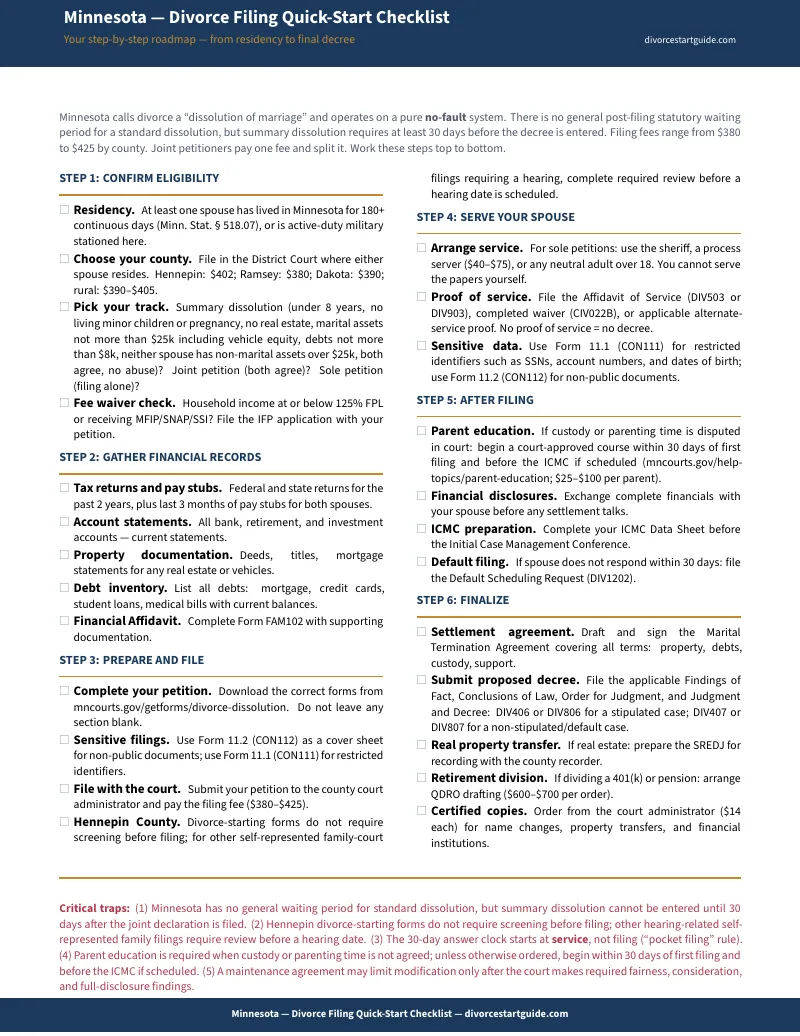
Download the free Minnesota Divorce Filing Quick-Start Checklist — a two-page overview of the filing steps, residency rules, and county-specific details. If you want the complete system — the full guide plus nine printable tools, including the Filing Track Decision Worksheet, the Service of Process Tracker, the ICMC Preparation Checklist, the Financial Disclosure Organizer, and the Marital Property Classification Worksheet — get the full Minnesota Divorce Filing Process Guide for less than the cost of a single half-hour with a paralegal.