
Your Spouse Filed. The CC 320 Is Due in 28 Days. Do You Know What Numbers to Write?
Michigan's Domestic Relations Verified Financial Information form asks you to disclose every asset, every debt, every dollar of income — under oath. Filing it wrong can trigger sanctions under MCR 3.206(D). Filing it right without understanding what your assets are actually worth means you might sign away equity you didn't know you had.
The state gives you the blank form for free. It does not give you the financial strategy to fill it out correctly.
The Equitable Distribution Math System
This is a process-navigation workbook for dividing money and property in a Michigan divorce. Not generic financial advice. Not a document-preparation service. The actual math — home equity buyouts, retirement account valuations, debt allocation formulas, Sparks factor analysis — organized in the exact sequence Michigan courts use to reach a final judgment.
You get 14 chapters covering every financial decision point from pre-filing through post-decree execution, plus 8 standalone printable worksheets designed to produce the numbers your CC 320, your settlement conference, and your Judgment of Divorce all require.
What's Inside
- Equitable distribution explained in plain English — the Sparks v. Sparks nine-factor framework that Michigan judges actually use, with self-assessment worksheets so you can model your likely outcome before mediation
- Marital vs. separate property classification — how to identify the commingling trap, trace an inheritance back to its source, and understand when a judge can "invade" your separate property under MCL 552.23 and MCL 552.401
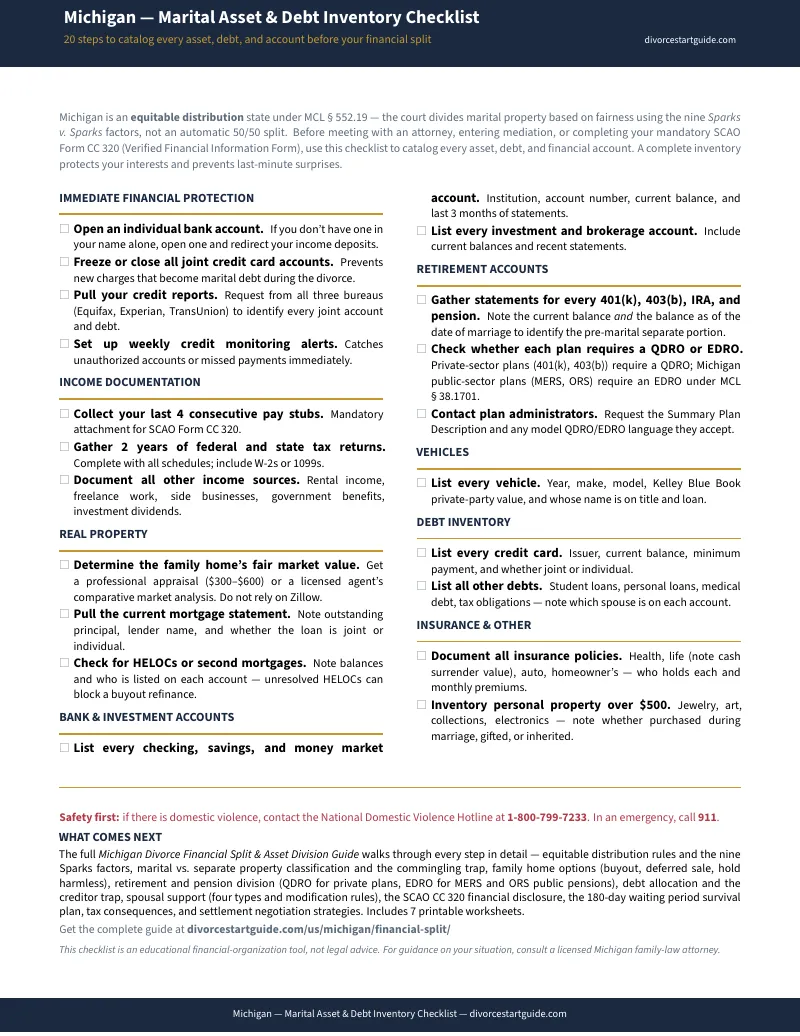
- SCAO CC 320 preparation system — a document-gathering checklist organized by disclosure category, so you walk into the 28-day deadline with every account statement, appraisal, and balance sheet already sorted
- Home equity buyout calculator — step-by-step worksheet for modeling a buyout (what you can afford to keep) vs. a sale (what you'll net after closing costs and remaining mortgage)
- Retirement and pension division sequencing — 401(k), 403(b), IRA, Michigan public pensions (MERS), QDRO vs. EDRO requirements, and the exact order of operations so you don't lose your share by filing late
- Debt allocation worksheet — who pays what, how to protect your credit during the 180-day waiting period, and how to handle debts your spouse ran up without your knowledge
- Spousal support analysis — the statutory factors Michigan judges weigh, the difference between rehabilitative and permanent support, and a worksheet to estimate your likely range
- Post-decree execution checklist — QDRO filing, title transfers, account closures, beneficiary updates — every administrative task that must happen after the judge signs, in order, with deadlines
Who This Is For
- Self-represented litigants who need more than blank court forms — you want the step-by-step financial strategy that Michigan Legal Help cannot legally provide
- People who've hired a lawyer and want to stop paying $225–$600/hour for basic document sorting — hand your attorney an organized financial packet instead of a shoebox of statements
- Couples attempting an amicable split who agree on fairness in principle but need a neutral framework to calculate the actual numbers — home equity, retirement offsets, debt responsibility — before emotions derail the agreement
- Parents facing the 180-day waiting period who need to protect their credit and maintain financial stability while the clock runs
Why Free Court Forms Aren't Enough
Michigan Legal Help provides excellent procedural guidance and automated form completion. But their forms are blank administrative containers — they ask you to fill in your house's value, your retirement balance, and your monthly expenses. They do not tell you:
- How to calculate the after-tax value of your 401(k) (a $200,000 balance is not worth $200,000 in a property offset)
- How to model a mortgage buyout you can actually afford on a single income
- Whether your spouse's inheritance claim is legitimate or whether commingling destroyed it
- How to prepare for the CC 320 deadline when you have 28 days and 47 accounts to document
- What order to file post-decree transfers in so you don't trigger taxes or lose retirement benefits
Free tools give you the blank boxes. This guide gives you the math that goes in them.
Satisfaction Guarantee
If the guide doesn't help you organize your financial disclosure, model your property division, or prepare for your settlement negotiation, email us at any time for a full refund. No forms to fill out, no questions asked.
Get Started Now
Download the free Michigan Marital Asset & Debt Inventory Checklist to see the approach. When you're ready for the full math — all 14 chapters, all 7 worksheets, the complete CC 320 preparation system — get the full guide for .
Frequently Asked Questions
What if the rules change after I buy?
We update the guide when the rules change. Email us any time, even years later, and we'll send you the current edition free.