The Schedule You Set in the First Six Months May Be the One You Keep
Michigan imposes a mandatory 180-day waiting period before any divorce with minor children can be finalized. Most parents treat that window as dead time — just something to get through. But the temporary custody arrangement you agree to during those months creates what Michigan law calls an Established Custodial Environment, and once that environment exists, changing it requires "clear and convincing evidence" — the highest standard of proof in family court. The schedule you accept temporarily often becomes permanent by default.
On top of that, Michigan judges evaluate custody against 12 statutory best-interest factors. The Friend of the Court conducts its own investigation and issues a recommendation that carries serious weight. Your parenting time schedule feeds directly into the Michigan Child Support Formula through an exponential overnight calculation, where a difference of just 10 overnights can shift monthly support by hundreds of dollars. And if you need to move more than 100 miles — even within Michigan — you face a separate court proceeding under the 100-mile relocation rule.
The Michigan Child Custody & Parenting Plan Guide is a Custody Strategy Workbook — a structured planning system that walks you through every custody decision from the first temporary order through the final judgment. It is not a form filler or a document generator. It is the preparation layer that helps you understand the long-term consequences of each choice before you commit to it.
What's Inside
- Legal vs physical custody breakdown — the four possible combinations, what each means for decision-making authority and residential time, how "impasse rights" work for non-emergency decisions under joint legal custody, and how to choose the arrangement that fits your family
- The 12 best-interest factors decoded — what judges actually evaluate at each factor under MCL § 722.23, how to present evidence for Factor (a) (love and emotional ties), Factor (e) (permanence), Factor (j) (willingness to foster the other parent-child relationship), and all the others
- Established Custodial Environment analysis — what creates an ECE, how it forms through temporary orders during the 180-day waiting period, why "clear and convincing evidence" makes it nearly impossible to reverse once established, and how to protect your position from day one
- Schedule comparison tools with overnight counts — side-by-side analysis of alternating weekends, 2-2-5-5, week-on/week-off, and 3-4-4-3 rotations, each mapped to the exact annual overnight total that feeds into the Michigan Child Support Formula
- Child support worksheets — how the Parental Time Offset Equation uses an exponential multiplier on overnights, why small schedule differences shift monthly payments dramatically, the income and healthcare inputs the Friend of the Court requires, and how to prepare your financial documents
- FOC conference and evaluation preparation — what to bring (tax returns, W-2s, pay stubs, health insurance premiums), how to present your evidence, what happens at a referee hearing, and how FOC recommendations influence the final judgment
- County-by-county SMILE program directory — registration formats across Michigan's 83 counties, from Washtenaw's live webinars to Eaton's video requirement to Branch County's bi-monthly sessions, with instructions for submitting completion certificates
- Ten print-and-fill tools — the Best-Interests Evidence Ledger, Temporary Orders Decision Worksheet, Parenting-Time Schedule Builder, Parenting-Time Violation Log, Holiday and School Break Rotation Planner, Tax and Financial Provisions Worksheet, Domicile and Relocation Decision Worksheet, FOC Investigation Preparation Checklist, Joint Legal Custody Worksheet, and Child Support Financial Prep — standalone PDFs you print, fill in by hand, and bring to your attorney consultation, mediation, or FOC conference
- Relocation analysis and modification guidance — the 100-mile rule under MCL § 722.31, the five statutory relocation factors, the Vodvarka standard for "proper cause" or "material change of circumstances" to modify custody, and the domestic violence safety exception
Who It's For
- Parents filing for divorce with minor children who need to understand the 180-day timeline and how temporary orders shape the permanent outcome
- Pro se filers who want to avoid the mistake of agreeing to a temporary schedule that creates an Established Custodial Environment they cannot undo — and who want to avoid paying an attorney $250 or more per hour for basic procedural questions
- Parents preparing for a FOC conference or custody evaluation who want organized evidence for the 12 best-interest factors rather than walking in unprepared
- Unmarried parents establishing custody for the first time who need to understand the differences between paternity and divorce proceedings
- Parents working with an attorney who want to arrive at the first consultation with completed worksheets instead of starting from scratch at billable rates
- Parents seeking to modify an existing custody or parenting time order after a material change of circumstances
Why Not Free Tools?
Michigan Legal Help and the State Court Administrative Office provide blank court forms at no charge through automated form-assembly tools. That is exactly right: you should never pay for blank court forms.
But blank forms do not explain how your temporary schedule creates an Established Custodial Environment that becomes nearly impossible to change. They do not model how overnight splits affect child support through the exponential formula. They do not help you organize evidence for the 12 best-interest factors before a FOC evaluation. And they do not prepare you for a FOC conference, where arriving without organized financial documents and a proposed schedule wastes the evaluator's time and weakens your position.
Online document assembly services like 3 Step Divorce or OnlineDivorce charge $199 to $299 to fill in the same free forms through a questionnaire. Co-parenting apps like OurFamilyWizard ($110 to $300 per year per parent) and Custody X Change ($72 to $288 per year) are built for ongoing co-parenting logistics — valuable tools once you have a final order, but they do not help you build the strategic foundation during the 180 days that determine your long-term outcome.
This guide fills the gap between blank forms and expensive professional help. It is the preparation layer — the strategic thinking you need to do before you start filling in boxes or walking into a FOC conference.
Satisfaction Guarantee
The guide reflects Michigan family law as of 2025–2026, including the 12 best-interest factors under MCL § 722.23, the current Michigan Child Support Formula, the 100-mile relocation rule under MCL § 722.31, and county-level SMILE program requirements. If the guide does not help you navigate your custody situation, email us and we will make it right.
Get Started
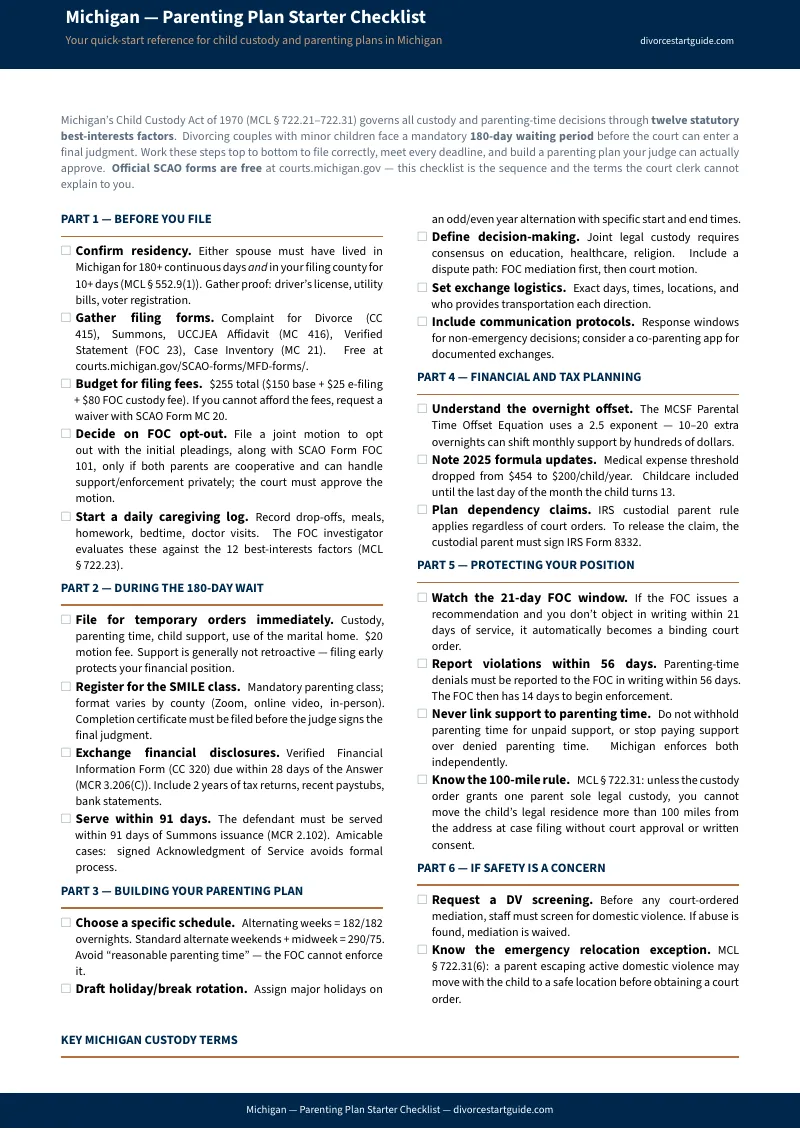
Download the free Michigan Parenting Plan Starter Checklist to see how the framework works — a two-page overview of the decisions you need to make and the documents you should gather. When you are ready for the complete guide with detailed explanations, worksheets, and step-by-step instructions, get the full Michigan Child Custody & Parenting Plan Guide for .