
You're about to divide everything you built together — and Massachusetts makes it harder than most states
In most states, there's a clear line between what's yours and what's shared. Massachusetts doesn't draw that line. Under the "all-property" rule, a probate judge can consider every asset either of you owns — including premarital savings, inheritances from your parents, and retirement accounts you contributed to before the marriage. The court won't automatically split things 50/50 either. Instead, the judge weighs fourteen statutory factors under M.G.L. c. 208, § 34 and decides what's "equitable." That word sounds fair until you realize it means unpredictable.
Meanwhile, the clock is running. Rule 410 gives you 45 days from service to exchange three years of tax returns, bank statements, pay stubs, and investment records. Your financial statement — the CJ-D 301 — is signed under penalty of perjury. An error doesn't just look bad; it can result in sanctions or a judgment reopened years later.
The state court gives you the blank forms. What it doesn't give you is a way to organize your numbers, compare your options, or figure out whether keeping the house makes more financial sense than keeping your 401(k).
The Section 34 Financial Workbook — a structured system for Massachusetts asset division
This guide is built around the fourteen factors that Massachusetts judges actually use to divide property. Instead of generic financial planning advice, every worksheet maps directly to a statutory requirement — so the numbers you organize here are the same numbers your attorney, mediator, or the court will need to see.
You'll classify every asset and debt, run side-by-side comparisons of settlement scenarios, calculate alimony limits under the Alimony Reform Act, and build a disclosure package that satisfies Rule 401 and Rule 410 — all before you spend a single hour of billable time.
What's inside
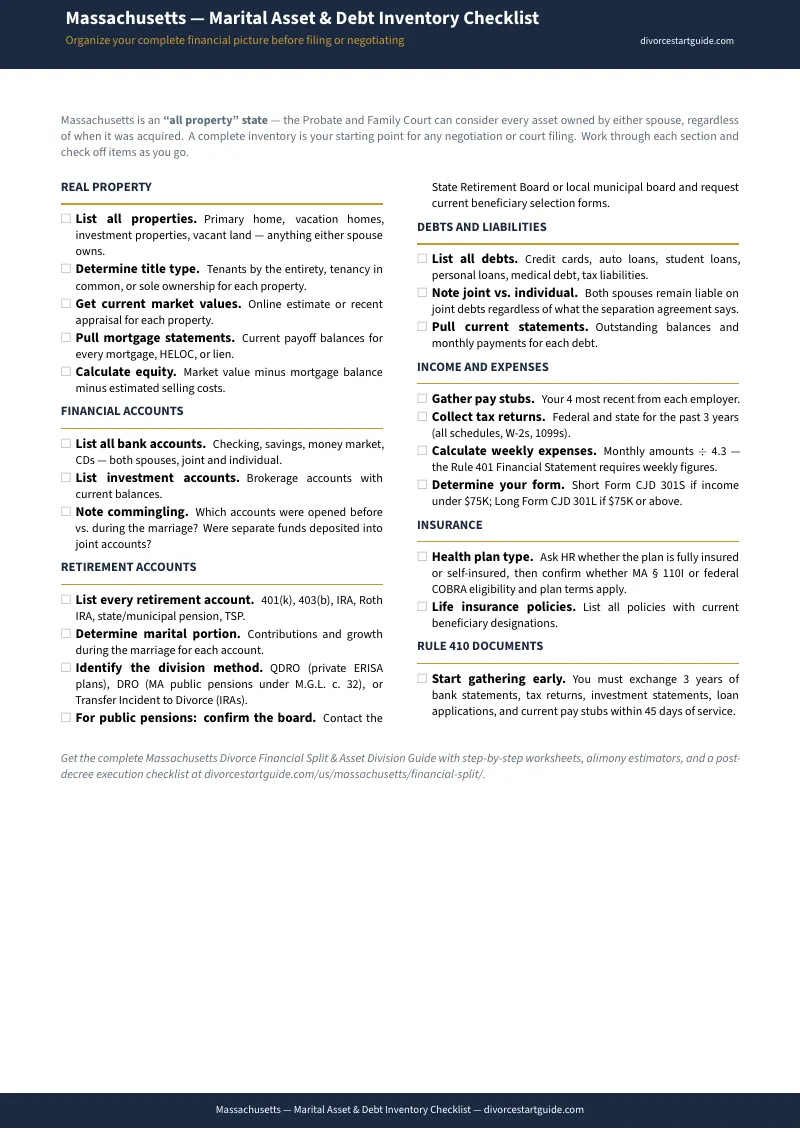
- Marital Asset and Liability Inventory — Massachusetts lets the court divide any asset, but origin still matters as one of the fourteen factors. This worksheet walks you through classifying each asset as premarital, inherited, gifted, or acquired during the marriage, then calculating the equity in each one so you can see what's actually on the table.
- House vs. Retirement Comparison Calculator — because keeping the family home often means giving up retirement savings, and most people don't realize the tax consequences until it's too late. This side-by-side worksheet factors in your mortgage balance, closing costs, refinancing requirements, and the tax-deferred value of retirement accounts so you can compare the real cost of each option.
- QDRO and Retirement Division Tracker — splitting a 401(k) or pension without a properly drafted Qualified Domestic Relations Order triggers immediate taxes and a 10% early withdrawal penalty. This tracker walks you through the timeline for each account type: QDRO for private employer plans, DRO for Massachusetts public pensions, and Transfer Incident to Divorce for IRAs.
- Alimony Duration and Amount Estimator — the 2022 Cavanagh v. Cavanagh ruling changed how Massachusetts courts handle cases where both alimony and child support are at issue. The court must now run a mandatory three-step comparison: alimony first, child support first, then pick the more equitable result. This worksheet walks you through the Reform Act duration caps and both Cavanagh calculations side by side.
- Weekly Expense Calculator for Rule 401 — the CJ-D 301 requires weekly income and expense figures that most people don't have at their fingertips. This worksheet converts your monthly bills, irregular expenses, and variable income into the weekly averages the form demands (monthly ÷ 4.3), organized by the exact categories the court uses.
- Rule 410 Document Gathering Checklist — a checklist of every document the 45-day mandatory disclosure requires, organized by category: tax returns, W-2s, bank statements, investment account statements, retirement statements, loan applications, and net-worth statements. Check off each item as you gather it so nothing is missing when the deadline hits.
- Debt Allocation Worksheet — joint credit cards, the mortgage, auto loans, student debt — Massachusetts courts can assign liability for any debt, even one in only your name. This worksheet helps you list every liability, identify who incurred it and why, and draft indemnification language for your separation agreement.
- Healthcare Continuation Checklist — Massachusetts law (M.G.L. c. 175, § 110I) can continue coverage on a fully insured employer plan. Self-insured ERISA plans do not have to follow that statute. This checklist helps you determine which type of plan you're on and write clear health insurance terms into your agreement.
- Post-Decree Execution Checklist — both 1A and 1B use a 90-day nisi period. On a 1A Joint Petition the nisi does not enter until 30 days after agreement approval (about 120 days from the hearing). This checklist maps what to do in the 30, 60, and 90 days after the judgment becomes absolute: QDROs, quitclaim deeds, beneficiary designations, and refinance fallbacks.
Who this is for
- You're preparing to file or have already been served, and you need to organize your finances before your Rule 410 deadline
- You and your spouse are negotiating a 1A uncontested separation agreement and want to make sure you're not leaving money on the table
- You're working with an attorney or mediator and want to arrive organized so you're not paying $300–$850 an hour for someone to sort your bank statements
- You have retirement accounts, a house, or debts that need to be divided and you want to understand your options before you agree to anything
Why free tools fall short
The Massachusetts Trial Court website gives you every form you need — the CJ-D 301 financial statement, the Joint Petition, the Rule 410 document list — and you should never pay for blank court forms. But the forms are designed for data entry, not decision-making. They tell you what numbers to report. They don't help you figure out which numbers matter, how to compare a house buyout against keeping your pension, or how the Cavanagh framework changes your alimony calculation when child support is also on the table.
Online document-preparation services like 3StepDivorce generate signature-ready forms for a flat fee, but they don't provide state-specific financial analysis for complex rules. They fill in what you tell them — they don't help you figure out what to tell them.
This guide sits in between. It's not a form filler and it's not a lawyer. It's the organized workspace you use before you fill out the forms or sit down with a professional — so the work you do with them is strategic, not administrative.
100% satisfaction guarantee
If the guide doesn't help you organize your Massachusetts divorce finances, email us for a full refund. No forms, no waiting period.
Get started now
Download the free Massachusetts — Marital Asset & Debt Inventory Checklist to see the structure. When you're ready for the full workbook with every worksheet, calculator, and tracker, get the complete guide for .