
The Court Hands You a Blank Parenting Plan. It Doesn't Tell You What Each Checkbox Costs You.
The Maryland Judiciary publishes the Parenting Plan Tool (CC-DR-109) for free. Your circuit court's Family Law Self-Help Center will hand you a copy. Online document services will auto-fill it for $84 a month. Every version of that form is perfectly valid.
But that form asks you to designate decision-making authority for healthcare, education, religion, and extracurricular activities — and nothing in the packet explains how "tie-breaker authority" works, why "right of first refusal" can shift your overnight count past the 92-night child support threshold, or what happens when a vague schedule like "reasonable visitation as agreed" fails the contempt enforcement test under Maryland law. That single set of checkboxes reshapes your parental rights for years. And the free form gives you no guidance on the trade-offs.
That gap — between having the form and understanding the decisions buried inside it — is where Maryland parents lose ground they never get back. The form is the paperwork. This guide is the Best-Interest Factor Navigator — the planning system that shows you what each decision means before you commit to it.
The Best-Interest Factor Navigator
Maryland's custody system changed fundamentally in 2023 (elimination of limited divorce) and again in 2025 (House Bill 1191 codifying 16 best-interest factors). National DIY divorce services charge $84/month to auto-fill generic forms and miss all of it. Maryland circuit courts operate under county-specific Differentiated Case Management tracks, mandatory parenting plan requirements under Rule 9-204.1, and a Joint Statement deadline system under Rule 9-204.2 that carries sanctions for non-compliance.
This guide is a process-navigation manual and co-parenting planner built entirely around Maryland's family law code. It does not generate forms or provide legal advice. It gives you the strategic framework to understand every custody decision, design a court-compliant parenting schedule, and organize your case before you spend a dollar on attorney time.
What You Get
The Complete Guide (12 Chapters + 6 Worksheets)
A 12-chapter guide plus 7 standalone printable worksheets covering the full arc of a Maryland custody case:
- 16 Best-Interest Factors Self-Audit — a factor-by-factor worksheet mapping to every criterion a judge evaluates under HB 1191, so you can document your caregiving history, home stability, and co-parenting cooperation before a scheduling conference or trial
- Overnight Tracker Workbook — an interactive calculator to determine whether your proposed schedule crosses the 92-overnight threshold that triggers shared physical custody child support calculations under Family Law § 12-204
- Parenting Plan Drafting Checklist — a structured walkthrough of every decision CC-DR-109 asks you to make, explaining the long-term consequences of each choice before you commit to it — including right of first refusal, tie-breaker authority, and transportation responsibilities
- Holiday and Vacation Schedule Planner — rotation matrices for Maryland school calendars, federal holidays, and cultural observances with clear alternating-year templates ready to be written into your plan
- Court Deadline Tracker — the Rule 9-204.2 Joint Statement timeline (30-day exchange, 15-day service, 10/20-day filing deadlines) mapped to your specific hearing dates so you never miss a sanctions-triggering deadline
- Evidence and Documentation Organizer — a courtroom readiness checklist covering Maryland's requirement that all digital evidence must be physically printed (judges will not view evidence on personal devices)
- Parenting Schedule Comparison — 2-2-3, 5-2-2-5, alternating week, and alternating weekend schedules with overnight calculations showing how each affects your child support formula
- Modification & Relocation Guides — the material change in circumstances standard, the 45-to-90-day relocation notice requirement under § 9-106, and how remote-work flexibility factors into relocation analysis
- Safety Planning Chapter — protective orders, emergency custody petitions, and how domestic violence allegations affect the best-interest factor analysis
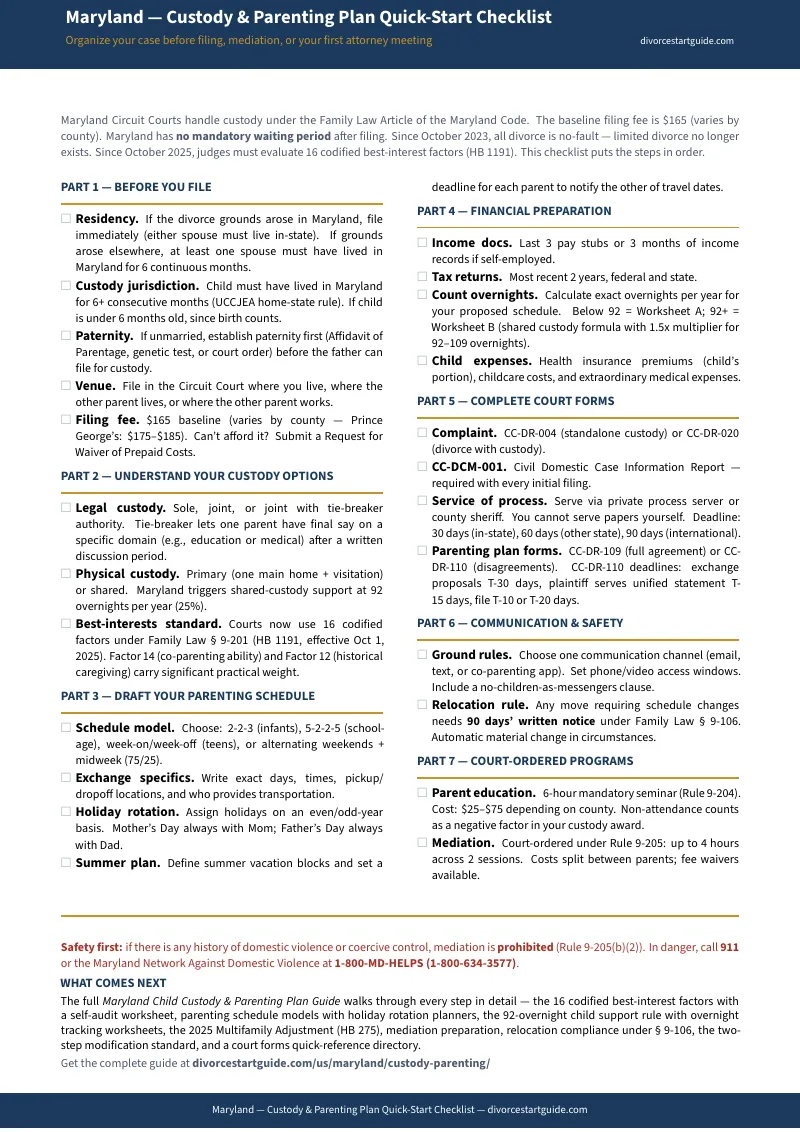
Quick-Start Checklist (Free Download)
A printable parenting-plan starter checklist — Maryland's custody vocabulary, the key court deadlines, and the first steps to take before filing. Enough to see the full picture and decide whether you need the complete guide.
Who This Is For
- You just got the scheduling conference notice and the court ordered you to complete CC-DR-109 in good faith — but the blank form doesn't explain why designating "tie-breaker authority" for education means one parent can unilaterally choose the school district
- You and your co-parent are cooperating and want to draft a parenting plan that a judge will actually approve — not a vague agreement that fails the contempt enforcement test because it says "reasonable visitation as agreed"
- You're filing pro se because attorney retainers in Maryland run $2,000–$15,000, and you need to understand the decisions inside those free court forms before you file them
- Your co-parent is high-conflict and you need a highly structured parenting plan with specific transition times, communication protocols, and decision-making boundaries — because vague agreements become weapons in enforcement disputes
- You want to understand the 2023 and 2025 reforms before deciding whether to hire a lawyer, use a mediator, or handle it yourself — especially how the elimination of limited divorce and the codification of 16 best-interest factors changed the process
Why Free Court Forms and $84/Month Document Services Don't Solve This
Maryland's circuit court Family Law Self-Help Centers provide every custody form you need. CC-DR-109 is free, court-approved, and legally required. The problem isn't the form — it's that no one explains the strategic decisions embedded in it. The clerk is legally barred from advising you on which choices protect your parental rights.
National automated services like 3StepDivorce charge $84/month to auto-populate those same free forms through a questionnaire. They generate the paperwork. They don't explain how the 92-overnight rule changes your child support calculation. They don't walk you through the difference between joint legal custody and tie-breaker authority. They don't cover the Rule 9-204.2 Joint Statement deadline system, Maryland's county-specific case tracks, or the 16 codified best-interest factors that took effect in 2025.
Co-parenting apps (OurFamilyWizard at $144+/year, Custody X Change at $96–$180/year) manage schedules after you have a custody order. They don't help you build the parenting plan that gets you there.
This guide costs — less than five minutes of a Maryland family law attorney's billable time. One purchase, instant download, no subscription. You keep it for your entire case.
100% Satisfaction Guarantee
If the guide doesn't give you a clear, usable path through Maryland's custody process, email [email protected] and we'll make it right — no hoops, no time limit.
— Less Than Five Minutes of Attorney Time
A typical Maryland family law attorney charges $200–$600 per hour. A contested custody case runs $5,000–$15,000 in legal fees. This guide gives you the complete decision-making framework, parenting schedule designer, overnight tracker, and court-prep worksheets for a fraction of a single billable hour — and you keep it for your entire case.