The court gives you blank forms. It does not give you the order to fill them in.
You've found the Maine Judicial Branch website. You've downloaded FM-004, FM-002, FM-050, and the Child Support Worksheet. You're staring at a stack of blank PDFs and trying to figure out which one to complete first, which needs to be notarized, and whether you're supposed to serve your spouse before or after you file with the clerk.
Meanwhile, a family law attorney in Maine charges $200 to $500 an hour. A standard uncontested divorce retainer starts around $3,000 — and half of those billable hours go toward administrative paperwork you could handle yourself, if someone showed you the correct sequence.
You don't need a lawyer to fill in court forms. You need to know the exact order, the specific service methods the court accepts, and the filing mistakes that get packets rejected — before you write anything down.
The District Court Filing Sequence System
This is a complete, step-by-step guide to filing for divorce in Maine — built for the specific rules that make Maine's District Court process different from every other state. It does not file your papers, generate forms, or provide legal representation. It is the sequencing, verification, and procedural intelligence that the blank forms leave out.
At its core is the District Court Filing Sequence System — a structured method that walks you from "I have a pile of downloaded forms and no idea where to start" to a clean, correctly ordered, clerk-ready filing packet. It handles the part everyone gets wrong: confirming jurisdiction under Title 19-A § 901, choosing between FM-004 (with children) and FM-005 (no children), purchasing the original Summons from the clerk because it cannot be downloaded, executing legal service so the 60-day waiting period actually starts, navigating the automatic preliminary injunction that freezes your assets the moment papers are served, and preparing for a Case Management Conference or Pre-Trial Conference depending on your case track.
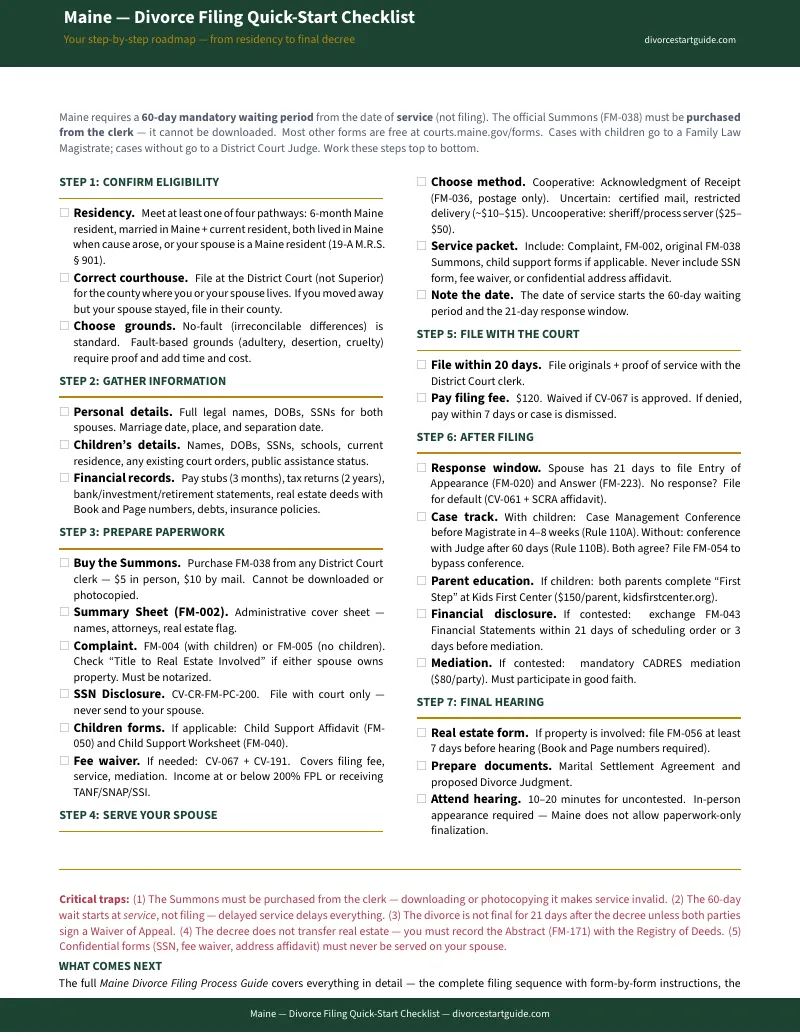
What's inside — the 16-chapter guide, 10 printable worksheets, and the free 25-item checklist
- Jurisdiction and Residency Verification — the four pathways under Title 19-A § 901, the military residency exception, and how to determine which District Court to file in. Because filing in the wrong venue means the court transfers your case to another location, adding weeks of delay.
- The Complete Form Sequence — which forms apply to your situation, what order to complete them in, which require notarization, and the exact copies to prepare for the court, yourself, and your spouse. Including the form most filers miss: the SSN Confidential Disclosure (CV-CR-FM-PC-200), which is filed with the court only and never sent to your spouse.
- Service of Process Step-by-Step — the three service methods Maine accepts (Acknowledgment of Receipt by first-class mail, certified mail with restricted delivery, and sheriff or process server), the 20-day return window for FM-036, and how to file your proof of service correctly so the 60-day clock starts running.
- The Two Case Tracks — cases with children go to a Family Law Magistrate for a Case Management Conference within 4 to 8 weeks; cases without children wait 60 to 90 days for a Pre-Trial Conference with a Judge. The guide covers both paths, including how to file Form FM-054 to waive the early conference if both parents agree on all terms.
- Financial Disclosure Preparation — a worksheet for organizing your assets, debts, income, and expenses before copying the totals onto the official Financial Statement (Form FM-043). Incomplete or sloppy financial statements are one of the most common reasons cases stall.
- CADRES Mediation Preparation — what happens in Maine's Court Alternative Dispute Resolution Service, the $80-per-party fee, how to request safety accommodations, and a goal-setting worksheet for identifying your non-negotiables versus areas of compromise.
- Real Estate Transfer Instructions — why the signed divorce decree does not automatically transfer property, how to prepare the Abstract of Divorce Decree (Form FM-171), the $10 court certification fee, and where to record it at the county Registry of Deeds.
- Complete Cost Breakdown — every fee from the $120 filing fee through CADRES mediation and co-parenting education, plus the fee waiver process (Form CV-067 and Financial Affidavit CV-191) for those who cannot afford the costs.
- The Complexity Audit — a diagnostic self-assessment that identifies when your case genuinely needs professional help (high-conflict custody, business valuations, domestic violence) and shows you how to find limited-scope counsel through the Maine State Bar Association's referral service.
Printable worksheets you fill in with a pen (also in your download): Residency and Venue Worksheet, District Court Filing Packet Checklist, Service of Process Tracker, Hearing Prep Checklist, Financial Disclosure Worksheet, CADRES Mediation Planner, Real Estate Transfer Checklist, Cost Breakdown Worksheet, Complexity Audit, and Deadline Timeline Tracker.
Who this is for
The spouse who has decided to file and needs to know what comes first. The person who downloaded every FM form from courts.maine.gov and cannot figure out whether the Complaint gets notarized before or after the Summons is purchased. The filer who discovered — after filling out paperwork — that the original Summons must be bought from the clerk and cannot be printed at home. The couple who agree on everything but need to move the paperwork through the District Court without paying a $3,000 retainer. And the person who tried an online document service, got their forms generated, and realized the service ends at the print button — nobody tells you how to execute service, start the waiting period, or prepare for the Magistrate conference.
Why not just use the free court forms?
Because the court gives you forms, not a filing sequence. The Maine Judicial Branch provides most divorce forms free online — and they should. But downloading a stack of blank PDFs with no chronological roadmap is where things break down. The court clerk is not your advisor. They are bound by rules that prevent them from telling you how to fix the errors they flag. They just reject the packet and send you to the back of the line.
The national document-prep platforms — 3StepDivorce at $299, and various subscription services charging monthly fees — generate forms. Once you print them, the service stops. None of them explain how to purchase the original Summons from the clerk, how to execute one of Maine's three approved service methods, how to navigate the Case Management Conference before a Family Law Magistrate, or how to prepare for CADRES mediation. And the subscription platforms keep charging you while your case sits in the court's scheduling queue for months.
An honest guarantee
Work through the District Court Filing Sequence System. If the guide does not make the Maine divorce filing process clearer and more organized than any blank form, free article, or paid document service could — email us at any time for a full refund. The risk of trying it is a fraction of one attorney consultation hour. The risk of getting your filing rejected is measured in weeks of delay and potentially having to repay the $120 filing fee.
For — less than fifteen minutes of attorney time — you get the filing sequence, the form checklist, the service instructions, and the step-by-step preparation guides that the free forms leave out.
Stop guessing which form comes next. Get the guide, follow the sequence, and file your divorce correctly the first time.