The Clerk Hands You 14 Blank Forms. No Instructions. Filing Fee: $200. Non-Refundable.
You've decided to file for divorce in Kansas. You pull up the Kansas Judicial Council website and find a stack of blank PDFs — Petition, Domestic Relations Affidavit, Parenting Plan, Settlement Agreement — with zero explanation of which ones you need, what order to file them in, or what to write in each field.
The district court clerk can accept your papers, but they're legally barred from telling you if you filled them out right. One misfiled document. One missed signature. One wrong service method. Your filing gets rejected, your $200 fee is gone, and you're back at square one — days behind, dollars lighter, and no closer to being done.
Meanwhile, Kansas divorce attorneys quote $3,000–$6,000 retainers at $225–$400 an hour. National document-prep websites charge $137–$299 upfront, then quietly bill $39.99 a month while your case makes its way through the 60-day waiting period. For paperwork you can absolutely handle yourself — if someone maps the process from beginning to end.
The Filing Sequence System
This isn't a pile of blank court forms (those are free from the Kansas Judicial Council). It's the chronological process map that tells you which forms to file, in which order, with which answers — so your case moves through the court system without clerk rejections, missed deadlines, or surprise hearings you weren't prepared for.
Built specifically for Kansas District Court procedure, the guide covers every stage from the 60-day residency check through your Final Decree — including the three procedural paths your case can take (uncontested, default, or contested) and how to keep yours on the fastest, cheapest track.
What's Inside — 9 Printable PDFs
- 17-Chapter Filing Process Guide (guide.pdf) — every stage from residency verification through post-decree steps, with Kansas-specific statutes cited throughout and plain-English explanations of what they mean for your case
- Service Method Decision Tree (service-decision-tree.pdf) — sheriff service, private process server, certified mail, or Voluntary Entry of Appearance — costs, timelines, and when each one makes sense
- DRA Walkthrough Worksheet (dra-walkthrough.pdf) — the Domestic Relations Affidavit is the most rejection-prone form in a Kansas filing. This standalone walks through every field and lists the documents to gather before you start
- 60-Day Waiting Period Planner (waiting-period-planner.pdf) — what to prepare while the mandatory cooling-off period runs, so you're ready for your Final Hearing the day you're eligible
- Final Hearing Preparation Script (hearing-prep-script.pdf) — what the judge asks, what you need to bring, and how to present your settlement agreement without freezing up
- Property Division & Maintenance Worksheets (property-maintenance-worksheet.pdf) — Kansas uses equitable distribution, not 50/50 — the worksheets help you organize assets, debts, and maintenance calculations before you negotiate
- Parenting Plan Worksheet (parenting-plan-worksheet.pdf) — residential schedule, decision-making authority, holiday rotation, and the factors Kansas judges actually weigh
- Filing Timeline Tracker (filing-timeline.pdf) — week-by-week checklist from filing through post-decree steps, so you never miss a deadline
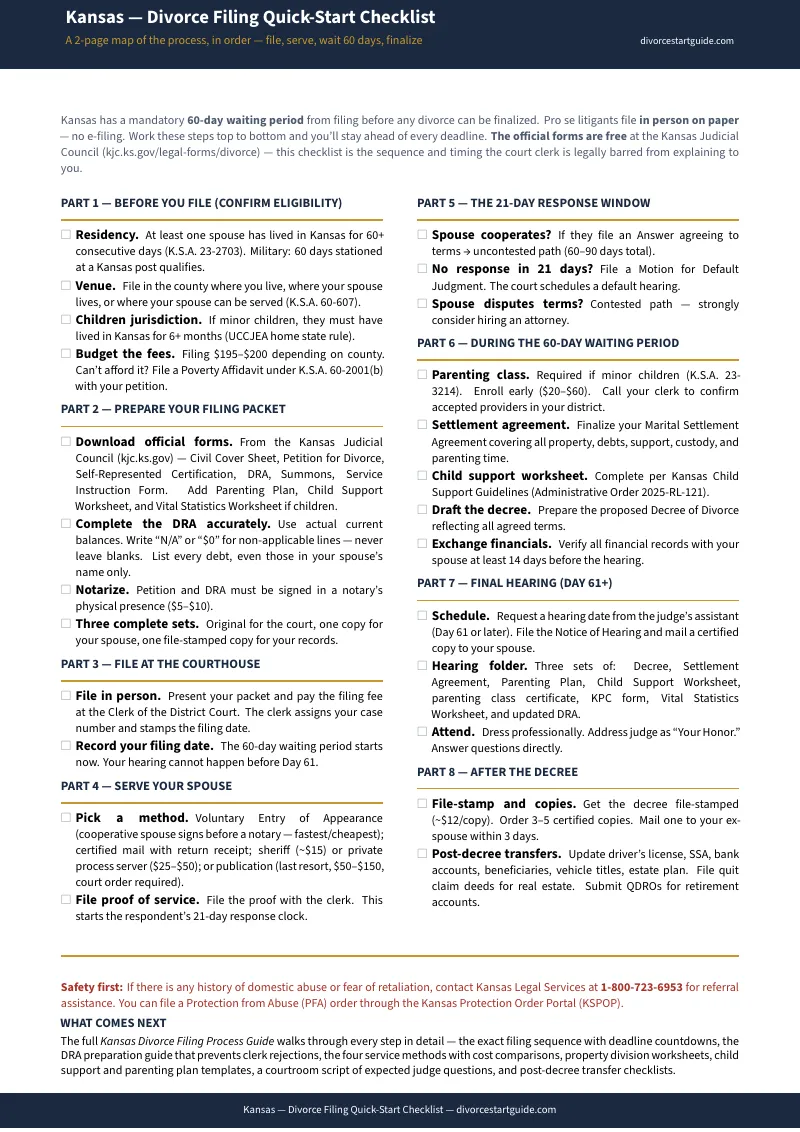
- Quick-Start Checklist (checklist.pdf) — one-page bird's-eye view of every step, document, and deadline in order (also included free)
Who This Is For
- You're filing for divorce in Kansas and want to handle it yourself — or at least understand every step before deciding whether to hire a lawyer
- You and your spouse are broadly cooperative and want the fastest, cheapest path through the court system
- Your spouse isn't responding and you need to know exactly how default judgment works in Kansas
- You've already downloaded the free court forms but have no idea which ones apply to your situation or what order to file them in
- You want to know what the 60-day waiting period is for and how to use it productively instead of just waiting
Why Free Resources Won't Get You Through
The Kansas Judicial Council gives you legally valid blank forms — but clerks are statutorily prohibited from helping you fill them out. Kansas Legal Services offers interactive tools, but full assistance is income-restricted. County self-help centers provide walk-in guidance, but coverage varies wildly by district and wait times can stretch for weeks.
None of these resources give you the sequential process map: here is the exact order of actions, here is what each form asks and why, here is what to prepare during the 60-day wait, and here is what to say at the Final Hearing.
That's what this guide does. It turns a confusing legal process into a series of concrete steps you check off one by one — protecting your filing fee, your timeline, and your peace of mind.
The Free Checklist vs. The Full Guide
The free checklist gives you the overview: what stages exist, what the deadlines are, and what documents you'll need. It's enough to understand the shape of the process and avoid the biggest mistakes.
The full guide goes step by step. It covers every form, every procedural path (uncontested, default, contested), every edge case (emergency 60-day waiver, fee waiver via Poverty Affidavit, service by publication when your spouse is unreachable), and every deadline. Plus worksheets you fill in as you go — so by the time you walk into your Final Hearing, you've already verified everything.
Download the free checklist to see if this approach works for you. When you're ready for the complete system, the full guide is — a fraction of what you'd lose re-filing after a rejected application.