Iowa Gives You the Forms. Nobody Gives You the Sequence.
The Iowa Judicial Branch provides free, interactive Chapter 17 forms for self-represented filers. Download them, answer the questions, and you have a filled-out petition. What the court does not provide — and is legally prohibited from providing — is guidance on what to do with those forms. Which ones to file first. How to register for the mandatory EDMS electronic filing portal without getting your documents rejected. Whether to pay the sheriff $50 for service or ask your spouse to sign an Acceptance of Service for free. How to use the 90-day waiting period to negotiate a settlement instead of watching the calendar.
The Iowa Divorce Filing Process Guide is an administrative navigation workbook — not a forms service, not legal advice. It maps out the entire dissolution process from residency verification to signed decree, step by step, with worksheets and checklists designed to be used alongside the court's own free forms.
What's Inside the Guide
- The Complete Filing Sequence — Petition (Form 101/201), Original Notice (Form 104/204), Confidential Information Form, Financial Affidavit (Form 124/224), and every ancillary filing, arranged in the exact order the court expects them. Not a generic national checklist — the Iowa-specific EDMS submission workflow with clerk-acceptance standards.
- EDMS Registration Walkthrough — Because the Electronic Document Management System is mandatory for all Iowa filers, and the official help pages assume you already know how electronic court filing works. The guide covers account setup, document formatting requirements, and what to do when EDMS returns a filing with a status you don't understand.
- Service of Process Decision Map — Acceptance of Service (free, cooperative), county sheriff delivery ($40–$75), private process server, and service by publication — with a tracking log and communication templates to secure a cooperative signature before you spend money on formal service.
- Asset and Debt Inventory Worksheet — Structured workspaces to document marital property, trace separate-property inheritances and gifts, list joint debts, and compile the financial records you need for Iowa's mandatory Financial Affidavit. Iowa uses equitable distribution — not automatic 50/50 — so documenting each spouse's contributions matters.
- Parenting Plan Framework and Overnight Calculator — Guided worksheets for drafting a joint parenting plan that meets your judicial district's requirements, scheduling physical care arrangements, and calculating the extraordinary visitation credit for overnight stays that affects child support.
- Child Support Preparation Worksheet — Step-by-step guidance through allowable net income deductions (taxes, FICA, union dues, mandatory pension contributions) so you can prepare accurate inputs for Iowa's official Child Support Estimator before the court hearing.
- Settlement Agreement Checklist — Guided compromise frameworks to help cooperative couples resolve property, debt, and support disagreements during the 90-day waiting period, keeping the case in the uncontested lane where it is fastest and cheapest.
- QDRO and Retirement Division Tracker — A specialized checklist for dividing employer-sponsored retirement plans, including how to negotiate which spouse absorbs the plan administrator's processing fees ($300–$1,200) in the final settlement agreement.
- Post-Decree Execution Checklist — Title transfers, insurance updates, name-change petitions, and QDRO processing — the administrative steps most people don't realize exist until after the judge signs the decree.
Why Free Court Guides Are Not Enough
Iowa's official self-help pages are written in statutory language designed to protect the court, not to simplify your filing experience. They explain what the rules are, but not how to resolve disagreements with your spouse, format your financial records for EDMS upload, or structure a parenting plan that meets local judicial district standards. Iowa Legal Aid offers excellent resources, but its direct assistance is limited to filers at or below 125% of the Federal Poverty Guidelines. National document-preparation services like DivorceWriter ($137) and 3 Step Divorce ($299) charge high fees primarily to fill out forms the state already provides for free.
This guide fills the gap between the free forms and an attorney's desk. It gives you the analytical worksheets, inventory frameworks, and procedural checklists required to complete those forms accurately and submit them through the right system in the right order.
Who This Guide Is For
- You and your spouse agree on most or all issues and want to file without paying for full legal representation
- You've been served with dissolution papers and need to understand your 20-day response deadline and options before it expires
- You want to organize your finances and negotiate a settlement before deciding whether to hire a lawyer for limited-scope review
- You're comparing the cost of DIY filing (court fees plus this guide) against unbundled legal consultations ($200–$300) or a full-service attorney ($1,500–$5,000+)
When to Hire a Lawyer Instead
This guide is for process navigation, not legal representation. We explicitly recommend consulting an attorney if your situation involves suspected hidden assets, business valuations, contested custody, domestic violence, or complex pension divisions. The guide includes a professional referral threshold checklist so you can assess where the DIY boundary is for your specific case — and it explains Iowa's unbundled legal services programs (like Community Lawyers of Iowa) where you can pay for limited consultations without retaining full representation.
What You Get
A complete downloadable PDF workbook — the main guide plus standalone worksheets and checklists — that you can print, annotate, and use alongside the court's free Chapter 17 forms. No subscription, no recurring fees, no upsells. One purchase, instant download, use at your own pace.
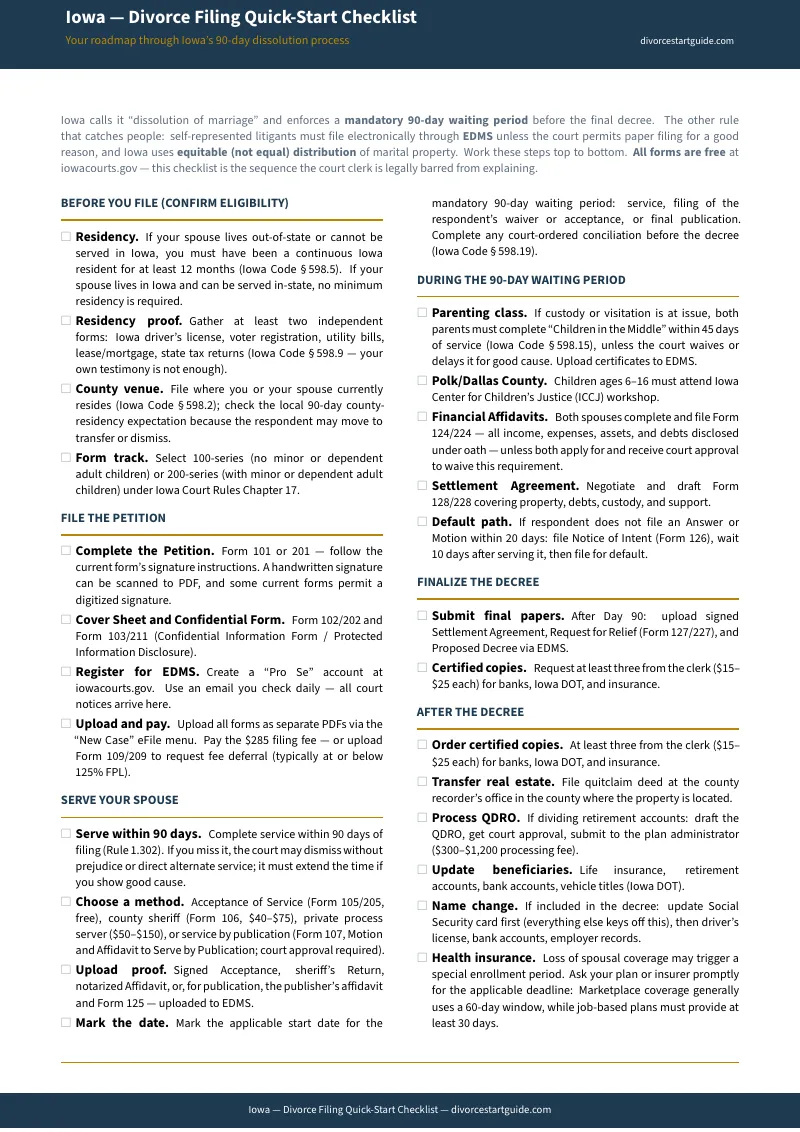
Or start with the free Iowa Divorce Filing Quick-Start Checklist — a procedural roadmap covering the timeline, EDMS basics, and resource links — and upgrade to the full guide when you're ready to file.