Illinois gives you blank court forms. It does not tell you how to divide your money.
You've found the statewide standardized Financial Affidavit on illinoiscourts.gov. You know Illinois is an equitable distribution state, not community property. And you're staring at 14 statutory factors under 750 ILCS 5/503(d) — each one giving the judge discretion to divide your marital estate in whatever ratio the court deems "just." You have no idea what ratio your situation will produce, and no worksheet to model the scenarios before you sit across a mediator's table or sign a settlement agreement.
Meanwhile, a family law attorney in Illinois charges $200 to $500 an hour. A $3,500 to $10,000 retainer covers the consultation, initial strategy, and document organization — half of which is administrative work you could prepare yourself if you had the right framework. A fully contested divorce with asset disputes runs $15,000 to $100,000. Mediation is more affordable at $100 to $400 an hour, but you still need to walk in knowing your numbers — the mediator facilitates the conversation, they don't run the math for you.
The free court forms are the destination. You need the calculation system that tells you what numbers to put on them.
The Equitable Distribution Workbook System
This is a 15-chapter guide and financial workbook built for the specific rules that make Illinois property division different from every other state. It does not file your papers, provide legal representation, or replace a divorce attorney. It is the classification logic, calculation framework, and decision system that the blank Financial Affidavit leaves out — so you walk into mediation or your attorney's office with your numbers already run instead of paying hourly rates for document organization.
At its core is the Equitable Distribution Workbook System — a structured method that takes you from "I don't know what's marital property and what isn't" to a complete financial profile with classified assets, modeled division scenarios, and calculated maintenance exposure. It handles what everyone gets wrong: understanding that equitable does not mean equal, tracing separate property before it gets reclassified through commingling, running the spousal maintenance formula correctly (including the 40% combined income cap that most online calculators skip), and knowing when a QDRO won't work because your spouse has an Illinois public pension that requires a QILDRO instead.
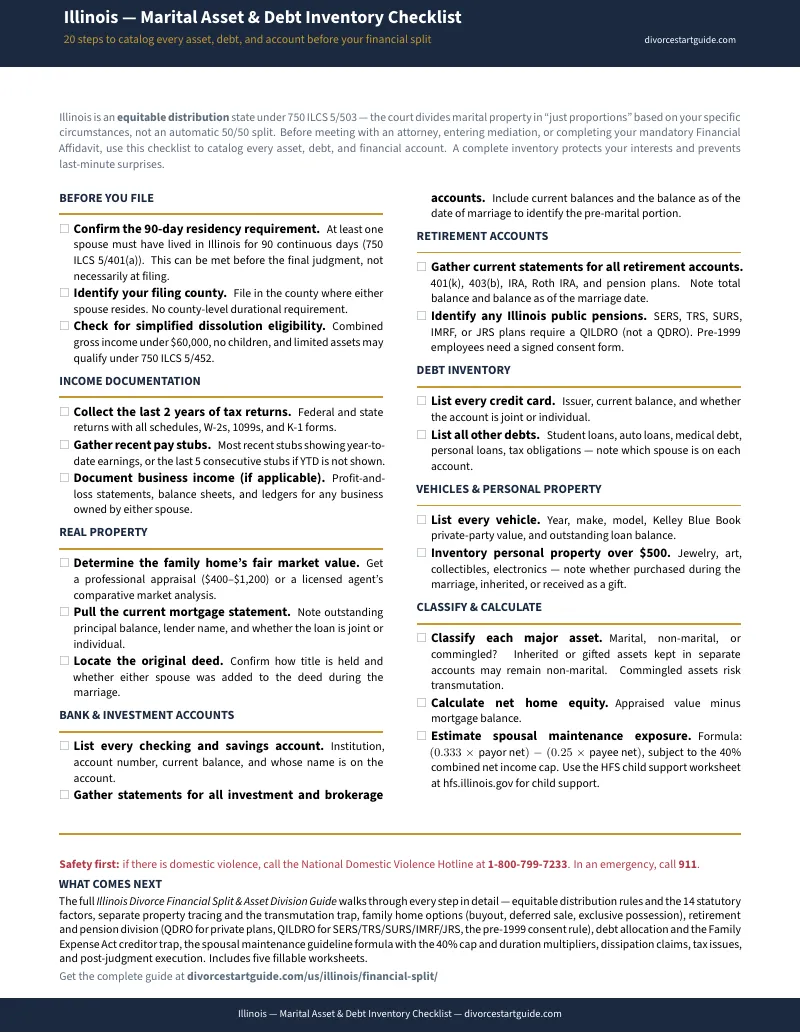
What's inside — the 15-chapter guide, 8 standalone worksheets, and the free inventory checklist
- Equitable Distribution Under 750 ILCS 5/503 — what "just proportions" actually means in practice, all 14 statutory factors the judge must consider, and why homemaker contributions carry real economic weight in Illinois courts. Because "equitable" can mean 50/50, 55/45, or 60/40 — and you need to understand which factors push the ratio in each direction.
- Your First Actions — the 90-day residency requirement, county selection, asset-freeze protections, and whether you qualify for a Joint Simplified Dissolution under 750 ILCS 5/452.
- The Financial Affidavit Preparation System — exactly what the Illinois Supreme Court standardized form requires after the June 2025 updates, what supporting documents to gather (two years of tax returns, three months of bank statements, recent pay stubs), and Cook County Local Rule 13.3 additional requirements. Because an incomplete or inaccurate affidavit can get your settlement overturned years after the decree is signed.
- Marital vs. Non-Marital Property Classification — the default presumption that everything acquired during the marriage is marital regardless of title, how inheritances and gifts qualify as non-marital under 750 ILCS 5/503(a), and the transmutation trap where depositing separate funds into a joint account or adding your spouse to a deed can permanently reclassify your protected assets. Includes a separate property tracing ledger and transmutation risk audit.
- Asset Valuation Framework — the fair market value standard under 750 ILCS 5/503(k), choosing a valuation date, the "garage sale" standard for household furnishings, and when to hire appraisers or forensic accountants for complex assets like business interests or stock options.
- Family Home Decision Framework — the four disposition pathways (buyout and refinance, immediate sale, deferred sale, co-ownership for school stability), the equity offset math, exclusive possession under the hardship standard, and how primary parenting time affects the court's decision. Includes a buyout vs. sell calculator.
- Retirement Account and Pension Division — QDROs for private employer plans (401(k)s, 403(b)s), the separate QILDRO process for Illinois public pensions (SERS, TRS, SURS, IMRF, JRS) under Section 1-119 of the Illinois Pension Code, the consent rule for pre-1999 employees, the two-step QILDRO/QCO court order process, SERS's $50 processing fees, and why IRAs use a transfer incident to divorce instead. Includes a pension offset vs. QDRO/QILDRO decision matrix that compares the administrative cost of dividing each account against trading other assets.
- Debt Allocation — mortgages, credit cards, student loans, and the Illinois Family Expense Act. The critical gap between what a divorce decree assigns and what a creditor can collect — because your ex defaulting on a jointly-held debt still damages your credit, regardless of what the settlement says.
- Spousal Maintenance Scenario Modeler — the two-step analysis (entitlement determination, then guideline formula), the 33.3% / 25% calculation, the 40% combined net income cap, the duration multipliers by length of marriage, and the post-2018 tax rule that maintenance is no longer deductible for the payor or taxable for the payee. Run your own scenarios before mediation.
- Child Support Integration — how the Income Shares Model under 750 ILCS 5/505 interacts with your property settlement and maintenance calculations.
- Dissipation Claims — the notice requirements, look-back limits, and how the burden of proof shifts once a claim is raised. Understand when frivolous spending becomes a legal claim that changes the division math.
- Tax Consequences — IRC Section 1041 non-taxable transfers, deferred tax liabilities on retirement accounts, capital gains on the family home (the exclusion drops from $500,000 for married couples to $250,000 for single filers), and post-divorce filing status changes.
- After the Judgment — the retitling, account transfers, beneficiary updates, and QDRO/QILDRO filings that must happen or your settlement is unenforceable.
- When to Hire a Professional — a diagnostic audit that identifies when your situation genuinely exceeds the self-help boundary (closely held businesses, suspected hidden assets, combined income above $500,000, domestic violence) and shows you how to package your organized financial profile for a flat-fee attorney review instead of handing over a full retainer.
Who this is for
The spouse who is quietly trying to figure out whether they can financially survive a divorce before bringing it up. The person filing pro se because a $5,000 retainer isn't in the budget, but who needs more than blank court forms and free FAQ articles. The couple heading into mediation who want to build a marital balance sheet together before the first session. And the person who has already hired an attorney but is watching billable hours evaporate on basic document organization — and wants to walk in with a complete, classified financial package so the attorney spends time on strategy, not paperwork.
Why not just use the free court forms?
Because the court gives you a Financial Affidavit to fill in, not a system for deciding what numbers to put on it. The Illinois Supreme Court standardized forms are free and publicly available on illinoiscourts.gov — as they should be. But a blank affidavit with no classification logic, no calculation tools, and no scenario modeling is where the costly mistakes happen. Listing an inheritance as marital property because you didn't understand the commingling rules. Accepting a 50/50 split when the statutory factors support 55/45 in your favor. Skipping the QILDRO process for your spouse's state pension because you assumed a regular QDRO would work. Miscalculating spousal maintenance because you applied the formula without checking the income cap.
The national document-prep platforms — DivorceNet at $159, LegalZoom, 3StepDivorce at $299 — generate filled-in forms. What they don't provide is the classification framework, the math worksheets, or the decision logic for the choices that determine whether your settlement protects you or costs you tens of thousands of dollars over the next decade.
An honest guarantee
Work through the Equitable Distribution Workbook System. If the guide does not give you a clearer, more organized financial picture than any free article, blank court form, or paid document-assembly service could — email us within 30 days for a full refund. The risk of trying it is a fraction of one attorney billable hour. The risk of signing a settlement you don't fully understand is measured in years of financial consequences.
For — less than fifteen minutes of attorney time — you get the classification system, the calculation worksheets, the maintenance modeler, and the pension decision matrix that the free forms leave out.
Stop guessing what's marital and what's yours. Get the guide, run your numbers, and walk into your next meeting prepared.