Your divorce decree is signed. The court's job is done. Yours is just beginning.
The Family Court judge signed your Divorce Decree. The marriage is legally over. And now you're staring at a stack of life admin that nobody prepared you for: a Social Security card in the wrong name, joint bank accounts your ex can still drain, a pension with no domestic relations order on file, a house registered in both names at the Bureau of Conveyances, and a car title that still lists someone you no longer want on your insurance policy.
Each agency has its own forms, its own fees, its own processing timeline — and a strict dependency order nobody tells you about. Update your driver's license before Social Security and the county DMV rejects you. Try to record a deed transfer on a Land Court property without first petitioning to note your divorce on the Certificate of Title and the Bureau of Conveyances rejects you. Submit the wrong form to the Employees' Retirement System and you lose a non-refundable review fee with nothing to show for it.
The Hawaii Family Court's self-help packets are excellent for getting you divorced. But the judicial system's job ends the day the judge signs the decree. The court does not update your driver's license, notify your bank, rewrite your timeshare deed, or submit your retirement plan filings. An attorney will do it — at $200–$500 an hour. Three of those hours go to explaining DMV procedures and bank closures. That's over $600 in administrative hand-holding you can handle yourself — if someone gives you the sequence.
The Hawaii Post-Divorce Navigation System
This is a complete, step-by-step guide to every administrative task after a Hawaii divorce — built around the one thing that free court packets and generic national checklists get wrong: Hawaii's unique procedural architecture.
At its core is the Post-Divorce Navigation System — a structured method that walks you through the exact order of federal, state, county, and private-institution updates specific to Hawaii. It handles the parts everyone gets stuck on: knowing that SSA must come before the county DMV, that the ERS requires its own model forms and will reject a standard QDRO, that Hawaii's dual Regular System/Land Court recording framework means a deed that works at the Bureau of Conveyances may be invalid at Land Court, and that an uncooperative ex-spouse has a legal workaround most people don't know about.
What's inside — the 13-chapter guide, 8 standalone worksheets, and the free checklist
- Decree Verification and Certified Copies — Hawaii splits records by date: pre-2003 divorces go through the Department of Health, post-2002 through your specific Family Court circuit. The guide maps exactly where to request copies, the fee structure for each source, and how to use eCourt Kōkua for digital retrieval.
- Name Restoration — Two Pathways — if the judge included a name restoration order in the decree, you skip the state petition entirely. If it was omitted, you face the Lieutenant Governor's administrative pathway: filing fees, notarization, a certified birth certificate issued within 90 days, newspaper publication in the Honolulu Star-Advertiser, and recording the final order with the Bureau of Conveyances within 60 days. The guide covers both paths with every form, fee, and deadline.
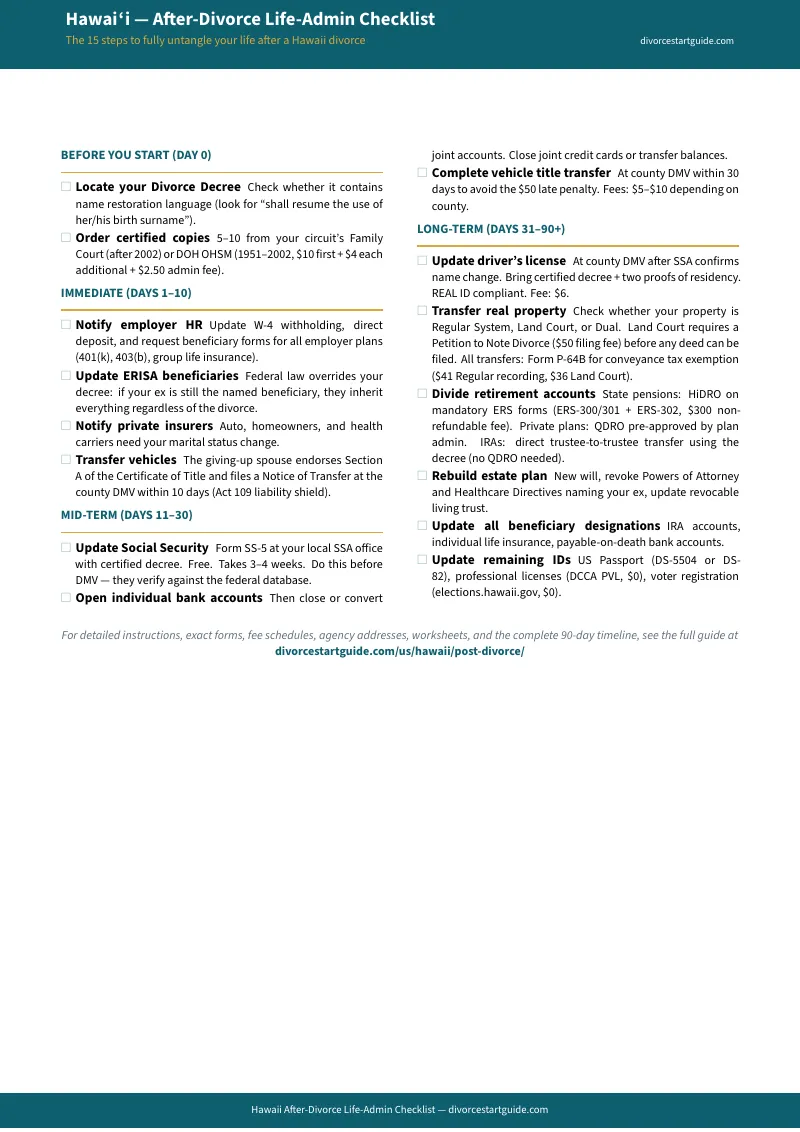
- The SSA-DMV Dependency Chain — the exact sequence (SSA Form SS-5 → county DMV → U.S. Passport) with processing windows and the documents each agency requires. Skip the order and the county DMV's database check against SSA will reject you.
- Joint Account Separation and Credit Protection — banks frequently refuse to close joint accounts without mutual written consent. The guide covers a bank-by-bank action plan for local institutions like Bank of Hawaii and First Hawaiian Bank, credit freeze procedures at all three bureaus, and how to open sole accounts while protecting your credit score.
- ERS Pension Division — The HiDRO Process — the Employees' Retirement System does not accept standard QDROs. You must use the ERS model forms (ERS-300 for pre-retirement members, ERS-301 for post-retirement members), and every submission costs a non-refundable review fee. The guide walks through the model forms, the Linson Formula calculation, the Request for Information (Form ERS-303), and a pre-submission audit worksheet so your filing isn't rejected on a formatting technicality.
- Private Retirement Accounts — QDRO and IRA — for ERISA-governed employer plans (401(k), 403(b), covered pensions), the guide covers the four-step QDRO workflow: drafting, plan-administrator pre-approval, judicial signature, and final execution. IRAs transfer tax-free without a QDRO under IRC § 408(d)(6). The guide explains both paths and the deadline risk — if your ex retires or withdraws before the order is filed, the money may be gone.
- Real Property — Hawaii's Dual Recording System — Hawaii is the only state with a centralized Bureau of Conveyances running two parallel systems: Regular System (race-notice) and Land Court (Torrens). Some properties are registered in both. A quitclaim deed that satisfies the Regular System can be rejected by Land Court if you haven't filed a petition to note your divorce on the Certificate of Title. The guide covers both systems, the Form P-64B conveyance tax exemption under HRS § 247-6(b)(7), and Land Court petition procedures and fees.
- Vehicle Title Transfers — County by County — transfers are county-administered with a strict 30-day deadline. Miss it and a late transfer penalty is assessed automatically. The transferring spouse must also file a Notice of Transfer within 10 days to escape ongoing liability under Act 109. The guide provides county-specific fees, required documents, and the endorsed-title checklist.
- Estate Plan Overhaul — Hawaii law revokes certain provisions for an ex-spouse in a pre-divorce will, but beneficiary designations on retirement accounts, life insurance, and payable-on-death bank accounts are largely unaffected. Federal ERISA law overrides state revocation for employer-sponsored plans. The guide includes a beneficiary audit worksheet covering every account type.
- Child Support and Enforcement — Hawaii Child Support Enforcement Agency (CSEA) registration, income withholding, medical support compliance, and what to do when payments stop.
- Tax Transition Year — filing status changes, Hawaii state tax adjustments, withholding updates, and the capital gains considerations on deferred property transfers.
- Domestic Violence Safety Planning — practical security measures for those who need them, including protective order procedures and safe address programs.
- The 90-Day Action Plan — a chronological timeline that sequences every update in the correct dependency order, from decree verification through title transfers, with an agency directory and forms reference.
Who this is for
The person staring at a signed Divorce Decree and a list of accounts, IDs, and titles that still have the wrong name on them. The self-represented litigant who saved money using the court's free packets and now faces administrative tasks those packets never covered. The alternate payee who's been told they need a HiDRO order to divide an ERS pension and has no idea what the model forms look like or what the Linson Formula means. The homeowner who needs to determine whether the property is in the Regular System, the Land Court System, or both before recording a single document. And the person whose attorney's job ended at the decree and who cannot justify $200–$500 an hour for someone to explain how the county DMV works.
Why not just use the free resources?
Because the free resources give you forms, not sequences. The Hawaii Family Court's self-help packets explain how to get divorced — they don't explain what to do after. The SSA tells you what to bring to their office — but doesn't tell you to finish there before visiting the county DMV. The ERS website provides model HiDRO forms — but doesn't walk you through the Linson Formula or warn you about the non-refundable review fee. The Bureau of Conveyances website describes both recording systems — but doesn't explain what happens when your property is registered in both and the deed you prepared only satisfies one.
The information exists across dozens of disconnected government websites, each one accurate for its own agency and silent about every other agency. This guide connects the dots into one sequenced workflow so you don't spend weeks bouncing between offices that each point you somewhere else first.
An honest guarantee
Work through the Post-Divorce Navigation System. If the guide doesn't make your post-divorce administration clearer and faster than any free court packet or generic national checklist could — email us at any time for a full refund. The risk of trying it is a fraction of one attorney billable hour. The risk of missing a beneficiary designation, a HiDRO deadline, or a Land Court petition is measured in years of financial consequences.
For — less than fifteen minutes of attorney time — you get the 13-chapter guide, 8 standalone printable worksheets (including the HiDRO audit, the property transfer tracker, the beneficiary audit, and the 90-day action plan), and the sequenced checklist that the free court packets leave out.
Stop bouncing between agencies. Get the guide, work the sequence, and clear your post-divorce to-do list in weeks instead of months.