Florida's 18-Page Financial Affidavit Has 999 Fields. The Court Doesn't Tell You Which Numbers Go Where.
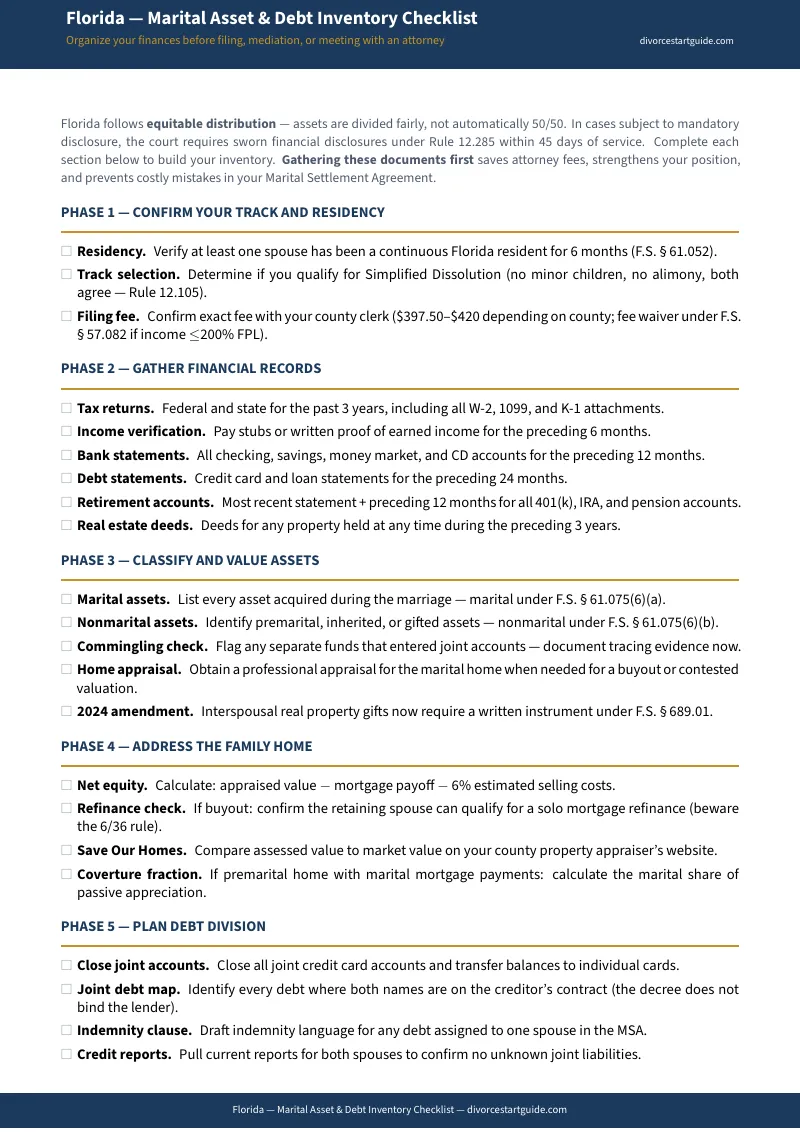
You've got 45 days from the date of service to exchange three years of tax returns, three months of pay stubs, twelve months of bank statements, and twenty-four months of loan applications. That's Rule 12.285 — mandatory, no exceptions, even in an uncontested case. Miss the deadline and the judge can draw adverse inferences, meaning the court assumes the worst about any records you didn't provide.
But gathering documents is the easy part. The hard part is figuring out what those documents mean for your settlement: which assets are marital and which are separate, how to calculate the marital portion of a premarital home's appreciation, what your spouse's pension is actually worth after you apply the coverture fraction, and whether the proposed split leaves you with a hidden tax bill five years from now.
The free court forms don't help with any of that. They give you blank lines and expect you to already know the answer.
The Equitable Distribution Workbook: Every Calculation in One System
This is the structured financial framework that sits between "I downloaded the court forms" and "I hired a $400-an-hour attorney to organize my paperwork." It walks you through every financial decision in a Florida divorce — classification, valuation, division, taxes — with worksheets that do the math for you.
It's built specifically for Florida's equitable distribution framework under Statute § 61.075, updated for the 2023 alimony reform (Senate Bill 1416) and the 2024 changes to interspousal gifts, homestead joinder, and business goodwill valuation (HB 521).
What's Inside
- Marital vs. Nonmarital Classification Worksheets — work through each asset and debt systematically: trace separate property, identify commingling, document active vs. passive appreciation, and apply the 2024 interspousal gift rule for real property transfers
- Interactive Equitable Distribution Grid — the same format Florida family law attorneys use to organize and balance property division, with a built-in equalization payment calculator that shows the exact cash transfer needed to balance any proposed split
- Home Buyout Calculator — a worked equity calculation covering the appraisal, outstanding mortgage, refinancing requirements, quitclaim deed process, and the 2024 homestead joinder clarification that protects premarital property proceeds
- Retirement Account Division Guide — how to split 401(k)s, 403(b)s, IRAs, and FRS pensions, including when you need a QDRO, how to calculate the coverture fraction for defined benefit plans, and the IRA transfer-incident-to-divorce mechanism that avoids a QDRO entirely
- Debt Allocation Worksheets — map every joint and individual liability, understand why a divorce decree doesn't bind creditors on joint accounts, and document the forgery exception under § 61.075(6)(b)5
- 2023 Alimony Calculator — models all four remaining types of spousal support (temporary, bridge-the-gap, rehabilitative, durational) using the strict durational caps and the 35% net income difference formula that replaced permanent alimony
- Rule 12.285 Disclosure Organizer — a document-gathering protocol structured to match the mandatory exchange requirements, with a file-naming guide and a visual map showing which documents are exchanged privately vs. filed in the public court record
- Tax Consequence Finder — identifies the carryover basis trap on appreciated assets, estimates capital gains exposure on the marital home, shows how to preserve the Section 121 exclusion with specific settlement language, and flags the pre-tax vs. post-tax value difference between traditional and Roth accounts
Who This Is For
This guide is for anyone dividing assets, debts, retirement accounts, or the marital home in a Florida divorce. It works whether you're filing pro se, preparing for mediation, or organizing your records before your first attorney meeting.
It's especially useful if you're dealing with a mortgaged home, employer-sponsored retirement plans, or shared debts — situations where the division math is too complex for a simple list but not complex enough to justify a $5,000 Certified Divorce Financial Analyst retainer.
Why Free Checklists and Generic Calculators Fall Short
Free asset-division calculators give you a single column to list what you own. They don't distinguish marital from nonmarital property. They don't model Florida's equitable distribution factors. They don't account for the tax basis of appreciated assets. And they don't tell you that the home your spouse owned before the marriage might be partially marital because you both paid the mortgage with joint funds — creating an active appreciation claim the calculator can't handle.
National online divorce services generate documents, but they often miss Florida-specific nuances like the 2024 business valuation standard (enterprise vs. personal goodwill), the strict alimony duration caps by marriage length, or the exact mandatory disclosure requirements under Rule 12.285. At , the Equitable Distribution Workbook costs a fraction of those services and gives you the analytical foundation they skip.
What Happens After You Buy
You'll get immediate access to 10 PDFs — the full 12-chapter guide, the checklist, and eight standalone fillable worksheets including the equitable distribution grid, home buyout calculator, coverture fraction calculator, alimony calculator, debt division planner, tax-adjusted comparison, disclosure organizer, and settlement timeline. Start with the disclosure organizer to gather your documents, then work through the classification and valuation worksheets before building your equitable distribution grid. Most people complete the process over a weekend.
If something doesn't work or doesn't apply to your situation, email us and we'll make it right.