
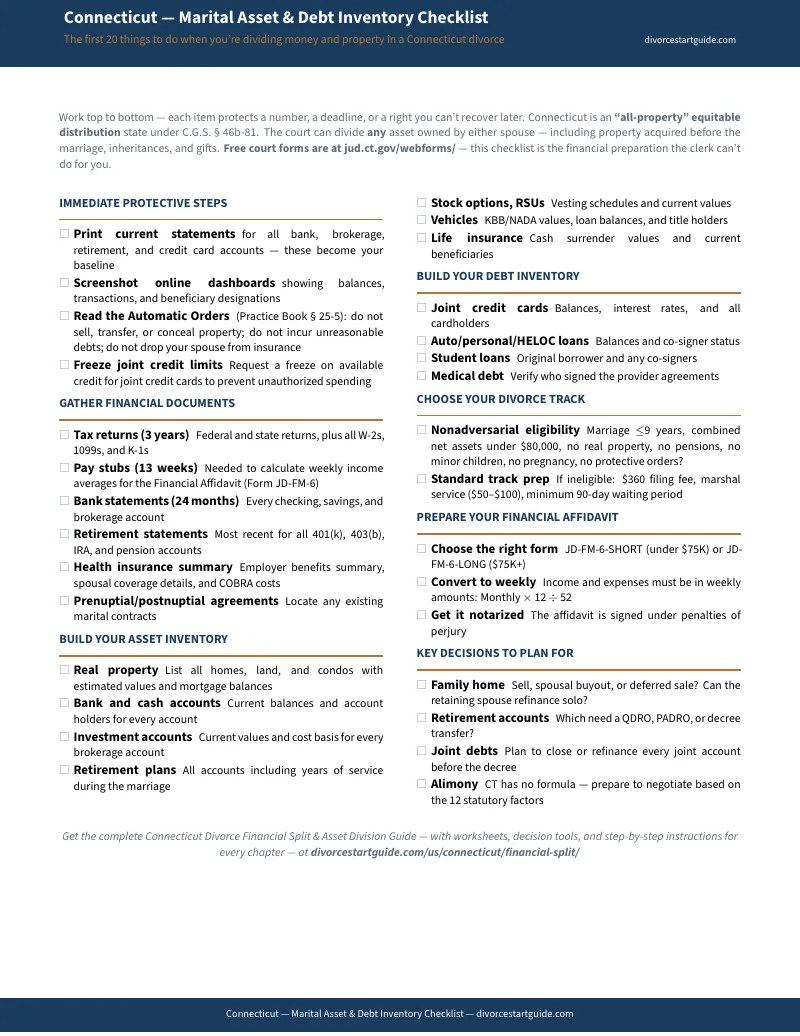
Connecticut Divides Everything — Including What You Brought Into the Marriage
Most states protect the assets you had before you said "I do." Connecticut doesn't. Under C.G.S. § 46b-81, the court can divide any asset owned by either spouse — premarital savings, family inheritances, unvested stock options, your pension. Everything goes into one pool and gets divided based on twelve statutory factors that even most attorneys have to look up mid-hearing.
That's why googling "how to divide assets in divorce" is actively dangerous if you live in Connecticut. National advice assumes your premarital assets are safe. In this state, they're not — unless you know how to trace, document, and negotiate around the all-property rule.
The Kitchen-Sink Settlement System
This guide replaces scattered legal research with a single, sequential system built for Connecticut's unusual "kitchen-sink" equitable distribution model. Instead of filling out court forms and hoping for the best, you work through a structured process that prepares you for every financial decision before you sit across from a mediator, attorney, or judge.
The system covers every asset class the court can touch — and shows you exactly how to handle each one.
What's Inside
- The Asset Classification & Tracing Worksheet — a standalone printable tracker for every asset and debt in your estate, with tracing columns that document when each asset was acquired and with whose funds. This is the single most important document you'll bring to mediation, because in Connecticut, the source of an asset is the only lever you have to keep it out of the division pool.
- The JD-FM-6 Weekly Math Converter — Connecticut's financial affidavit requires all income and expenses as weekly averages. Most people get this wrong because they divide monthly bills by 4 (the actual factor is monthly × 12 ÷ 52). This standalone worksheet walks through every pay cycle — bi-weekly, semi-monthly, annual — with the exact formulas the court accepts.
- The Home Equity Buyout Worksheet — a step-by-step framework for the three paths forward with the family home: sell and split, buyout with equity offset, or deferred sale. Includes the mortgage refinance qualification checklist so you know whether a buyout is financially realistic before you agree to one.
- The Retirement Division Roadmap — a standalone reference covering 401(k)/403(b)/IRA splits (via QDRO), Connecticut state pensions (SERS coverture fraction), municipal pensions (CMERS PADRO process), and teacher retirement (TRB). Each section explains the marital share calculation, the transfer mechanism, and the survivor benefit election — because trading a $100,000 retirement account for $100,000 in cash isn't an even trade once you account for embedded taxes.
- The Debt Inventory & Indemnification Worksheet — a divorce decree can assign your joint credit card to your ex, but the bank doesn't care. If they default, the creditor comes after you. This standalone worksheet tracks every joint debt with refinancing deadlines, indemnification clauses, and credit monitoring steps that actually protect your credit score after the decree is signed.
- The Alimony Negotiation Worksheet — Connecticut has no spousal support formula, which means every dollar of alimony is negotiable. This worksheet walks through the C.G.S. § 46b-82 factors, models the common 40%/50% temporary support benchmark, and provides the documentation checklist that strengthens your position whether you're the potential payor or recipient.
- The Nonadversarial Qualification Filter — a quick-reference checklist for the 35-day expedited track under C.G.S. § 46b-44a. If you qualify, you can finalize your divorce without a court hearing. If you don't, the guide maps the standard dissolution timeline so you know exactly what to expect.
- Settlement Scenario Worksheets — side-by-side comparison templates that let you model up to three different asset-for-asset trade-offs (e.g., keep the house but give up a larger share of retirement) and see the after-tax value of each scenario before you commit to anything. Paired with a standalone tax impact worksheet that flags the four most common tax traps.
Who This Is For
- Spouses who need to divide real estate, retirement accounts, or significant assets in a Connecticut divorce
- Self-filers preparing their JD-FM-6 financial affidavit and settlement agreement
- Anyone heading into mediation who wants organized numbers and a clear negotiation framework — not a stack of legal jargon
- Couples exploring whether they qualify for the nonadversarial 35-day track
Why Not Just Use Free Resources?
Connecticut's Judicial Branch provides the JD-FM-6 form for free. It does addition and subtraction. It does not tell you how to convert a bi-weekly paycheck into a court-compliant weekly average, how to trace a premarital inheritance to keep it out of the division pool, or how to evaluate whether keeping the house is worth giving up a larger share of retirement.
Online divorce services like 3StepDivorce and Hello Divorce generate documents — they don't analyze trade-offs. They'll ask you "who gets the house?" without helping you figure out whether keeping it is financially viable on a single income.
Hiring a Certified Divorce Financial Analyst costs $300 per hour. Using those hours to compile a list of your bank accounts is an expensive way to do data entry. This guide handles the organization, inventory, and math so you can use professional hours strictly for strategic decisions.
Satisfaction Guarantee
If the guide doesn't help you organize your financial picture and prepare for negotiations, email us and we'll make it right. No hoops, no time limit.
— Less Than One Hour of Attorney Time
Connecticut divorce attorneys bill $250 to $600 per hour. A single mediation session costs $250 to $500. This guide gives you the preparation system that makes every one of those hours more productive — and for couples who qualify for the nonadversarial track, it may be the only financial guidance you need.
Download the free Connecticut Marital Asset & Debt Inventory Checklist to start organizing your financial picture tonight. When you're ready for the full system — the worksheets, the math converters, the settlement scenarios — upgrade to the complete guide.