The court gives you 50 pages of forms. Nobody gives you the sequence.
You've been to jud.ct.gov. You've downloaded the Do It Yourself Divorce Guide — all 50-plus pages of it. You've printed the blank forms: JD-FM-3, JD-FM-159, JD-FM-158, JD-FM-6, JD-FM-172. And now you're staring at a stack of official documents with no clear indication of which ones you need for your specific situation, what order to complete them in, or what happens if you pick the wrong Tuesday for your Return Date and the whole case stalls before it starts.
You call the Court Service Center. The clerk tells you they are legally prohibited from giving process advice. They can notarize your signature and check that the right boxes are filled in, but they cannot tell you which forms to file first, whether you qualify for the nonadversarial track, or what to do when your spouse's certified mail comes back unclaimed. You're on your own with the forms.
Meanwhile, a Connecticut family law attorney charges $300 to $600 per hour. A retainer for an uncontested case starts around $2,500. If your divorce is truly cooperative and you're willing to do the paperwork, most of that retainer is paying for a paralegal to organize the same documents you could assemble yourself — if someone told you the filing sequence.
The Connecticut Court Filing System
This is a complete, step-by-step guide to filing for divorce in Connecticut without an attorney. It does not sell you blank court forms — those are free. It does not generate documents from a questionnaire. It is the Court Filing System — the chronological, court-aware workflow that tells you exactly which forms to complete, in what order, how to prepare the financial math correctly across multiple filings, and what to do at every stage from residency verification through your final decree.
Connecticut is one of the few states that offers a nonadversarial dissolution track under CGS § 46b-44a — a fast-track joint petition that can finalize your divorce in roughly 35 days with no courtroom appearance and no marshal service. But only if you meet all ten eligibility requirements. The guide covers all four dissolution pathways in full: nonadversarial, standard uncontested, default, and contested — including the conversion mechanics if your uncontested filing becomes contested because your spouse stops cooperating.
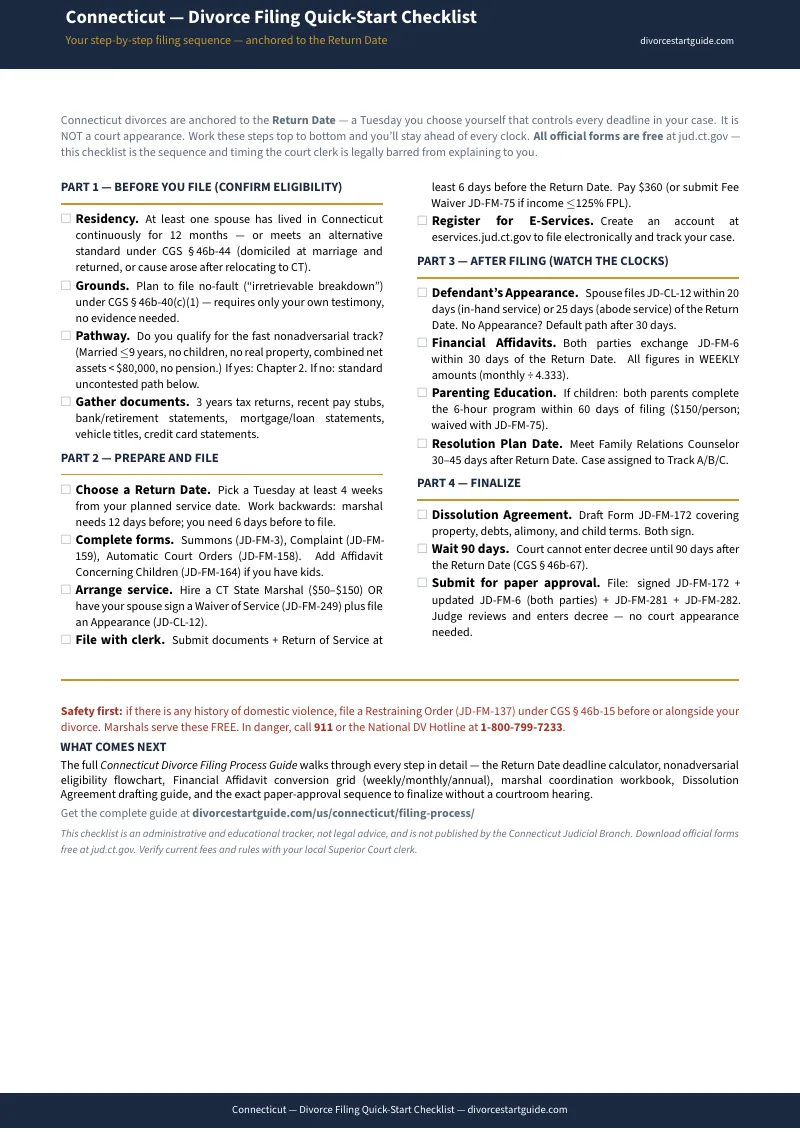
What's inside — the 16-chapter guide, the filing checklist, and 8 standalone worksheets
- Four-Pathway Decision Framework — a structured flowchart that walks you through nonadversarial, standard uncontested, default, and contested tracks so you choose the right path before you complete a single form. Filing on the wrong track wastes your $360 fee and costs you months.
- Nonadversarial Eligibility Diagnostic — a ten-point verification checklist for the CGS § 46b-44a fast track, including the $80,000 combined net asset cap, the 9-year marriage limit, and the property and pension disqualifiers that trip up couples who assume they qualify without checking.
- Return Date Calculator Logic — Connecticut's Return Date is always a Tuesday at least four weeks from your service date. Every downstream deadline — service completion, Appearance filing, financial affidavit exchange, the 90-day waiting period — is calculated from this date. The guide shows you exactly how to choose it and what happens when you get it wrong.
- Complete Form Filing Sequence — every form from initiation through final decree, in the exact order your Judicial District expects them. Includes the Summons (JD-FM-3), Complaint (JD-FM-159), Automatic Court Orders (JD-FM-158), Financial Affidavit (JD-FM-6), Dissolution Agreement (JD-FM-172), and the remote judgment package (JD-FM-281 and JD-FM-282).
- Financial Affidavit Conversion Grid — Connecticut's mandatory Financial Affidavit requires all income, expenses, and liabilities in weekly figures. The Fee Waiver Application (JD-FM-75) requires monthly averages. Misaligning these numbers across forms suggests financial dishonesty to a reviewing judge. The grid translates your real-world finances into both formats so the numbers match perfectly.
- Service of Process Coordination — step-by-step marshal service logistics, fee calculations, and the complete waiver-of-service alternative where your spouse signs Form JD-FM-249 and files an Appearance (JD-CL-12) to bypass the marshal entirely. Includes the escalation path when your spouse won't sign or can't be located.
- Remote Paper Approval Walkthrough — how to finalize your divorce without a courtroom hearing. The guide walks you through preparing the Dissolution Agreement (JD-FM-172), completing the Affidavit in Support of Judgment (JD-FM-281), and filing the Request for Approval Without Appearance (JD-FM-282) so a judge can enter your final decree on paper.
- Fee Waiver Strategy — detailed walkthrough of Form JD-FM-75, including the 125% Federal Poverty Level threshold, which state benefits automatically qualify you, and how to present your financial information consistently across the waiver form and your Financial Affidavit.
- Default Judgment Process — the complete timeline and filing sequence when your spouse does not respond, including the 30-day post-Return Date waiting period, military status verification under the Servicemembers Civil Relief Act, and how to prepare a unilateral property division proposal the judge will accept.
- Automatic Court Orders Compliance Guide — what you can and cannot do after the Automatic Court Orders (JD-FM-158) take effect. Covers the asset transfer restrictions, insurance change prohibitions, and child relocation rules that catch self-represented filers off guard.
Who this is for
The person who just downloaded the court's 50-page DIY divorce guide and cannot figure out which of the fourteen forms apply to their situation. The couple who agree on everything but discovered they don't qualify for the nonadversarial track because they own a house or have been married for more than nine years. The spouse whose certified mail came back unclaimed and has no idea whether to hire a state marshal, wait, or do something else entirely. The parent trying to reconcile their weekly income on the Financial Affidavit with the monthly income on the Fee Waiver form and getting different numbers every time. And the person who paid $299 to an online platform, received a generic form packet, and found zero Connecticut-specific instructions for choosing a Return Date, navigating marshal service, or submitting the remote paper approval package.
Why not just use the free resources?
Because the free resources give you forms, not sequence. The Connecticut Judicial Branch provides every blank form you need — and zero guidance on which ones to file first, how to reconcile the weekly and monthly financial calculations across multiple filings, or how to execute the remote paper approval process that lets you finalize without a hearing.
Court Service Center staff are legally prohibited from offering process strategy. They can notarize your signature and confirm that a box is checked, but they cannot tell you whether your Dissolution Agreement is likely to satisfy the judge's "fair and equitable" standard or help you draft a waiver motion to skip the 90-day waiting period.
The national platforms — 3StepDivorce at $299, LegalZoom starting at $499, Hello Divorce at $1,500+ — generate form packets from questionnaires. They handle document assembly. But they do not cover Connecticut's unique Return Date system, the nonadversarial eligibility requirements, the financial affidavit conversion math, or the specific marshal coordination steps your case requires. You're paying for documents. You need process navigation.
An honest guarantee
Work through the Court Filing System. If the guide doesn't give you a clearer, more organized path through the Connecticut court process than any free form packet or general overview could — email us within 30 days for a full refund. The risk of trying it is a fraction of one attorney billable hour. The risk of filing blind is weeks of delays, rejected paperwork, and administrative hearings you didn't plan for.
For — less than ten minutes of a Connecticut attorney's time — you get the complete filing sequence, the financial conversion grid, the service coordination system, and every worksheet the free forms leave out.
Stop guessing at the sequence. Get the guide, assemble your filing packet, and submit it correctly the first time.