Connecticut hands you a one-page form with empty boxes. It doesn't tell you what to write in them.
You've found Form JD-FM-199 — the Proposed Parental Responsibility Plan. One page, five blank sections, zero instructions. It asks for your proposed custody arrangement, your parenting schedule, your dispute resolution plan, and your approach to major medical, educational, and religious decisions. But it doesn't explain how to calculate whether your proposed schedule crosses the 35% overnight threshold that triggers a child support deviation. It doesn't walk you through what the Family Relations Counselor will ask at your Resolution Plan Date. And it doesn't tell you how to draft enforceable clauses about holidays, communication, and relocation that won't leave you back in court six months later.
Meanwhile, a family law attorney in Connecticut charges $250–$600 per hour. A standard custody retainer runs $5,000–$10,000. Two or three of those billable hours will go to the attorney asking questions you could have answered yourself — if someone had told you what the questions were and how to think through the answers.
You don't need someone to write your parenting plan for you. You need to understand what the court expects before you sit down to draft it.
The Pathways Navigation System
This is a complete, step-by-step guide to navigating child custody in Connecticut — built around the specific statutes, court rules, and administrative procedures that make this state different from every other. It is not legal representation and it does not generate court forms. It is the planning intelligence that blank forms and generic legal websites leave out.
At its core is the Pathways Navigation System — a structured method that takes you from "I just got my Resolution Plan Date notice and I don't know what to expect" to a comprehensive, child-focused arrangement that meets the best-interest standard under C.G.S. § 46b-56(c). It handles the part everyone gets wrong: understanding that you can't access the nonadversarial divorce track as a parent with minor children — regardless of how cooperative your separation is — so your case will be triaged through the Pathways Program into Track A, B, or C based on how you present at your RPD. Mapping parenting time templates against the 35% overnight threshold (128 overnights per year) so your schedule doesn't accidentally reclassify your custody tier and trigger a child support recalculation. Converting your monthly expenses into the weekly figures that Form JD-FM-6 requires — because the Financial Affidavit uses weekly calculations while your fee waiver application uses monthly, and the mismatch regularly causes computational errors and filing delays.
What's inside — the 15-chapter guide, 8 standalone worksheets, and the free starter checklist
- The Connecticut Custody System Explained — why the nonadversarial track is unavailable to parents, how your case enters the standard family court docket, and what the filing process looks like from start to finish. Because the first thing most cooperative parents discover is that their cooperation doesn't qualify them for a shortcut.
- The 16 Best-Interest Factors — Explained and Applied — every statutory factor a judge evaluates under C.G.S. § 46b-56(c), from child safety and parental fitness to the quality of the parent-child relationship and each parent's willingness to support the other's involvement. Includes a standalone self-assessment worksheet you can print and complete before your RPD interview.
- Pathways Program and RPD Preparation — a step-by-step walkthrough of what happens at your Resolution Plan Date, what the Family Relations Counselor is evaluating, how the three tracks (A, B, C) differ, and how to present your case clearly. Includes a standalone RPD preparation guide with document checklists and notes pages to bring to the meeting.
- Parenting Schedule Templates with Overnight Calculations — detailed walkthroughs of the 2-2-3, 2-2-5-5, 3-4-4-3, and week-on/week-off rotations, each with exact overnight counts mapped against the 35% threshold. Includes a standalone overnight calculation worksheet for your specific schedule.
- Holiday and Vacation Planner — a standalone printable worksheet covering every major holiday with alternating odd/even year options, specific transition times, school break allocation, and summer vacation planning.
- Child Support Calculation Worksheets — the Income Shares Model under the Connecticut Child Support and Arrearage Guidelines, including the August 2026 guideline overhaul. Includes a standalone planning worksheet for income, deductions, and add-on expenses.
- Financial Affidavit Preparation Guide — step-by-step instructions for completing Form JD-FM-6, with a standalone monthly-to-weekly conversion worksheet and consistency checks against your JD-FM-75 fee waiver application.
- Protective Clause Templates — standalone printable sheet with pre-drafted plan language for communication protocols, Right of First Refusal, non-disparagement, introduction of new partners, travel notifications, relocation notice, dispute resolution, and technology boundaries.
- Relocation Planning Worksheet — a standalone worksheet covering the three-prong relocation standard under C.G.S. § 46b-56d, with space to document good faith, best interests, and relationship preservation evidence.
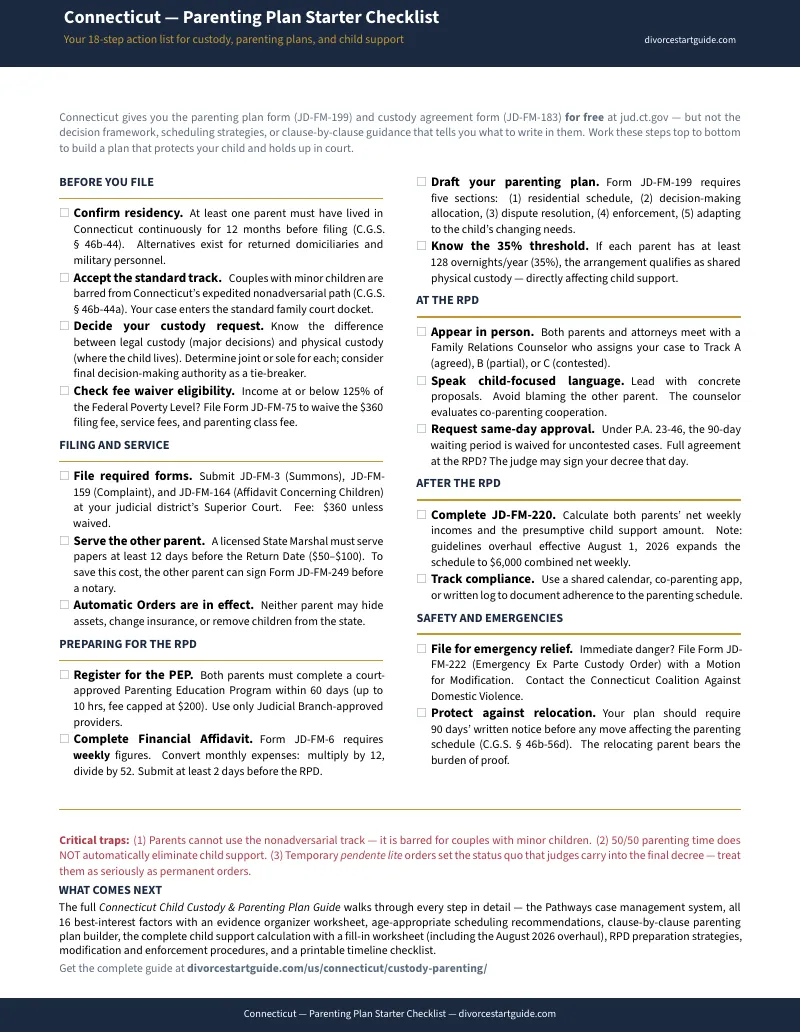
- Free Starter Checklist — an 18-item parenting plan starter checklist covering custody basics, filing deadlines, required documents, and PEP class registration — yours to keep whether or not you get the full guide.
Who this is for
The parent who just received their Resolution Plan Date notice and has no idea what a Family Relations Counselor is about to ask. The self-represented filer who downloaded Form JD-FM-199 from the court website and realized the blank boxes don't come with instructions. The cooperative couple who assumed they could use the nonadversarial track and just discovered they can't — and now need to prepare a joint custody agreement that a judge will accept on consent. The parent running the overnight math to see whether their proposed schedule crosses the 128-overnight threshold for shared physical custody — and what dropping below it means for child support. And the parent with an existing custody order who needs to understand whether a job change, relocation, or new school enrollment qualifies as a "substantial and material change in circumstances" that supports a modification.
Why not just use the free resources?
Because free resources give you definitions, not decisions. The Connecticut Judicial Branch provides blank forms and basic filing instructions. CT Law Help explains the difference between legal and physical custody in general terms. Statewide Legal Services can tell you about fee waivers and income thresholds. Law firm blogs discuss the best-interest factors in language designed to get you to call for a $400-per-hour consultation. None of them give you a worksheet that maps your specific week across two households and calculates whether you meet the 35% overnight threshold. None provide RPD preparation guides for organizing your position before you sit across from a Family Relations Counselor. None walk you through the child support formula with your actual income numbers — or show you exactly how shifting one overnight per week changes your obligation.
The co-parenting apps — Custody X Change at recurring monthly subscriptions, OurFamilyWizard at $110–$300 per year per parent — are built for ongoing schedule tracking and communication logging after an order is in place, not initial plan drafting. They require both parents to sign up and pay, and they don't map the Connecticut-specific Pathways system, RPD process, or mandatory PEP requirements. They are useful tools once you have an agreement. This guide helps you write the agreement.
A straightforward guarantee
Work through the Pathways Navigation System. If the guide doesn't give you a clearer, more organized understanding of Connecticut's custody process than any free government page or blank court form could — email us within 30 days for a full refund. The cost of trying it is a fraction of one attorney consultation. The cost of filing an incomplete or poorly structured parenting plan is a rejected motion, an escalated Pathways track assignment, or months of additional litigation.
For — less than ten minutes of attorney time in Connecticut — you get the scheduling worksheets, the overnight calculations, the RPD preparation tools, the Financial Affidavit converter, and the step-by-step filing roadmap that the blank forms leave out.
Stop guessing what the court expects. Get the guide, build your parenting plan, and walk into your next step — whether that's the RPD, a mediator's office, or the courthouse — with the work already done.