You Have the Forms. You Don't Have the Filing Sequence.
Colorado gives you free, blank divorce forms through the Judicial Branch website. What it doesn't give you is which forms to file first, how the 91-day waiting period actually works, what documents go to the court versus what stays between you and your spouse, or what happens when mandatory financial disclosures are due in 42 days and you haven't started organizing your records.
The Colorado Divorce Filing Process Guide is a court-process navigation system — built specifically for self-represented filers who need the operational sequence, not a pile of JDF forms and a courthouse appointment they're not prepared for.
The Problem With "Free Forms"
Colorado's Self-Help Center and Court Resource Coordinators (called "Sherlocks") do their job well: free, accurate forms and basic procedural direction. But under Chief Justice Directive 13-01, Sherlocks are legally prohibited from giving you strategic advice — they can't tell you whether to file jointly or solo, how to calculate spousal maintenance, or what to do when your spouse refuses to cooperate.
That leaves you with the right forms but no roadmap. You know what to submit — you don't know in what order, by which deadline, or how to handle the financial calculations that trip up most pro se filers.
This guide fills that gap.
What's Inside
Filing Pathway Decision Tree
Sole Petitioner vs. Co-Petitioners — with the specific criteria that determine which track fits your situation. Filing jointly avoids formal service of process and starts the 91-day clock immediately. Filing solo gives you control of the timeline but adds service requirements and a separate response deadline. The guide maps both paths with separate checklists for each.
Residency and Venue Worksheet
Colorado's 91-day domicile rule for adults and the separate 182-day UCCJEA residency requirement for children operate on different timelines. File in the wrong county or before you've met the residency threshold, and your case gets dismissed on jurisdictional grounds. The worksheet confirms eligibility before you pay the filing fee.
91-Day Waiting Period Tracker
Colorado's mandatory cooling-off period can't be shortened or waived — not by agreement, not by a judge, not even if you've been separated for years. The tracker maps exactly when your clock starts (different dates for joint vs. solo filings), what productive steps to complete during the wait, and when you can request your final decree.
Financial Disclosure Workbook
Rule 16.2 requires both spouses to exchange a Sworn Financial Statement (JDF 1111) plus three years of tax returns, three months of pay stubs, bank statements, retirement records, and debt documentation — all within 42 days of filing. Miss the deadline and you face sanctions, adverse presumptions about hidden assets, or contempt charges. The workbook organizes everything before the clock starts, and clarifies the distinction that costs most pro se filers: supporting documents get exchanged between spouses, not filed with the court.
Spousal Maintenance Calculator
Colorado's statutory formula applies to marriages of three or more years with combined income under $240,000. The calculator walks you through the gross-to-net conversion, the post-2018 tax adjustment, and the 40% income cap — step by step, in plain language, so you can negotiate from real numbers instead of guesses.
Service of Process Roadmap
Voluntary waiver (JDF 1013), personal service by sheriff or private process server, and the publication route for a missing spouse. Includes the 21-day response deadline for in-state service, the 35-day deadline for out-of-state service, and the default divorce pathway when your spouse doesn't respond at all.
Separation Agreement and Parenting Plan Checklists
Structured worksheets for JDF 1115 (property and financial agreement) and JDF 1113 (parenting plan) that help you negotiate terms before filling out the official forms — so you're not drafting custody schedules and asset divisions on the spot during a stressful court hearing.
Fee Waiver Eligibility Guide
The $230 filing fee is waivable if your household income is at or below 125% of the federal poverty guidelines, or if you're enrolled in qualifying programs like SNAP, SSI, or TANF. But the application must be filed in person or by mail — not online. The guide covers every eligibility pathway and the paperwork required.
Who This Guide Is Built For
- Self-representing filers who want to handle their own dissolution without paying $10,000–$20,000 in attorney fees or $300–$500 for a document preparation service
- Couples filing jointly who agree on everything but need the exact sequence of forms, signatures, and deadlines to get through the process without tripping the 42-day disclosure deadline
- Sole Petitioners whose spouse won't cooperate, won't respond, or can't be found — and who need to navigate the service, default, and hearing requirements correctly
- Parents with minor children who need to handle the 182-day UCCJEA residency rule, the mandatory parenting class, and the parenting plan requirements
- Filers on a tight budget who qualify for fee waivers and need to understand the income thresholds, application process, and the in-person filing restriction
Why Not Just Use the Free Court Portal?
You should absolutely use the free forms from the Colorado Judicial Branch — this guide is designed to work alongside them.
But consider what the state portal doesn't provide:
- No filing sequence — forms are grouped by topic, not arranged in the order you actually need them
- No deadline tracking — the 42-day financial disclosure requirement isn't explained on most form pages, and missing it triggers serious consequences
- No calculation help — the Sworn Financial Statement asks for numbers, but nothing walks you through organizing three years of records or running the maintenance formula
- No default pathway support — if your spouse doesn't respond, the self-help materials assume both parties are cooperating
- No worksheet prep — the official forms ask for final decisions on property, debts, and parenting, but nothing helps you reach those decisions before you start filling in the blanks
The official forms give you the bricks. This guide gives you the blueprint for assembling them into a completed case — filed correctly the first time.
Satisfaction Guarantee
If the guide doesn't give you a clearer understanding of your filing path within 24 hours of download, email us for a full refund. No forms to fill out, no hoops.
— Less Than One Hour of an Attorney's Time
Colorado family law attorneys charge $250–$400 per hour. Document preparation services run $300–$500 just to type your information onto the same free court forms. This guide gives you the complete filing sequence, financial disclosure workbook, and maintenance calculator for a fraction of what you'd spend on a single consultation — and you can reference it every time you hit a procedural question.
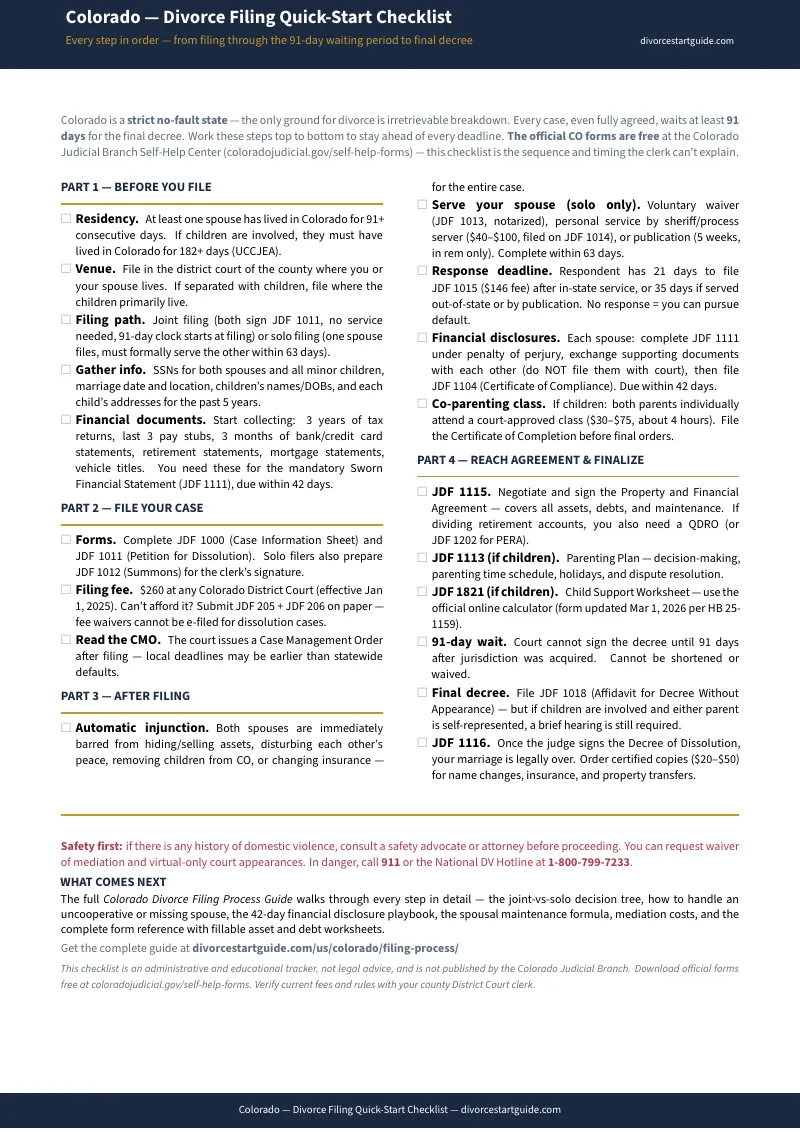
The free checklist gives you the quick-start overview. When you're ready for the full filing instructions, financial disclosure workbook, maintenance calculator, and 10 standalone printable worksheets — the complete guide is here.