
Colorado's court forms ask for your parenting plan. They don't tell you how to build one.
You've found the JDF 1113 — Colorado's official ten-page Parenting Plan form that becomes a binding court order the moment a judge signs it. And you've discovered the problem: the form has blank fields for your residential schedule, your decision-making arrangement, your holiday rotation, your summer plan, your exchange logistics, and your overnight calculation. But it doesn't tell you how to structure a schedule where every overnight now scales your child support credit under the 2026 graduated system. It doesn't tell you how to prepare for court-ordered mediation — or how to invoke the domestic violence exception under C.R.S. § 13-22-311 if mediation isn't safe. And it doesn't explain whether a 2-2-3 rotation or a 5-2-2-5 schedule fits your child's developmental stage, your commute, and your co-parent's work pattern.
Meanwhile, a family law attorney in Colorado charges $300–$500 per hour. A $3,500 retainer buys you roughly ten hours. Two or three of those hours go to your lawyer asking you questions you could have answered yourself — if someone had told you what the questions were and how to think through the answers.
You don't need someone to write your parenting plan for you. You need to know what the court expects before you sit down to draft it.
The Parenting Plan Navigation System
This is a complete, step-by-step guide to building a parenting plan in Colorado — designed for the specific statutes, court forms, and procedural rules that make this state different from every other. It is not legal representation and it does not file your papers. It is the planning and structuring intelligence that the blank JDF 1113 leaves out.
At its core is the Parenting Plan Navigation System — a structured method that walks you from "I know we need a schedule but I don't know what the court expects" to a comprehensive, child-focused agreement that meets the best-interests standard under C.R.S. § 14-10-124. It handles the part everyone gets wrong: understanding that Colorado retired the words "custody" and "visitation" entirely and replaced them with Allocation of Parental Responsibilities — so you don't signal to the judge that you haven't done your homework. Calculating how your proposed schedule translates into overnight credits under the March 2026 child support overhaul, which eliminated the old 93-overnight cliff effect and replaced it with a graduated system that scales from the first overnight. Preparing for mandatory mediation with organized, child-focused arguments. And building modification-proof plan language for holidays, relocation, and communication protocols so you don't end up back in court six months from now.
What's inside — the 15-chapter guide, 7 standalone worksheets, and the free checklist
- JDF 1113 Section-by-Section Walkthrough — a dedicated chapter that maps every section of the official Parenting Plan form to the decisions you need to make: regular schedule, holiday alternation, summer parenting time, transportation and exchanges, communication rules, dispute resolution, and the Line 13 overnight calculation that directly connects to child support. Because "we'll split time 50/50" is not what the form asks for.
- 2026 Child Support Overhaul Explained — walks you through the new unified calculation that replaced the old Worksheet A / Worksheet B system on March 1, 2026. Covers the graduated parenting-time credit that scales from the first overnight (eliminating the 93-overnight cliff), the expanded $40,000 combined monthly income cap, the self-support reserve floor, income imputation rules, and the daytime care deviation. Because under the old system, parents fought over a single overnight — the new system rewards cooperation.
- Best-Interests Factor Breakdown — the nine statutory factors for parenting time and three additional factors for decision-making allocation under C.R.S. § 14-10-124, explained with practical examples of what judges actually look for. Covers past patterns of involvement, the friendly-parent doctrine, geographic proximity, and the child's own preferences. Includes what the court cannot consider — gender, paternity testing requests, and leaving home to escape abuse.
- Schedule Templates by Developmental Stage — age-appropriate parenting-time patterns from infancy through adolescence: 2-2-3 rotations for young children who need frequent contact, 5-2-2-5 for school-age consistency, alternating weeks for older children, and primary-residence schedules when parents live more than thirty minutes apart. Each template includes overnight counts and transition guidance. Because a schedule that works for a four-year-old fails a fourteen-year-old.
- Court Filing Roadmap — step-by-step from initial petition through final orders. Covers the 91-day mandatory waiting period for divorce cases, the 182-day UCCJEA residency rule for children, service of process via JDF 1414(b), the mandatory Initial Status Conference within 42 days, financial disclosures under Rule 16.2, electronic filing through the CCE system, and fee waiver eligibility. Both divorce and standalone APR paths covered.
- Mediation Preparation — structured preparation for court-ordered mediation through the Office of Dispute Resolution. Covers what to bring, how to frame proposals in child-focused language, and what to expect. Includes the domestic violence exception under C.R.S. § 13-22-311 — when you can object to mediation and how to invoke the statutory protection.
- Safety Planning and Emergency Restrictions — protocols for emergency motions to restrict parenting time under C.R.S. § 14-10-129(1.3)(a), the fourteen-day expedited hearing timeline, mandatory supervised parenting time during the pending period, and the legal presumption against joint decision-making under C.R.S. § 14-10-124(1.5)(a)(III.5) when domestic violence is found. Because high-conflict cases require the most precise preparation.
- Modification Guide — the substantial-and-continuing-change standard for parenting-time modifications, the heightened endangerment standard for changing the primary residential parent, the two-year waiting period and its exceptions, and the required forms (JDF 1406 or JDF 1423 plus updated JDF 1113). Covers the 10% threshold for child support recalculation under the 2026 rules.
- Court-Appointed Experts Explained — what a Child and Family Investigator (CFI), Parental Responsibilities Evaluator (PRE), and Child's Legal Representative (CLR) actually do, how they're appointed, what they cost, and how to prepare for their investigation. Because understanding who the court sends into your home changes how you prepare.
- Co-Parenting Communication Templates — ready-to-use plan clauses for designated communication channels, response-time requirements, emergency contact procedures, and the BIFF standard (Brief, Informative, Friendly, Firm). Includes guidance on court-approved platforms like OurFamilyWizard, TalkingParents, and AppClose.
- Costs Worksheet — a realistic breakdown of filing fees ($230), parenting class costs ($30–$110), mediation fees, CFI/PRE costs, and attorney rates. Includes fee waiver eligibility under JDF 205 and strategies for minimizing professional fees by arriving prepared.
- Official Forms Directory — a reference listing of every JDF form referenced in the guide, what it does, and when you need it. From JDF 1001 (Petition) through JDF 1113 (Parenting Plan), JDF 1111 (Sworn Financial Statement), and JDF 1406 (Motion to Modify).
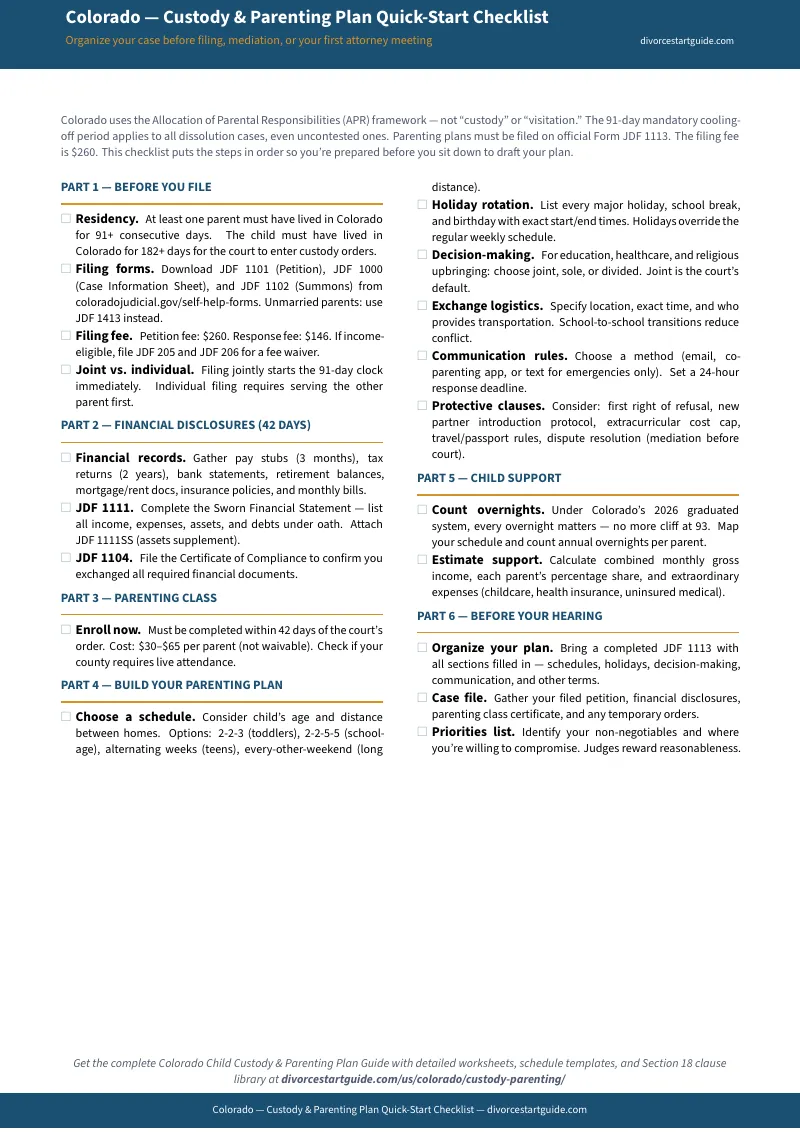
- Parenting Plan Starter Checklist — the free lead magnet. A standalone checklist covering the 20 items your parenting plan must address before you file or walk into mediation. Start here to see exactly what the full guide covers in depth.
7 standalone printable worksheets (included with the full guide)
- JDF 1113 Section-by-Section Walkthrough — print this and work through it alongside the blank Parenting Plan form. Every section mapped to the decisions you need to make, with space for your answers.
- Parenting Schedule Comparison Card — side-by-side comparison of 2-2-3, 5-2-2-5, alternating weeks, and other patterns with age-based guidance and overnight counts.
- Holiday and Vacation Rotation Planner — fill-in worksheet for your alternating holiday schedule, summer arrangement, and transition times.
- Child Support Preparation Worksheet — step-by-step income calculation, overnight count, and extraordinary expenses under the 2026 graduated system.
- Co-Parenting Communication Templates — the BIFF standard, platform comparison, and six ready-to-use clauses for your JDF 1113 Section 18.
- Mediation Preparation Sheet — what to bring, your positions worksheet, and the domestic violence exception procedure.
- Colorado JDF Forms Quick Reference — every form referenced in the guide with its purpose, plus the filing path for both married and unmarried parents.
Who this is for
The parent who just learned that Colorado calls it "Allocation of Parental Responsibilities," not custody — and needs to understand what that means for their court forms and their hearing. The self-represented filer preparing JDF 1113 who needs a parenting plan that won't get sent back for missing required sections. The parent heading into court-ordered mediation who wants to arrive with a draft schedule, organized overnight counts, and child-focused arguments — so the mediator's session reflects their preparation, not their panic. The unmarried parent who needs to file a standalone APR case and can't find instructions that aren't written for divorce. The parent recalculating child support under the 2026 rules who needs to understand how the new graduated overnight credit actually works. And the parent with an existing order that no longer fits because the children are older, school schedules changed, or one parent needs to relocate.
Why not just use the free resources?
Because free resources give you forms, not decisions. The Colorado Judicial Branch Self-Help Center provides the blank JDF 1113 and basic filing instructions. But it does not tell you how to structure an alternating holiday schedule that accounts for winter break, spring break, and three-day weekends. It does not explain how the March 2026 child support overhaul changes your overnight calculation. It does not prepare you for what happens in a mediation session. It provides the blank form. This guide provides the strategic preparation you complete before you fill it out.
The co-parenting apps — OurFamilyWizard at $110–$300 per year per parent, Custody X Change at $120–$480 per year — are built for ongoing communication logging and schedule tracking after you already have an agreement. They require both parents to pay, both parents to participate, and they don't address Colorado's specific APR terminology, JDF forms, or 2026 child support changes. They are useful tools once you have a plan. This guide helps you write the plan.
An honest guarantee
Work through the Parenting Plan Navigation System. If the guide doesn't make your parenting plan clearer, better organized, and more court-ready than any free government form or generic national kit could — email us at any time for a full refund. The risk of trying it is a fraction of one mediation session. The risk of filing an incomplete JDF 1113 is a judge rejecting your plan, a mediator filling in the gaps for you, or a child support calculation based on numbers you didn't understand.
For — less than ten minutes of attorney time — you get the JDF 1113 walkthrough, the 2026 child support formula explained, the schedule templates, the mediation preparation, and the step-by-step filing roadmap that the blank court forms leave out.
Stop guessing what the court expects. Get the guide, build your parenting plan, and walk into your next step — whether that's mediation, a lawyer's office, or the courthouse filing window — with the work already done.