California's court forms ask for your parenting plan. They don't tell you how to write one.
You've found the Judicial Council forms — the FL-300 Request for Order, the FL-341 Custody and Visitation Order Attachment, the FL-355 Stipulation. And you've discovered the problem: the forms have blank boxes for your parenting schedule, your decision-making arrangement, and your holiday rotation. But they don't tell you how to structure a schedule where your timeshare percentage directly determines your child support obligation. They don't tell you how to prepare for the mandatory CCRC mediation session where, in a recommending county, a counselor you've never met will write a custody recommendation to the judge. And they don't explain whether a 2-2-3 rotation or an alternating-week schedule is the right fit for your child's developmental stage and your commute pattern.
Meanwhile, a family law attorney in California charges $250–$600 per hour. A $5,000 retainer buys you roughly fifteen hours. Two or three of those hours go to your lawyer asking you questions you could have answered yourself — if someone had told you what the questions were and how to think through the answers.
You don't need someone to write your parenting plan for you. You need to know what the court expects before you sit down to draft it.
The Custody Navigation System
This is a complete, step-by-step guide to building a parenting plan in California — designed for the specific rules, formulas, and court processes that make this state different from every other. It is not legal representation and it does not file your papers. It is the planning and structuring intelligence that the blank court forms leave out.
At its core is the Custody Navigation System — a structured method that walks you from "I know we need a parenting schedule but I don't know what the court expects" to a comprehensive, child-focused agreement that meets the best-interests standard under Family Code Section 3011. It handles the part everyone gets wrong: calculating how your proposed schedule translates into the timeshare percentage that drives the guideline child support formula. Preparing for your mandatory CCRC mediation with organized, child-focused arguments — not emotional accusations. Understanding whether you're in a recommending or confidential county and what that means for how your mediator's role works. And building modification-proof plan language for holidays, relocation notices, and communication protocols so you don't end up back in court six months from now.
What's inside — the 17-chapter guide, 8 standalone worksheets, and the free checklist
- Parenting Plan Drafting Worksheet — a standalone fillable that turns vague "we'll share time" into a documented, week-by-week schedule with overnight counts. Covers your regular weekly rotation, holiday alternation using the Form FL-341(C) structure, summer and school-break schedules, decision-making authority across education, healthcare, religion, and extracurriculars, and transition logistics including exact times and locations. Because "we'll figure it out" is not enforceable language.
- Child Support Preparation Worksheet — walks you through the statewide uniform guideline formula: CS = K × [HN − (H%)(TN)]. Calculates your net disposable income, maps your parenting schedule to the critical timeshare percentage, and tallies mandatory add-ons for childcare and uninsured medical costs plus discretionary add-ons for extracurriculars and travel. SB 343 updates included. Because the difference between a 30% and a 35% timeshare can be hundreds of dollars per month.
- CCRC Mediation Preparation Chapter — the most anxiety-producing step in a California custody case gets its own dedicated preparation system. Covers recommending vs. confidential county classifications (with a county-by-county reference), the five rules of child-focused framing, a documentation checklist for school schedules, work calendars, and travel times, and what to expect in the 30-minute session. Because a CCRC counselor's recommendation is often the single most influential document in a contested case.
- Age-Appropriate Schedule Builder — developmental stage templates from infancy through adolescence with specific rotation patterns, overnight calculations, and transition guidance. Explains why infants and toddlers need frequent, shorter visits to build secure attachment, why school-age children need consistent weekday routines, and why teenagers need schedule flexibility. Includes a timeshare percentage calculator so your schedule aligns with your child support position.
- Safety Planning and DV Provisions — structured protocols for invoking the Family Code Section 3044 domestic violence presumption, requesting supervised visitation under Form FL-341(A), obtaining a Domestic Violence Restraining Order (DVRO), and building corroborated evidence packages from police reports, CPS records, therapist letters, and communication histories. Because high-conflict cases require the most precise preparation — not emotional accusations.
- Modification and Post-Judgment Guide — the Montenegro v. Diaz "substantial change of circumstances" standard explained with concrete examples: what qualifies (relocation, parental relapse, severe alienation, developmental milestones) and what doesn't (scheduling inconveniences, general dissatisfaction). Includes filing procedures for the Request for Order (Form FL-300) and evidence organization worksheets.
- Court Filing Roadmap — step-by-step reference covering residency requirements, petition filing, service of process, the six-month waiting period, mandatory financial disclosure, and fee waiver applications (Forms FW-001 and FW-003). County-specific filing fee ranges included.
- Communication Protocol Templates — ready-to-use plan language for co-parenting communication rules: designated apps, response-time requirements, emergency contact procedures, and the enforceable boundaries that keep text-message arguments out of your children's daily life. Includes guidance on court-approved logging tools like OurFamilyWizard and TalkingParents.
- California Case Law Reference — the landmark decisions that control how judges actually rule: Montenegro v. Diaz (modification standard), Burgess (relocation presumption), LaMusga (detriment analysis for move-aways), and Burchard v. Garay (initial custody decisions). Because knowing what the statute says is not the same as knowing how judges apply it.
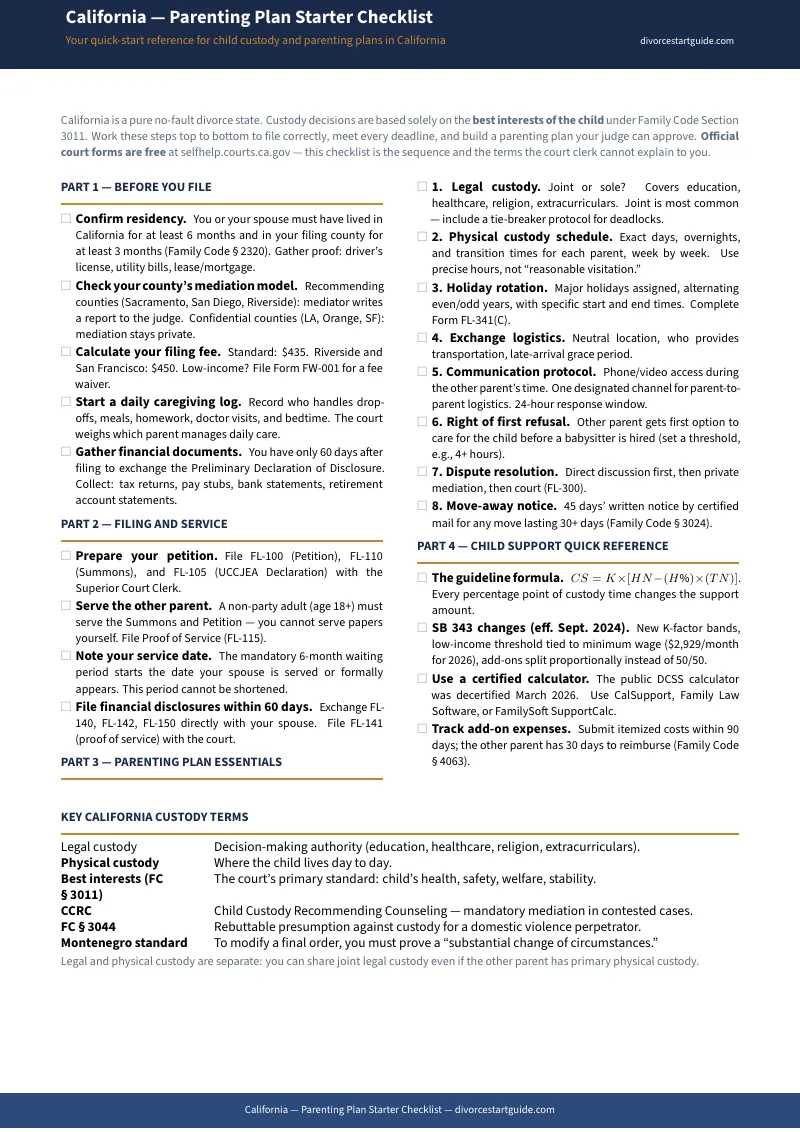
- Parenting Plan Essentials Checklist — the free lead magnet. A standalone one-page checklist covering the 20 items your parenting plan must address before you walk into mediation or file with the court. Start here to see exactly what the full guide covers in depth.
Who this is for
The parent who just discovered that California has no automatic presumption for or against joint custody — and needs to understand how the judge will actually decide. The self-represented filer preparing a Stipulation and Order (Form FL-355) who needs a parenting plan that won't get sent back for missing elements. The parent heading into mandatory CCRC mediation who wants to arrive with organized, child-focused arguments and a draft schedule already mapped — so the counselor's recommendation reflects their preparation, not their anxiety. The parent calculating whether a proposed 2-2-5-5 schedule puts their timeshare percentage at a level that makes financial sense. And the parent with an existing final order that no longer works because the children are older, school schedules have changed, or one parent needs to relocate.
Why not just use the free resources?
Because free resources give you definitions, not decisions. The California Judicial Council self-help portal provides excellent, accurate form definitions and filing instructions. But it does not tell you how to structure an alternating holiday schedule, how to calculate your timeshare percentage for child support purposes, or how to present your case during a 30-minute CCRC mediation session. It provides forms. This guide provides the strategic preparation you complete before you fill them out.
The co-parenting apps — OurFamilyWizard at $150–$300 per year per parent, Custody X Change at $97–$480 per year — are built for ongoing communication logging and schedule tracking, not initial plan drafting. They require both parents to pay, both parents to participate, and they don't address the California-specific CCRC process, county-by-county mediation models, or the timeshare-to-support formula. They are useful tools after you have an agreement. This guide helps you write the agreement.
An honest guarantee
Work through the Custody Navigation System. If the guide doesn't make your parenting plan clearer, better organized, and more court-ready than any free government page or blank Judicial Council form could — email us within 30 days for a full refund. The risk of trying it is a fraction of one mediation session. The risk of filing an incomplete parenting plan is a CCRC recommendation written without your preparation and a support calculation based on numbers you didn't understand.
For — less than fifteen minutes of attorney time — you get the scheduling worksheets, the child support formula walkthrough, the CCRC preparation system, and the step-by-step filing roadmap that the blank forms leave out.
Stop guessing what the court expects. Get the guide, build your parenting plan, and walk into your next step — whether that's mediation, a lawyer's office, or the courthouse filing window — with the work already done.