Northern Ireland's Divorce System Is Paper-Based, Fault-Based, and Unforgiving of Mistakes
While England and Wales moved to a no-fault online portal in 2022, Northern Ireland still runs on typed paper petitions, fault-based grounds, and the Matrimonial Office in Belfast. There is no digital filing system for personal petitioners. Every form must be typed — the court rejects handwritten petitions outright. The conditional deletion rules are dense. The fee waiver process requires a separate application for each individual charge. And if your spouse refuses to sign the Acknowledgement of Service, the whole case stalls unless you know the procedural workaround.
Most people discover this the hard way: a rejected petition, weeks of delay, and the sinking feeling that they need to hire a solicitor at £200–350 an hour just to decode the paperwork.
The Personal Petitioner Filing System
The Northern Ireland Divorce Filing Process Guide is a step-by-step process navigation system built specifically for personal petitioners filing without a solicitor. It does not sell court forms — those are free from the Department of Justice. It sells the sequence, the formatting rules, and the conditional logic that the blank forms do not explain.
The guide walks you through the exact order of operations from eligibility verification to the Decree Absolute, with worksheets and checklists at every stage where the paperwork can trip you up.
What's Inside
The full kit includes 12 PDFs — a 17-chapter process guide plus 10 standalone printable worksheets and reference cards you can bring to the Matrimonial Office, pin to your fridge, or fill in at the kitchen table.
- Complete process guide (guide.pdf) — 17 chapters covering eligibility, grounds selection, Form M1 formatting, process service, the court hearing, fees, ancillary relief, children's arrangements, and post-divorce admin
- Jurisdiction verification worksheet — confirm the two-year marriage bar and map your residency addresses for Form M1 paragraph 3
- Ground selection decision chart — identify which of the five statutory facts applies to your situation, with same-roof separation evidence tracking
- Document preparation checklist — tick off every form, certificate, and payment before visiting the Matrimonial Office
- Form M1 formatting reference — paragraph-by-paragraph typing rules, conditional deletion checklist, and the common mistakes that get petitions rejected
- Process service methods reference — the three valid service methods, the deemed service fallback, and a tracking log for dates and reference numbers
- Court fee schedule and ER1 tracker — post-April 2026 fees for County Court and High Court, plus a tracker for filing separate Form ER1 waiver applications at each fee stage
- Cost planning worksheet — estimate your total costs across court fees, documents, service, and optional items before you begin
- Full process tracker — an 18-step checklist tracking every milestone from eligibility through the Decree Absolute, with a key dates summary
- Key contacts and resources — Matrimonial Office details, official form download URLs, support services, and government portals on one printable page
- Post-divorce admin checklist — government agencies, financial updates, pension notifications, and name change options to complete after the Decree Absolute
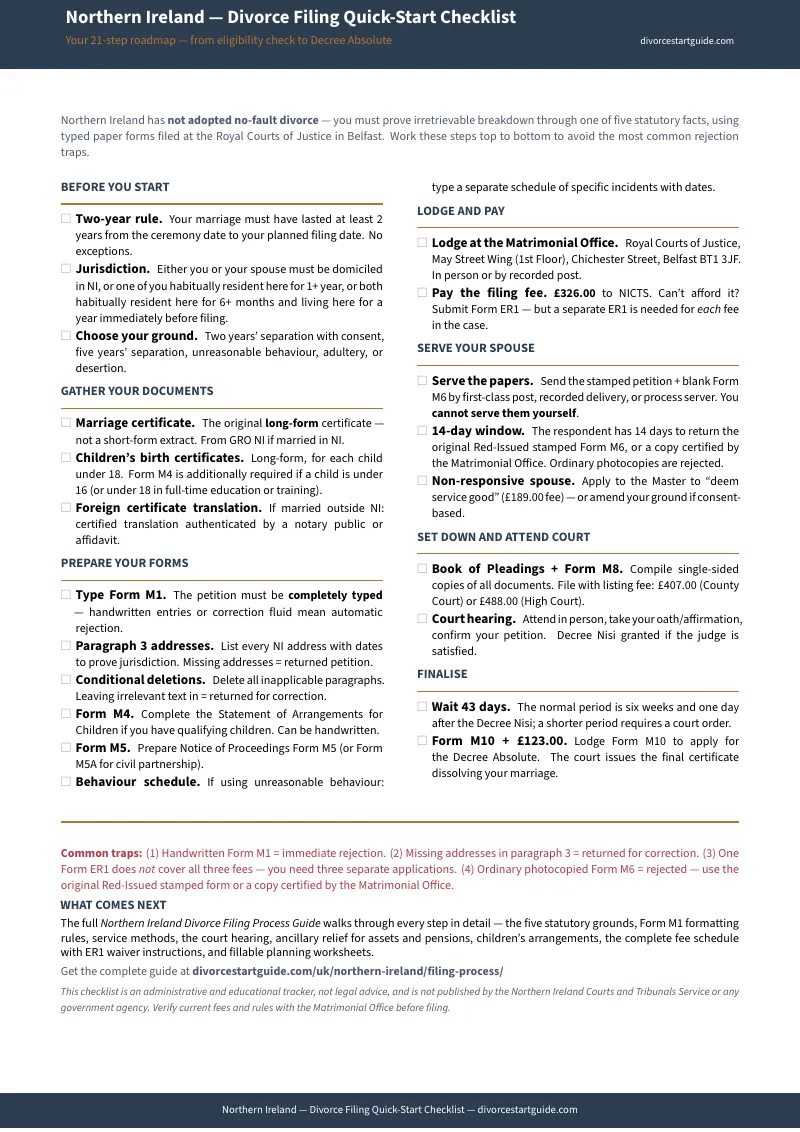
- Quick-start filing checklist (checklist.pdf) — the condensed filing sequence in one page, also included as the free download
Who This Is For
- You and your spouse broadly agree the marriage is over, and you want to handle the filing yourselves
- You want to avoid solicitor fees (£1,500–4,000+ per person) on a case that does not need full legal representation
- You have already tried reading the government forms and found them confusing — the conditional paragraphs, the deletion rules, the fee structure
- You want a sequential process map that tells you what to do next at every stage, not a collection of disconnected fact sheets
Why Not Just Use the Free Government Forms?
The Department of Justice provides blank Forms M1 through M8 and a brief administrative overview. These are the forms you will file — they are free, and you should download them.
What they do not provide is the step-by-step sequence for completing them. The Form M1 petition has conditional paragraphs where you must delete specific lines depending on whether you have children, prior court orders, or active child support cases. Get one deletion wrong and the Matrimonial Office returns the entire package. The fee waiver system requires a separate, fully documented Form ER1 for each fee stage — not a single blanket application. And if your spouse will not cooperate with service, the official guidance does not walk you through the deemed service application process.
This guide covers the part between "download the forms" and "lodge the papers" — the process navigation that free resources leave out.
Generic UK Divorce Kits Do Not Work in Northern Ireland
Online DIY divorce services like LegalZoom, Rocket Lawyer, and "quickie divorce" portals are built around the England and Wales no-fault system — digital applications, no grounds to prove, and Conditional Orders instead of Decree Nisi. Their templates do not comply with Northern Ireland's paper-based, fault-based rules. Filing with the wrong forms or terminology will get your petition rejected.
Satisfaction Guarantee
If the guide does not give you a clear, sequential understanding of the Northern Ireland divorce filing process, email us and we will refund your purchase — no questions, no conditions.
Get Started
Download the free Quick-Start Checklist to see how the process breaks down — eligibility, grounds selection, and the 2026 fee schedule in one page. Ready for the full system? The complete Northern Ireland Divorce Filing Process Guide gives you the step-by-step filing sequence, formatting rules, worksheets, and checklists for — a fraction of a single hour of solicitor time.