Blank Court Forms Are Free. Knowing How to Fill Them In Is Not.
You and your spouse broadly agree on how to split things. Or maybe you don't agree yet, but you want to negotiate from a position of evidence rather than emotion. Either way, you're looking at the same problem: England's financial remedy process doesn't come with instructions.
GOV.UK gives you blank Form E and Form D81 templates. It doesn't tell you how to value a defined-benefit pension against home equity. It doesn't explain why the judge will reject your Consent Order if you leave out a Clean Break clause. It doesn't show you the difference between a Mesher order and a Martin order when neither of you can afford to buy the other out of the family home.
Solicitors charge £200–£400 per hour to walk you through this. A basic Consent Order drafting service runs £269–£599 before you've even negotiated the terms. Contested court proceedings can escalate to £10,000–£30,000 per person.
The Financial Remedy Preparation System
This guide gives you the preparation framework that solicitors use — structured into worksheets you complete yourself before you spend a single billable hour. It covers every decision point in the financial split: what counts as matrimonial versus non-matrimonial property, how to handle the family home when children are involved, the mechanics of pension sharing versus offsetting, debt allocation rules, spousal maintenance factors, and the Capital Gains Tax changes that took effect in April 2023.
Built specifically for the English legal system under the Matrimonial Causes Act 1973 and the Divorce, Dissolution and Separation Act 2020. No American community property rules. No QDROs. No advice that doesn't apply in your jurisdiction.
What's Inside
The complete 13-chapter guide plus 10 standalone printable worksheets you can take to your solicitor, mediator, or negotiation meeting:
- The Financial Remedy Roadmap — the exact sequence of steps from initial disclosure through sealed Consent Order, showing what to do during the 20-week reflection period and what must wait until after the Conditional Order
- Section 25 Self-Assessment — walk through every statutory factor a judge will use to evaluate whether your split is "fair," so you can build a proposal that survives judicial scrutiny the first time (standalone worksheet included)
- Asset Classification Worksheet — classify each asset as matrimonial or non-matrimonial property, applying the Standish v Standish rules on commingling and needs invasion
- Complete Asset & Debt Inventory — fillable tables for bank accounts, property equity, pension CETVs, investments, vehicles, and liabilities — structured to mirror Form D81 so you can transfer figures directly (standalone worksheet included)
- Family Home Decision Framework — compare transfer of equity, sale and split, Mesher order, and Martin order side by side, with mortgage capacity calculations to test whether one spouse can realistically take over the payments alone (standalone worksheet included)
- Pension Division Worksheet — compare Pension Sharing Orders, offsetting, and Pension Attachment Orders with worked examples, including how to account for provider implementation fees (£2,000–£3,500 for defined-benefit schemes like NHS and Teachers' Pensions)
- Debt Allocation Worksheet — classify joint vs sole debts, matrimonial vs non-matrimonial, and plan your credit protection steps
- Spousal Maintenance Assessment — the factors the court considers, the Clean Break presumption, and how to calculate reasonable needs versus earning capacity (standalone worksheet included)
- CGT Tax Planning Checklist — the three-year no-gain/no-loss transfer window and unlimited timeframe for court-ordered transfers, so you don't trigger a tax bill by transferring assets in the wrong sequence
- Settlement Proposal Worksheet — build your proposal by asset category, test it against the judge's lens, and choose your negotiation channel
- Consent Order Preparation Blueprint — convert your informal agreement into structured instructions a solicitor can draft from in under an hour, instead of three (standalone worksheet included)
Who This Is For
- You're dividing finances in an England divorce and want to do the groundwork yourself before instructing a solicitor
- You and your spouse are negotiating directly or through mediation and need structured frameworks to guide the conversation
- You have property, pensions, or debts to divide and want to understand your options before someone else tells you what's "fair"
- You're worried about the Consent Order being rejected by a judge and want to catch the common rejection triggers before you submit
- You're a higher earner concerned about open-ended spousal maintenance, or a lower earner worried about being pressured into an unfair split
Why Free Tools Won't Get You There
GOV.UK gives you blank forms — no guidance on how to complete them correctly. Online forums are full of pre-2022 advice that doesn't account for the no-fault divorce changes. Generic "how to divide assets in divorce" articles from US legal sites reference community property, equitable distribution formulas, and QDROs — none of which exist in English law.
Fixed-fee Consent Order services (£269–£599) draft the legal document, but they don't help you decide what goes into it. You arrive at the drafting appointment and someone asks "how do you want to split the pensions?" — and if you don't have a structured answer, you're either guessing or paying a solicitor £300 per hour to figure it out for you.
This guide fills the gap between free blank forms and expensive professional advice. You do the analytical preparation work yourself, arrive at negotiation or drafting with evidence-based positions, and cut the billable hours it takes to reach a sealed order.
The Free Checklist vs. The Full Guide
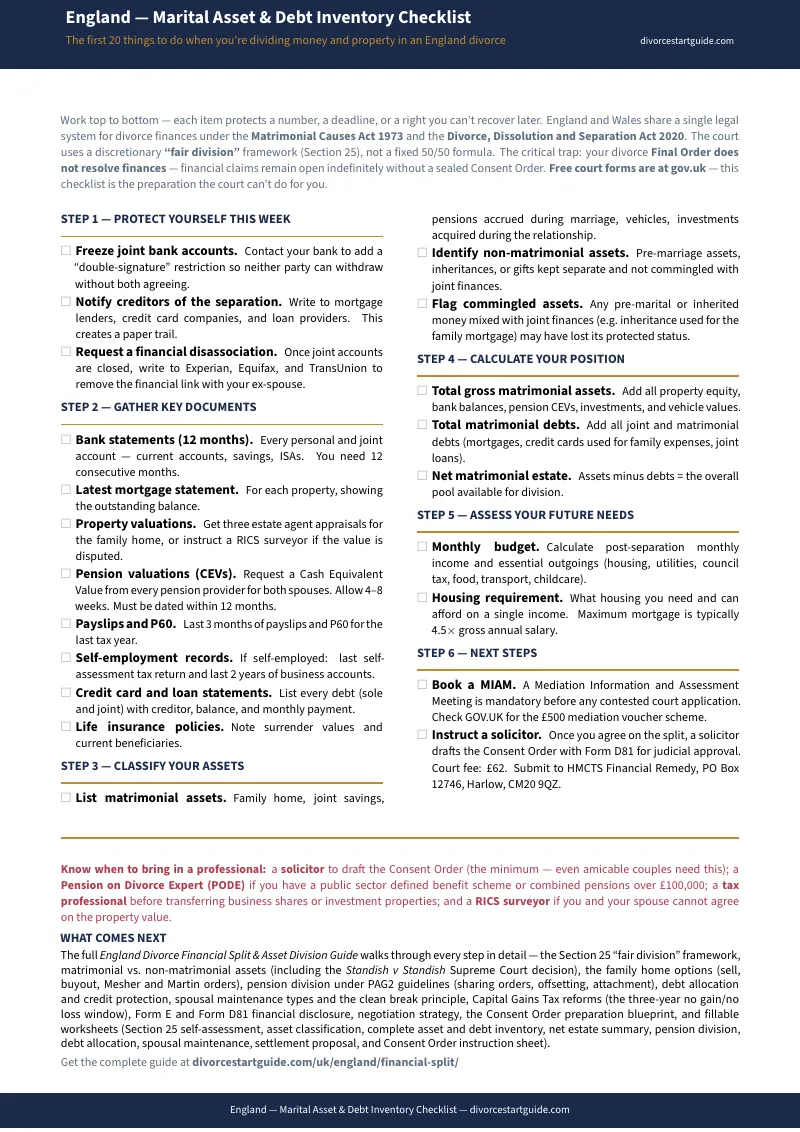
The free checklist is a 20-item inventory covering the immediate protective steps, documents to gather, and a simplified net-position calculation. It's enough to get organised during the first weeks of separation.
The full guide goes deeper on every front: 13 chapters covering the financial remedy process, Section 25 framework, matrimonial vs. non-matrimonial asset classification, all four family home options, pension sharing mechanics with worked calculations, debt allocation, spousal maintenance, CGT rules, Form E and D81 disclosure, negotiation strategy, and a complete Consent Order preparation blueprint. Plus fillable worksheets for every major decision point.
Download the free checklist to start organising your finances tonight. When you're ready for the complete preparation system, the full guide is — less than fifteen minutes of a solicitor's time.
Frequently Asked Questions
What if the rules change after I buy?
We update the guide when the rules change. Email us any time, even years later, and we'll send you the current edition free.