
Your divorce is governed by your state. Your pension, your housing, and your benefits are governed by federal law. The gap between those two systems is where military families lose the most.
You called JAG. They gave you a solid overview and told you they can't represent you in court. You searched online and found a hundred articles about the 10/10 rule — half of them wrong. You talked to a civilian divorce attorney who quoted $5,000 to $20,000 and admitted they'd never handled a military pension division order. And your separation date is ticking closer while you still don't know whether filing in your spouse's state or your domicile state will let DFAS actually enforce the pension split.
The problem isn't a lack of information. It's that the information is scattered across Military OneSource factsheets, branch-specific regulations, DFAS forms, and legal blogs written for attorneys — and none of it tells you the order to do things in or what happens when you do them in the wrong order.
A missed SBP "deemed election" deadline costs your former spouse lifetime survivor benefits — permanently. Filing in a state without USFSPA jurisdiction means your divorce goes through but DFAS rejects your pension division order. And not calculating interim support under your branch's regulation before separating can trigger a UCMJ Article 92 violation that threatens your career and clearance.
The Military Divorce Operations Map
This guide is a process-navigation system built specifically for the intersection of federal military law and state family court. It doesn't file your forms — your state court provides those for free. It doesn't replace an attorney in contested cases. What it does is organize the entire military divorce sequence into a chronological workflow with worksheets, calculators, and scripts so you walk into every appointment — JAG, mediator, attorney, or court — already knowing what to ask and what to protect.
At its core is the Military Divorce Operations Map — a structured sequence that takes both service members and military spouses from initial separation through pension division, custody planning, benefit transitions, and post-decree administration. It handles the part that trips up both sides: understanding how SCRA protections interact with state court timelines, calculating the coverture fraction before your spouse's attorney does it for you, and hitting every administrative deadline between the day you separate and the day your DEERS records are updated.
What's inside — 14-chapter guide, 20-item checklist, and 8 standalone worksheets
- Jurisdiction Planner Worksheet — Map your domicile, duty station, and spouse's state to confirm USFSPA pension-division authority before you file. Includes the three-criteria test and a decision matrix so you don't file in the wrong state and lose pension-division enforcement.
- SCRA Protection Coordinator — Understand when and how to invoke the 90-day stay, what documentation your commanding officer needs to provide, and how to coordinate civil court timelines around deployment and training cycles.
- Branch-Specific Interim Support Worksheets — Calculate your temporary support obligations under AR 608-99 (Army), MILPERSMAN 1754-030 (Navy), AFI 36-2906 (Air Force), and MCO P5800.16A (Marines). Protects service members from UCMJ violations and spouses from sudden loss of income.
- Coverture Fraction Calculator — Work through the exact formula DFAS uses: (months of marriage overlapping service ÷ total months of service at retirement) × court-ordered percentage. Walk into mediation with your own numbers.
- Frozen Benefit Rule Checklist — Understand how the 2017 NDAA caps the former spouse's share at the member's rank and years of service on the divorce date. Includes the COLA adjustment timeline and a worksheet for comparing frozen vs. unfrozen values.
- SBP Cost Allocation Templates — Negotiate how to split Survivor Benefit Plan premiums between parties. Covers the one-year "deemed election" deadline that, once missed, permanently forfeits coverage.
- TSP Division Worksheet — Step-by-step guidance for dividing the Thrift Savings Plan using a Retirement Benefit Court Order (RBCO), including the difference between a QDRO and an RBCO and why the wrong document gets rejected.
- Deployment Custody Planner — Build a parenting plan that accounts for substitute visitation, communication schedules, and automatic reversion clauses when the service member returns. Covers state-level protections against using deployment as a negative custody factor.
- BAH and Housing Transition Tracker — Understand how housing allowances shift when you separate, when a non-military spouse must vacate base housing (typically 30 days after divorce), and OCONUS relocation considerations.
- TRICARE and DEERS Transition Checklist — The 20/20/20 and 20/20/15 benefit thresholds, the 60-day CHCBP enrollment window, and the 90-day Qualifying Life Event deadline for DEERS updates.
- Command Notification Scripts — Professional language for informing your CO about a pending separation without jeopardizing your security clearance or triggering unnecessary command involvement.
- Negotiation and Mediation Scripts — Non-confrontational templates for discussing pension splits, BAH allocation, SBP premiums, and custody terms in mediation or informal discussions.
- Post-Decree Administrative Tracker — Every form, every office, every deadline: DEERS update at the ID card office, DD Form 2293 for direct DFAS payments, Social Security name change, driver's license, passport, and TSP division order submission.
- Safety-First Protocols — Domestic Abuse Victim Advocate contacts, Family Advocacy Program (FAP) transitional compensation eligibility, and confidential planning resources for unsafe separations.
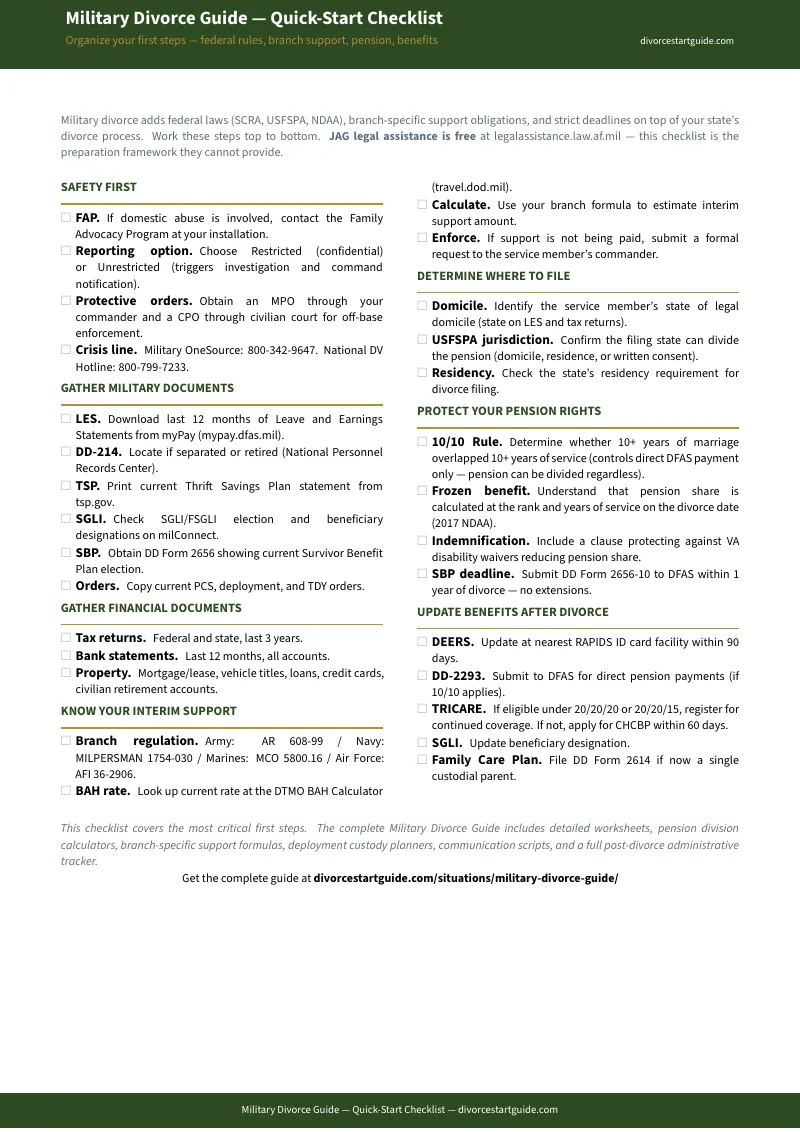
The free checklist gives you the 20-step military divorce sequence at a glance — print it, work through each item, and know exactly where you are in the process.
Who this is for
The active-duty service member who just learned that filing in their spouse's state might mean DFAS rejects the pension order. The military spouse who needs to understand the 20/20/20 rule before the divorce decree is signed. The couple heading into mediation who need a shared framework so both sides are working from the same federal rules. The deploying parent who needs a custody plan that holds up when they're overseas. The recently divorced veteran who has 60 days to enroll in CHCBP and doesn't know the clock is running. And the Guard or Reserve member whose part-time status creates jurisdiction and benefit questions nobody on base seems able to answer.
Why not just use free resources?
Military OneSource gives you a thorough overview of federal rules — but it cannot provide strategic advice, step-by-step filing roadmaps, or advocacy in civilian court. That's a legal limitation, not a criticism. JAG officers offer confidential consultations and can explain your rights clearly — but they can't represent you in court, can't draft divorce pleadings, and can't advise both spouses.
The specialized alternatives are expensive and narrow. QDRO Masters charges $900 for a pension division order — one piece of the puzzle. Custody X Change runs $100 to $200 per year for schedule software. A military divorce attorney retainer starts at $3,800 for uncontested cases and climbs past $20,000 for contested ones. The ABA's Military Divorce Handbook — the attorney-grade reference — costs $199 to $249 and reads like a legal treatise, not a planning tool.
The gap is a guide that costs less than 15 minutes of attorney time, covers every military-specific issue in one place, and gives you worksheets you actually fill in — not just rules you read about.
A straightforward guarantee
Work through the Operations Map. Use the worksheets to organize your case. If the guide doesn't make the military divorce process clearer and more manageable than any free resource, government factsheet, or scattered internet search could — email us at any time for a full refund. The risk is a fraction of one attorney consultation. The risk of navigating this process without a system is a rejected pension order, a missed SBP deadline, or a UCMJ violation you didn't see coming.
For — less than fifteen minutes of attorney time — you get the jurisdiction planner, the pension worksheets, the custody templates, the benefit transition checklists, and the administrative tracker that the free resources leave out.
Stop piecing together military divorce rules from a dozen different sources. Get the guide, follow the sequence, and protect what you've earned.
Frequently Asked Questions
What if the rules change after I buy?
We update the guide when the rules change. Email us any time, even years later, and we'll send you the current edition free.