
You Agreed on Everything. The Court System Doesn't Care.
You and your spouse have already done the hardest work — you've agreed. No custody battle. No hidden accounts. No one's lawyering up. You just need to file the right papers in the right order, show up when the court says, and sign.
Simple? In theory. In practice, you're on your county court's website staring at a seventeen-form filing packet with instructions written by lawyers for lawyers. The forms are free. Understanding what order to file them in, what each one actually requires, and what happens when you get it wrong — that's the expensive part.
Miss a financial disclosure exchange and your case stalls. File your settlement agreement before both parties have been properly served and the court rejects it. Use "shared custody" without specifying pickup times and the judge sends you home to rewrite your parenting plan. Each of these mistakes doesn't just delay your divorce — it adds weeks of court clerk back-and-forth, sometimes hundreds in re-filing fees, and always the emotional toll of a process that should have been finished by now.
The Administrative Workflow Map
The Uncontested Divorce Step-by-Step Roadmap is the process navigator that bridges the gap between blank court forms and a $5,000 attorney retainer. It maps every phase of the uncontested divorce sequence — petition to signed decree — and gives you the worksheets, templates, and checklists to prepare each step before you file it.
This isn't a form generator. It's the chronological workflow that tells you when to file, what to prepare first, and which local rules to verify with your county clerk so nothing gets rejected, delayed, or thrown out.
What's Inside
- 8-Phase Process Map — the complete uncontested divorce sequence from eligibility assessment through post-decree execution, laid out in the order courts actually process them. Each phase tells you what to prepare, which documents to gather, and the specific procedural traps that delay cases at that stage.
- Property & Debt Allocation Worksheets — printable templates for categorizing marital vs. separate property, listing assets with current values, documenting all debts with account numbers, and building the asset-and-debt schedule your settlement needs. Courts require full financial transparency — these worksheets organize it systematically instead of scattering it across kitchen-table conversations.
- Co-Parenting Plan Templates — courts reject vague custody arrangements. These templates produce the specificity judges require: physical custody schedules with exact days and times, legal decision-making authority, holiday and vacation rotation, expense-sharing frameworks, and communication protocols. Designed for both parents to fill out independently, then compare and resolve differences before filing.
- Settlement Agreement Checklist — the comprehensive clause-by-clause checklist that ensures your marital settlement covers every topic courts look for: real property, vehicles, bank accounts, retirement accounts, debts, insurance, tax filing, spousal support, pet custody, digital accounts, and the details that trip up most DIY filers (frequent flyer miles, security deposits, storage units).
- Jurisdiction Quick-Reference Tables — residency requirements, mandatory waiting periods, filing fee ranges, and service-of-process rules for 12 major jurisdictions across the US, Canada, Australia, and UK. Not a replacement for your local court's rules — a reference that tells you exactly which questions to ask your county clerk.
- Service of Process Guide — three valid service methods, when to use each one, what proof-of-service documentation you need, and why the petitioner can never serve the papers themselves. Includes the acceptance-of-service and waiver-of-service paths that save weeks for cooperative spouses.
- Court Hearing Prep — your prove-up hearing takes 10-15 minutes if you're prepared. This section covers what to bring, what the judge asks, how to present your settlement, and the testimony structure most courts expect. Shows up unprepared? The judge reschedules — adding weeks or months.
- Post-Decree Execution Tracker — the guide that doesn't stop at the final hearing. Covers retitling vehicles, refinancing the mortgage, splitting retirement accounts (including when you need a QDRO and what it costs), updating beneficiary designations, closing joint accounts, and completing name changes. A missed post-decree step can cost thousands.
- Amicable Negotiation Scripts — framework language for raising the topics that derail good-faith discussions: who keeps the house, how retirement accounts get split, holiday schedules, expense sharing. Structured to prevent the defensiveness that turns "uncontested" into "contested."
- Safety Planning Chapter — guidance for filing an uncontested divorce when there are safety concerns, including how to use waiver of service without revealing your address, options for courthouse procedures, and when the "amicable" framework should be set aside entirely.
Who This Is For
- Couples who agree on the terms but not the process — you've decided who gets what. This roadmap shows you how to make it legally official: forms, sequence, deadlines, court procedures.
- DIY filers who want to skip the $5,000 retainer — get organized enough that a single one-hour attorney consultation (or no attorney at all) is all you need.
- Parents who need a court-approved co-parenting plan — the templates produce the level of detail judges require, not the vague "we'll share custody" that gets rejected.
- Couples with assets to divide but no system for documenting them — house equity, retirement accounts, credit card debt — the worksheets make the inventory systematic.
- People mid-process who got stuck — filed the petition six months ago? Can't figure out service of process? Settlement agreement missing clauses? This guide picks up wherever you are.
Why Not Just Use Free Court Forms?
You should use the free court forms — they're official and required. This roadmap doesn't replace them. It prepares you for them.
The gap in every court self-help page is the same: they give you blank forms but not the process that connects them. They don't explain that financial disclosures must be exchanged before the settlement is signed. They don't tell you that "service by certified mail" requires a separate proof-of-service form filed at a different stage. They don't warn you that a missing clause in your settlement agreement can force a post-decree modification that costs more than the original filing.
And if you're considering a document-preparation service like LegalZoom ($499+) or Hello Divorce ($100-$3,500), this roadmap works as the preparation layer. Those services generate your forms through a questionnaire — but they don't teach you how to negotiate the terms that go into the forms, or how to manage your case timeline once the forms are filed. Organize with this roadmap first, and you'll move through any automated service faster, with fewer revisions, and with better results.
Satisfaction Guarantee
If the roadmap doesn't help you organize your divorce process, email us for a full refund. No hoops, no deadlines.
Get the Full Roadmap — or Start With the Free Checklist
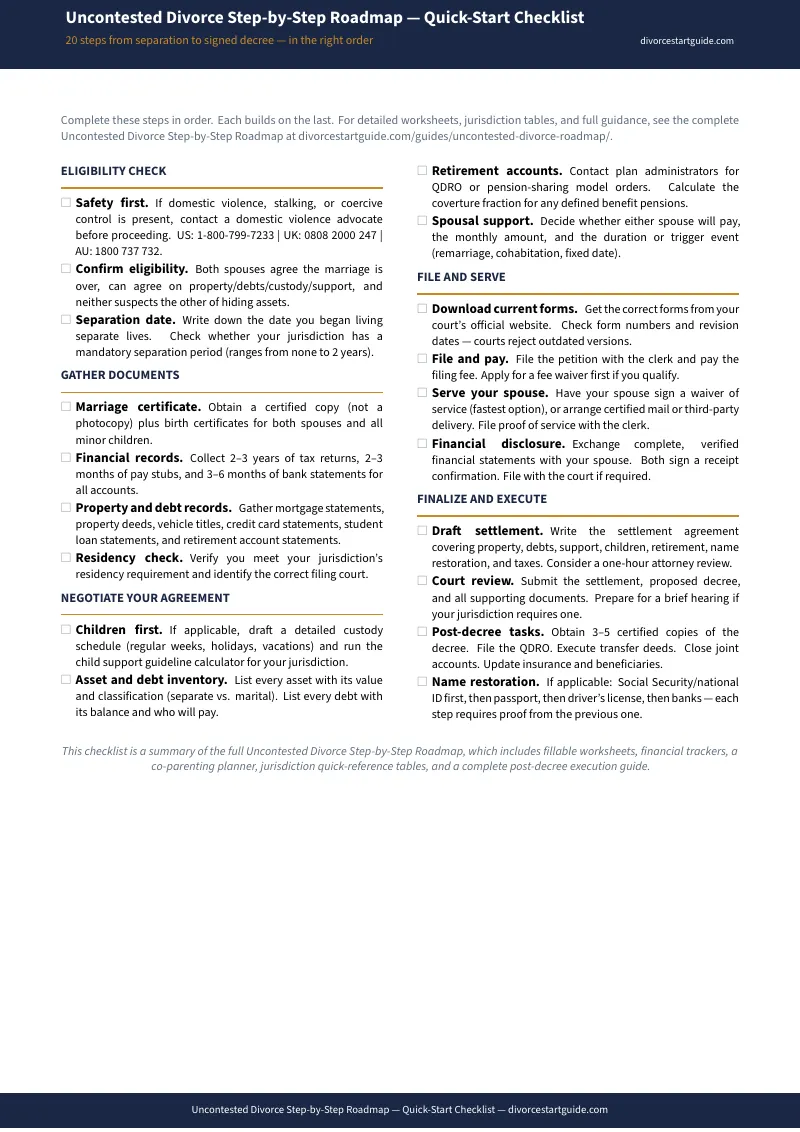
The free checklist gives you a quick-start overview of the uncontested divorce sequence and the first steps to take. The full roadmap gives you the worksheets, templates, negotiation scripts, and court-prep tools to actually file.
For , you get a process-navigation system that would take 40+ hours to piece together from court websites, legal blogs, and Reddit threads — organized into one chronological walkthrough that works regardless of which state or country you're in.