The Strategy Courts Don't Give You
Your court's self-help website has every form you need to file for divorce. What it cannot give you is a strategy for negotiating the terms that go on those forms — the property split, the parenting schedule, the support arrangement, the debt allocation. Those decisions will shape your finances and your family for years. And right now, you're expected to figure them out on your own.
Meanwhile, attorneys charge a median of $312 per hour nationally — $384 in California, $397 in New York. A contested divorce with full legal representation costs $7,000 to $11,300. Private mediation runs $3,000 to $10,000 per case. Even basic DIY document-preparation services charge $149 to $159 just to generate the paperwork you could download for free.
The Divorce Settlement Negotiation Guide is a step-by-step negotiation playbook built on a Structured Concession System — a framework for organizing your financial picture, ranking your priorities by emotional and financial value, and trading concessions methodically instead of reacting to your spouse's demands under pressure. It covers the full arc of a negotiated settlement, from financial discovery through a signed agreement, and works in any common-law jurisdiction.
What's Inside
- Asset & Liability Ledger — a structured worksheet to inventory everything the marriage owns and owes, with columns for title, acquisition date, current value, marital-versus-separate characterization, and supporting documentation. No asset gets overlooked; no separate property accidentally enters the negotiation pool.
- Three-Tier Priority Matrix — rank every issue as Non-Negotiable (limit to 3–5 items), Important-But-Tradable, or Willing-to-Concede. Then estimate your spouse's priorities and identify where your concessions align with their must-haves. That alignment is where productive trades happen.
- Concession Calculator — worksheets that let you compare asset trade-offs side by side: retirement accounts versus vehicle equity, monthly support versus a lump-sum buyout, keeping the house versus selling and splitting. Each calculation accounts for tax treatment so you're comparing real after-tax values, not face-value numbers.
- BATNA Analysis Worksheet — calculate your Best Alternative to a Negotiated Agreement before you sit down at the table. Factor in litigation costs, representation fees, court delays, and the probability of a judge's ruling to establish a clear walk-away point. When you know your BATNA, no proposal can pressure you into a bad deal.
- Parenting Time Worksheet — calculate overnight stays per year for each parent (the figure that drives child support formulas in most jurisdictions), draft weekly schedules with specific transition times, and build an even/odd-year holiday rotation that covers every scenario before it becomes a conflict.
- BIFF Communication Templates — pre-written response frameworks for high-conflict situations. Brief (under 5 sentences), Informative (facts only), Friendly (neutral opener), Firm (clear deadline). Stop reacting emotionally to hostile messages and start responding with language that builds an admissible paper trail.
- Settlement Proposal Template — a structured format with fill-in sections for property division, debt allocation, custody, support, and tax exemptions. Designed to match the layout family courts expect, so your agreement doesn't get sent back for redrafting.
- Spousal Support Negotiation Framework — understand the types of support (temporary, rehabilitative, long-term), the factors courts consider, and how to compare monthly payments against a lump-sum buyout. Draft a post-divorce budget to identify the actual support gap before you propose terms.
Who This Guide Is For
- Self-represented litigants negotiating directly with a spouse — you want a system, not just scattered free advice
- People preparing for mediation — you need organized proposals and a clear priority list before your first paid session
- Anyone dealing with a difficult or unreasonable spouse — you need communication templates and a calculated walk-away point, not more patience
- Couples who agree on the goal (fair settlement) but disagree on the details — the Structured Concession System gives you a shared framework for resolving each issue methodically
Why Free Resources Fall Short
State court self-help portals provide accurate procedural instructions and blank forms — and you should use them for exactly that. But they are legally prohibited from giving you negotiation strategies, priority-setting frameworks, or tactical coaching. They tell you where to file. They cannot tell you what to propose.
Free divorce checklists online are a starting point, but they are disconnected fragments: one site covers asset categories, another lists documents to gather, a third explains custody schedules. None of them connect the dots into a sequence of decisions. The result is 40 hours of Google searches piecing together advice that may be outdated, state-specific, or simply wrong — with no way to verify until it's too late.
The Divorce Settlement Negotiation Guide replaces that scattershot research with a single, structured process that follows the natural arc of a negotiated settlement: understand what you own and owe, decide what matters most, propose and trade, handle conflict, and formalize the agreement.
Your Purchase Is Protected
If the guide doesn't give you a clearer framework for your negotiation, email us and we'll make it right. No hoops, no time limit, no fine print.
Two Ways to Start
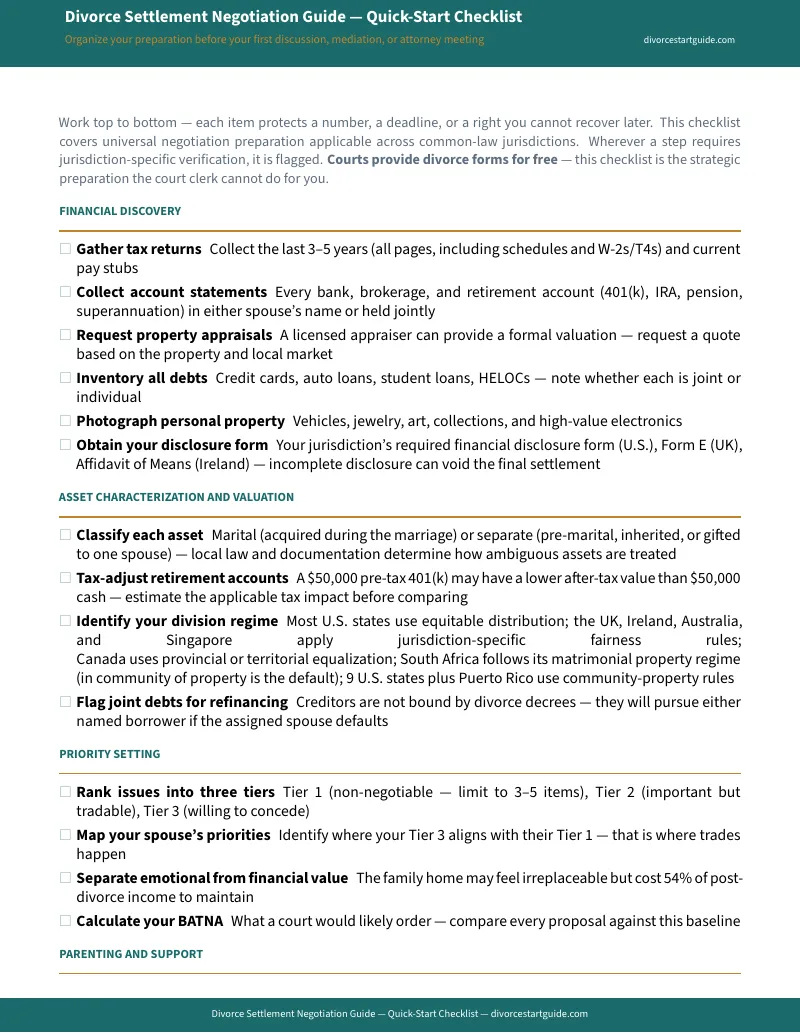
Download the free Quick-Start Checklist to organize your preparation tonight — financial documents, asset classifications, priority rankings, and communication boundaries in a printable one-page format.
When you're ready for the complete system — the worksheets, the calculators, the communication templates, the settlement drafting framework, and the worked examples that show the arithmetic step by step — get the full Divorce Settlement Negotiation Guide for less than the cost of fifteen minutes with a family law attorney.