The court gives you blank forms. It does not tell you how to divide what you own.
You have downloaded Form 94A from the Supreme Court of Yukon website. You are staring at a Financial Statement that asks you to list and value every asset, debt, pension, and bank account in your marriage — but gives you no framework for deciding who gets what, how a defined benefit pension should be valued, or what happens to the house when only one of you can afford the mortgage.
Meanwhile, a family law attorney in Whitehorse charges $250 to $700 an hour. Initial retainers start at $2,500 and routinely climb past $10,000. A significant portion of those billable hours is spent on tasks you can handle yourself — organizing financial records, classifying assets, running equalization calculations — if someone showed you the structured method.
You do not need a lawyer to organize your financial picture. You need to know exactly what counts as a family asset under the Family Property and Support Act, how to value each asset type at the correct date, and how to calculate the equalization payment that produces a clean 50/50 split — before you spend a single dollar on professional fees.
The FPSA Equal Division System
This is a complete, territory-specific toolkit for dividing money and property in a Yukon divorce — built around the rules that make Yukon's Family Property and Support Act different from every other Canadian jurisdiction. It does not generate court forms, file your documents, or provide legal advice. It is the structured calculation method, the classification framework, and the negotiation preparation that the blank forms leave out.
At its core is the FPSA Equal Division System — a step-by-step method that takes you from "I have no idea what we own or how to split it" to a complete, organized, court-ready financial picture. It handles the part everyone gets wrong: classifying assets as "family property" versus excluded property under Section 4 and Section 14 of the FPSA, choosing the correct valuation date (Yukon has unusual flexibility here), running the net family property calculation, splitting defined benefit pensions that are restricted to lump-sum commuted value transfers, deciding the fate of the family home, allocating debts correctly for married versus common-law couples, and calculating spousal support under the SSAG with the Rule of 65 threshold.
What's inside — 15 chapters, printable worksheets, and the free 20-item checklist
- The FPSA Asset Classification Framework — how to identify what is a "family asset" under Section 4 (property used by the family for shelter, transportation, recreation, or household purposes), what may be excluded under Section 13 factors (pre-marital property, gifts, inheritances kept separate), and how commingling destroys an exemption claim. Because getting the classification wrong means your entire equalization calculation starts from a bad number.
- The Net Family Property Worksheet — a fill-in-the-blanks calculation tool that walks you through listing each spouse's family assets at valuation date, subtracting excluded property, subtracting debts, and arriving at the equalization payment. This is the math the FPSA requires — laid out so you can complete it with a pen and a calculator.
- Pension Division for Public Servants — Whitehorse has one of the highest concentrations of federal and territorial government employees in Canada, and their pensions are often the largest single family asset. This chapter covers defined benefit plans (restricted to lump-sum commuted value transfers to a LIRA), defined contribution plans (divided by account balance), Canada Pension Plan credit splitting through Service Canada, and why the standard valuation statement from a plan administrator almost certainly understates the true economic value of a DB pension.
- The Family Home Decision Matrix — the three realistic paths (buyout and refinance, sell and split, deferred sale), plus a buyout math worksheet covering pre-marital equity credits, current mortgage balance, refinancing qualification, real estate commissions, and the Part 2 FPSA protections that prevent either spouse from unilaterally selling or mortgaging the home.
- Common-Law Property Rights — Yukon does not extend the 50/50 presumption to common-law partners, which surprises many people. This chapter explains the "joint family venture" analysis, the unjust enrichment framework, and how to build a contribution-based claim if you are not legally married.
- Debt Division Strategy — how family debts are split equally for married couples but default to the contracting party for common-law partners, why a separation agreement does not release you from joint liability to a creditor, and how to pursue a formal release of covenant from your bank.
- Spousal Support Calculations — the Spousal Support Advisory Guidelines (SSAG) formulas for amount and duration, the Rule of 65 threshold for indefinite support, and the March 2022 legislative change that permanently removed the 90-day deadline for common-law support applications.
- The 9-Step Court Filing Sequence — the chronological procedure from drafting initial pleadings (Form 91A or 91B) through service of process, the defendant response period, and requesting the final Certificate of Divorce (Form 101). Including the mandatory 31-day appeal wait, the document formatting rules that Registry clerks enforce, and the Rule 63A financial disclosure timeline.
- Separation Agreement Clauses — what a binding Yukon separation agreement must contain, the independent legal advice requirement, and a library of clean clauses covering property division, pension splitting, spousal support, and the family home.
- Tax Implications — capital gains on secondary properties, the CRA Form T2220 process for tax-free RRSP rollovers (skipping this form triggers immediate withholding tax on the full amount), and the different tax treatment of child support versus spousal support.
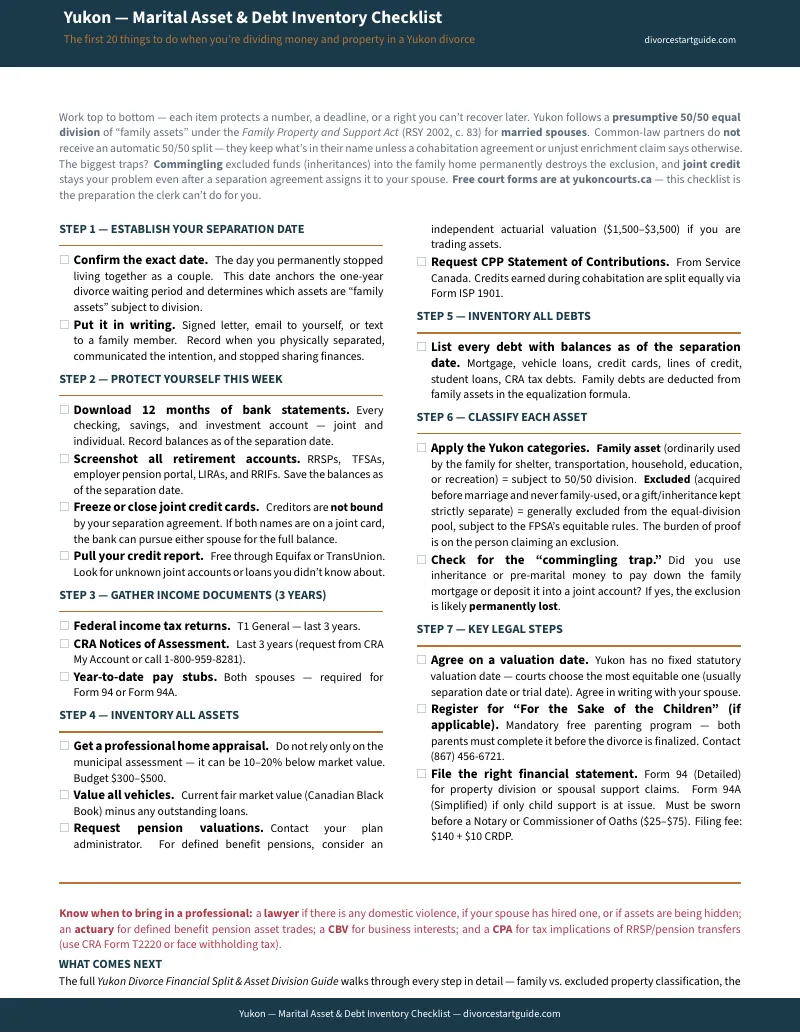
Printable worksheets and reference sheets in your download: Asset Classification Worksheet (two-page landscape format), Net Family Property Worksheet, Debt Division Worksheet, Pension Division Decision Flowchart, Family Home Buyout Worksheet, Financial Disclosure Checklist, Court Filing Sequence reference, and the free 20-item Marital Asset and Debt Inventory Checklist.
Who this is for
The spouse who has agreed to separate amicably and wants to organize the financial picture before paying for professional help. The public servant in Whitehorse who knows their defined benefit pension is the largest marital asset but cannot find clear guidance on how it gets divided. The common-law partner who just discovered that Yukon does not automatically split property 50/50 for unmarried couples. The person whose spouse presented a settlement proposal and who needs a way to verify whether the numbers are actually fair. And the couple who qualify for Yukon's free Family Mediation Service but need to arrive with an organized financial disclosure binder to make those sessions productive.
Why not just use the free court resources?
The Yukon Family Law Information Centre (FLIC) provides free fact sheets and blank court forms — and they should. But FLIC staff are legally prohibited from providing legal advice, negotiation strategies, or calculation frameworks. They cannot tell you how to value a defined benefit pension, whether your inheritance is protected from division, or how the SSAG formulas produce a spousal support number. They give you blank forms and point you toward the door.
Generic national document tools — LawDepot, automated divorce kits — generate templates designed for broad Canadian audiences. They do not account for the FPSA's specific treatment of common-law property, the unique restrictions on dividing federal public service pensions, the March 2022 support amendment, or the mandatory formatting rules that the Supreme Court Registry enforces on every filed document. A rejection at the Whitehorse Registry counter means delays, re-filing, and sometimes repaying the $140 to $180 filing fee.
An honest guarantee
Work through the FPSA Equal Division System. If this guide does not make the Yukon divorce financial split process clearer and more organized than any blank form, free brochure, or national template could — email us at any time for a full refund. The risk of trying it is a fraction of one consultation hour with a Whitehorse family lawyer. The risk of walking into negotiations without a structured financial picture is measured in thousands of dollars of missed entitlements.
For — less than fifteen minutes of Whitehorse attorney time — you get the classification framework, the calculation worksheets, the pension division guide, and the step-by-step court filing sequence that the blank forms leave out.
Stop guessing what you are entitled to. Get the guide, run the numbers, and negotiate your financial split from a position of clarity.