The court forms are blank boxes. They don't tell you how to calculate what goes in them.
You've found the Petition for Divorce and the Financial Statement forms on the Court of King's Bench website. You've looked at the FamLi form wizard on PLEA's website — and discovered it's offline for revision again. And you've hit the wall: Saskatchewan requires a complete sworn Financial Statement (Form 15-47) that demands three years of tax returns, three years of Notices of Assessment, six months of pay stubs, and twelve months of bank statements for every account. But the blank form doesn't tell you how to classify an inheritance that went into the joint chequing account. It doesn't tell you how to value a Defined Benefit pension. And it doesn't explain what happens when your exempt pre-relationship savings got commingled with joint mortgage payments over fifteen years.
Meanwhile, a family law attorney in Saskatchewan charges CA$250–$400 an hour. A $5,000 retainer buys you roughly fourteen hours. Two or three of those go to sorting bank statements and pay stubs into the right categories — over $1,000 in administrative work you could have done yourself, if someone had shown you how the pieces fit together.
You don't need someone to fill in the forms for you. You need to know what the numbers mean before you write them down.
The FPA Division Navigation System
This is a complete, step-by-step guide to dividing money and property in a Saskatchewan divorce — built for the specific rules that make this province different from every other jurisdiction in Canada. It is not legal representation and it does not file your papers. It is the calculation and sequencing intelligence that the blank forms leave out.
At its core is the FPA Division Navigation System — a structured method that walks you from "I have a pile of bank statements and no idea what's exempt vs. family property" to a clean, organized financial inventory that meets the court's disclosure standard under The Family Property Act. It handles the part everyone gets wrong: classifying assets under the FPA's equal division rules, tracing exempt property through commingled accounts under Section 23, navigating the mandatory pre-court dispute resolution process, splitting Defined Benefit pensions under The Pension Benefits Act, 1992, transferring RRSPs tax-free using CRA Form T2220, and preparing a Form 15-47 disclosure package that won't get rejected at the court registry counter.
What's inside — 15-chapter guide, 9 standalone worksheets, and the free checklist
- The Family Property Act Framework — how Saskatchewan's equal division system works, the difference between married couples and common-law partners (two-year cohabitation threshold), the unique valuation-date flexibility (date of application vs. date of adjudication), and the critical limitation periods that expire without notice.
- The Mandatory Pre-Court Roadmap — since July 1, 2022, couples must attempt early family dispute resolution before proceeding with contested court applications. The guide walks through your options (mediation, collaborative law, arbitration), the mandatory Parenting After Separation (PAS) program, and the Family Dispute Resolution (FDR) and Judicial Case Conference (JCC) processes — step by step, with what to prepare before each one.
- Form 15-47 Financial Disclosure System — every document category the sworn Financial Statement requires, organized into a single preparation checklist. Income, real property, vehicles, bank accounts, investments, pensions, business interests, debts, and more. Each category lists exactly what to gather, where to find it, and what the court registry checks before accepting your filing.
- Exempt Property and the Section 23 Tracing Rule — pre-relationship assets, inheritances, and third-party gifts are exempt from equal division. But if you deposited an inheritance into a joint account or used it to pay down the family mortgage, those funds may be reclassified as family property and divided 50/50. The tracing worksheets walk you through documenting the paper trail with the evidence standards Saskatchewan courts require.
- The Family Home Decision Framework — under Section 22, the entire value of the family home is split 50/50 regardless of title or who paid the down payment. The Homesteads Act protects occupancy rights for both spouses. The guide walks through the three paths: refinance and buy out, sell and split net proceeds, or defer the sale. The home buyout worksheet factors in pre-marital equity, mortgage balance, refinancing costs, and transaction fees.
- Pension and Retirement Division — Defined Benefit pension division under The Pension Benefits Act, 1992 (Forms 1, 2, 5, and 6), Defined Contribution plan splits, PEPP division, RRSP rollovers using CRA Form T2220, TFSA division, and CPP credit splitting through Service Canada (including Saskatchewan's unique opt-out provision). Three different systems, three different processes, all in one chapter.
- Debt Allocation and Joint Liability Protection — family debt is divided regardless of whose name is on the account. But a separation agreement does not bind your bank — if a joint line of credit stays open, both parties remain liable. The guide covers joint debt strategy, credit protection, and restructuring during separation.
- Spousal Support — SSAG range modelling for compensatory, non-compensatory, and contractual entitlement. The Without Child formula (1.5%–2% of income difference per year of marriage, up to 50%) and the With Child formula (which prioritizes child support and net disposable income). Duration calculations and when duration can be extended indefinitely.
- Business Interests, Farms, and Complex Assets — how the court values and divides corporate interests, agricultural holdings, shareholder loans, and retained earnings. Covers the three valuation methods (Asset-Based, Income/Going Concern, and Market), the corporate disclosure requirements, and specific considerations for Saskatchewan's agricultural economy.
- The Interspousal Contract — under Section 38 of the FPA, a separation agreement is only fully enforceable if both spouses obtain Independent Legal Advice from separate lawyers. Without ILA, the agreement is classified as a domestic contract under Section 40 and can be set aside. The guide covers what goes in, what to negotiate, and how to avoid the clauses that Saskatchewan courts routinely invalidate.
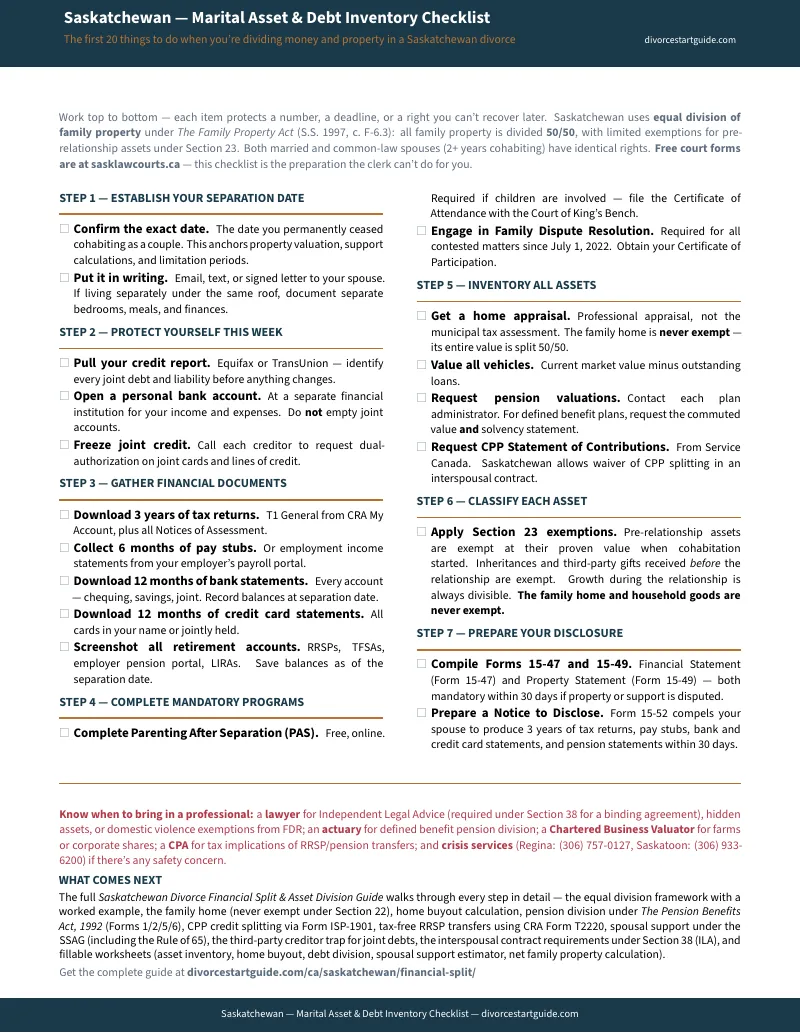
Every worksheet referenced above is included as a standalone printable PDF — the asset and debt inventory, exempt property tracing log, home buyout calculator, spousal support estimator, financial disclosure checklist, pension division checklist, agreement drafting checklist, court filing reference, and post-division execution checklist. Print only what you need, bring it to mediation or your lawyer's office, and fill it in as you go. Plus the free one-page quick-start checklist.
Who this is for
The spouse quietly gathering records before filing. The person staring at the Form 15-47 requirements with a shoebox of bank statements and no idea where to start. The government employee wondering how their PEPP or Teachers' Pension gets divided. The homemaker calculating whether they can afford to keep the house after a buyout and refinance. The cooperative couple heading into mandatory dispute resolution who want to arrive with organized numbers — not scattered documents that run up the mediator's hourly bill. And the spouse who already has a lawyer but wants to stop paying $350 an hour for document organization they can handle themselves.
Why not just use the free resources?
Because the free resources give you forms, not calculations. PLEA's FamLi website is an excellent resource for understanding Saskatchewan family law — but its interactive Agreement Maker and Form Wizard tools are frequently offline for revision. The Saskatchewan government's self-help kits provide blank forms and filing instructions, but they don't offer interactive worksheets, structured asset classification systems, or step-by-step pension division instructions. They explain the law — they don't help you calculate your specific financial division.
The national platforms — Divorcepath for support-only calculations, LawDepot at CA$54 per month — don't know about Saskatchewan's unique valuation-date flexibility, the mandatory dispute resolution requirements enacted in July 2022, the Section 23 commingling rules, or the specific pension division forms required under The Pension Benefits Act, 1992. Generic separation agreement templates risk being set aside under Section 38 if they lack full financial disclosure or Independent Legal Advice.
An honest guarantee
Work through the FPA Division Navigation System. If the guide doesn't make your financial split clearer and better organized than any blank form or free article could — email us within 30 days for a full refund. The risk of trying it is a fraction of one attorney billable hour. The risk of guessing on your asset division is measured in years of financial consequences.
For — less than fifteen minutes of attorney time — you get the classification system, the pension division instructions, the worksheets, and the step-by-step sequence that the blank forms leave out.
Stop staring at blank boxes. Get the guide, build your inventory, and walk into your divorce with the numbers already done.