
The CLIA Divorce Form Builder generates blank forms. It doesn't calculate what goes in them.
You've found the PEI Community Legal Information resources — the Form Builder, the $200 uncontested package, the government brochures about your rights. And you've hit the gap: the tools can print blank court forms, but they don't help you calculate your Net Family Property. They don't explain that pre-marital equity in the matrimonial home — equity you built before you ever walked down the aisle — cannot be deducted from the equalization formula under Section 19 of the Family Law Act. And they don't warn you that PEI is the only province in Canada without a proclaimed pension division law, meaning your pension administrator has no legal obligation to split the pension at source.
Meanwhile, a family law attorney in Charlottetown or Summerside charges $250 to $500 an hour. A $3,500 retainer buys you about ten hours. Two or three of those go to sorting your bank statements and T4 slips into categories. That's $1,000 in administrative work you could have done yourself — if someone had shown you how the equalization math actually works under PEI's rules.
You don't need someone to fill in the forms. You need to know what the numbers mean before you write them down.
The PEI Equalization Navigation System
This is a complete, step-by-step guide to dividing money and property in a Prince Edward Island divorce — built for the specific provincial rules that make PEI different from every other jurisdiction in Canada. It is not legal representation and it does not file your papers. It is the calculation and sequencing intelligence that the blank forms and government brochures leave out.
At its core is the PEI Equalization Navigation System — a structured method that walks you from "I have a pile of bank statements and no idea what's marital vs. excluded" to a clean, defensible asset-and-debt inventory that meets the Supreme Court's Family Section equalization standard under the Family Law Act. It handles the part everyone gets wrong: running the NFP formula at both valuation dates, tracing excluded property so the burden-of-proof doesn't eat your inheritance, navigating the pension division vacuum with if-and-when agreements vs. buyout strategies, preparing sworn Rule 70 financial disclosure, and calculating equalization payments that will actually hold up in court.
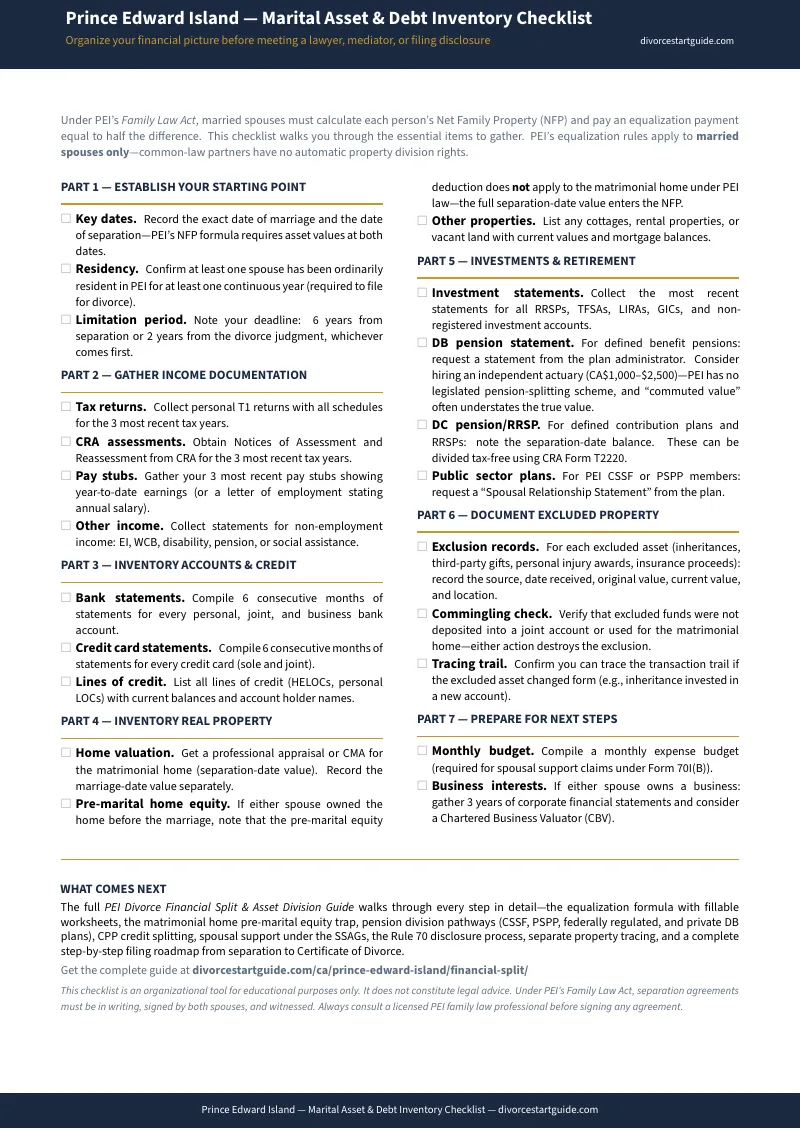
What's inside — 12-chapter guide, 7 standalone worksheets, and the free checklist
- The Legal Framework Chapter — how PEI's equalization-of-value model works (not physical asset division), the difference between federal divorce rules and provincial property rules, which courts handle what, and the strict limitation periods that can extinguish your rights entirely.
- The Matrimonial Home Trap + Buyout Calculator — the most expensive mistake in PEI divorce. Unlike other assets, you cannot deduct pre-marital equity from the matrimonial home. The guide explains Section 19, the Section 20 disposition freeze, the Matrimonial Home designation on title, and the buyout math covering refinancing costs, outstanding mortgage, and the equity split.
- Complete NFP Calculation + Master Equalization Worksheet — the step-by-step formula: separation-date assets minus separation-date debts, minus marriage-date net worth, minus excluded property. The worksheet walks you through every line, with examples and a final equalization payment calculation.
- Excluded Property & Tracing + Exemption Tracing Log — inheritances, third-party gifts, personal injury awards, and insurance proceeds are excluded from equalization, but Section 4(3) puts the burden of proof on you. The tracing log builds the audit trail you'll need to prove the funds stayed separate. One deposit into a joint account can destroy the exclusion permanently.
- The Pension Division Vacuum — PEI's Pension Benefits Act has never been proclaimed. Private pension plans are not required to split at source. The guide walks through three pathways: if-and-when payment arrangements, asset buyouts using commuted value, and the separate rules for public sector plans (CSSF, PSPP). Plus mandatory CPP credit splitting through Service Canada and tax-free RRSP transfers using CRA Form T2220.
- Sworn Financial Disclosure + Document Preparation Checklist — exactly what Rule 70 requires: tax returns, Notices of Assessment, pay stubs, pension statements, business financials. The guide explains the severe consequences of incomplete disclosure and the strategic considerations of each document category.
- Spousal Support Estimator — SSAG range modelling for both the "Without Child" and "With Child" formulas, including the "Rule of 65" for indefinite support, the 20-year marriage threshold, and how entitlement is established under the compensatory, non-compensatory, and contractual bases.
- Step-by-Step Filing Process — from the one-year separation period through Form 70A, proof of service, the 20-day response window, uncontested desk orders vs. contested motions, interim relief applications, and the final Certificate of Divorce. Every fee listed, every form referenced.
- Common-Law Partners — the equalization regime does not apply to you, but unjust enrichment claims, constructive trust, and the two-year limitation period give you a separate pathway. This chapter covers what you can and cannot claim.
Every worksheet is included as a standalone printable PDF — print the ones you need and bring them to mediation, your lawyer's office, or the kitchen table.
Who this is for
The spouse quietly gathering records before the separation conversation. The person staring at a $200 Divorce Form Builder screen and realizing it can't do the math behind the forms. The public servant wondering whether the CSSF pension can actually be split. The homemaker calculating whether they can afford to keep the house after accounting for the pre-marital equity trap. The cooperative couple heading into private mediation who want to arrive with a completed asset inventory instead of paying $300 an hour for the mediator to help them sort bank statements. And the spouse who already has a lawyer but wants to stop paying for document organization they can handle themselves.
Why not just use the free resources?
Because the free resources give you explanations, not calculations. The Community Legal Information Association provides excellent legal overviews. The Divorce Form Builder generates blank forms. The Family Law Navigator offers procedural guidance. But none of them provide interactive worksheets, step-by-step pension division instructions, or a structured equalization calculation. They explain the law — they don't help you run the numbers for your specific financial situation.
The national template platforms — LawDepot at $35–$39 per month, CanadianLegal.org's generic agreements — don't know about PEI's matrimonial home pre-marital equity exception, the pension division vacuum, Rule 70 disclosure requirements, or the specific sections of the Family Law Act that determine how your property gets classified. A generic Canadian separation agreement that ignores PEI's unique rules can be challenged and set aside.
An honest guarantee
Work through the PEI Equalization Navigation System. If the guide doesn't make your financial split clearer and better organised than any blank form or free article could — email us within 30 days for a full refund. The risk of trying it is a fraction of one attorney billable hour. The risk of guessing on your equalization calculation is measured in years of financial consequences.
For — less than fifteen minutes of attorney time — you get the equalization formula, the pension division pathways, the tracing worksheets, and the step-by-step sequence that the free forms leave out.
Stop staring at blank forms. Get the guide, build your inventory, and walk into your divorce with the numbers already done.