The Supreme Court gives you blank forms. It does not tell you what to file first.
You've found the fillable PDFs on courts.pe.ca. You've opened Form 70A and realized you're also going to need Form 70P, Form 70R, Form 70S, Form 70I, possibly Form 70J, and maybe Form 70A* instead of 70A — and none of these come with instructions about which one goes in which filing stage, how long to wait between stages, or what happens when the registry clerk returns your entire package because you submitted Step 2 before Ottawa sent the Clearance Certificate.
A private family lawyer in Prince Edward Island charges $3,000 to $7,000 for an uncontested divorce retainer. Half of that goes toward administrative work you could handle yourself — if someone told you the precise three-stage filing sequence that Rule 70 demands.
You don't need a lawyer to fill in blanks. You need to know the exact order, the mandatory wait windows, and the registry-clerk rejection triggers that cause months of delay — before you walk into the Charlottetown or Summerside courthouse.
The Rule 70 Filing Sequence Navigator
This is a complete, step-by-step guide to filing for divorce through the Supreme Court of Prince Edward Island's Family Section — built for the specific rules that make PEI different from other Canadian provinces. It does not file your papers or provide legal representation. It is the sequencing, timing, and verification intelligence that the blank Rule 70 forms leave out.
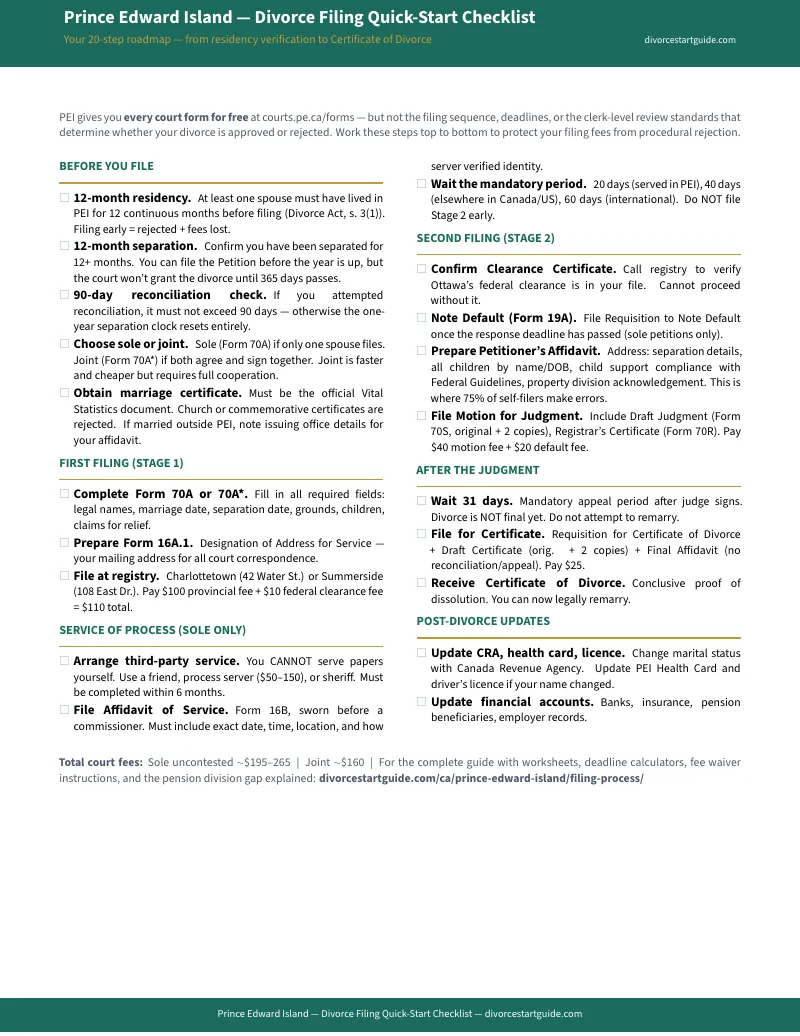
At its core is the Rule 70 Filing Sequence Navigator — a structured method that walks you from "I have a stack of blank court forms and no idea where to start" to a clean, correctly sequenced, registry-ready package that meets the Supreme Court's filing standards on the first attempt. It handles the part everyone gets wrong: confirming your 12-month provincial residency, choosing between a sole petition (Form 70A) and the faster joint petition path (Form 70A*), executing service of process through a competent third party, calculating the exact response deadline based on where your spouse lives, waiting for the federal Clearance Certificate before assembling your Step 2 motion package, and compiling the Petitioner's Affidavit, draft Judgment, and Registrar's Certificate in the format the reviewing judge expects.
What's inside — the 12-chapter guide, 8 printable worksheets, and the free quick-start checklist
- Residency Verification and Jurisdiction — the strict 12-month continuous residency rule under Section 3(1) of the Divorce Act, what counts as "ordinarily resident," how temporary absences affect the clock, and what happens if you file before the 12 months are met. Because filing too early means the registry clerk rejects your petition and you forfeit your $100 filing fee.
- Sole vs. Joint Petition Decision Framework — the concrete differences between Form 70A (sole, requires service, 20–60 day response window) and Form 70A* (joint, no service required, faster timeline). The Legal Info PEI Form Builder costs $200 and only supports sole petitions. This guide covers both paths completely.
- The Three-Stage Filing Sequence — Stage 1 (Initiation: petition, marriage certificate, Central Registry request), Stage 2 (Motion for Judgment: Petitioner's Affidavit Form 70P, Registrar's Certificate Form 70R, draft Divorce Judgment Form 70S), and Stage 3 (Finalization: 31-day appeal wait, Certificate of Divorce Form 70T). Each stage mapped with exact documents, fees, and timing.
- Service of Process Step-by-Step — why you cannot personally serve your spouse, how to use a third-party friend or professional process server ($50–$150), how to use registered mail with Form 16A, how to complete the Affidavit of Service (Form 16B), and the strict response deadlines: 20 days in PEI, 40 days elsewhere in Canada or the U.S., 60 days internationally.
- The Clearance Certificate Timing Guide — why the Central Registry of Divorce Proceedings in Ottawa must confirm no duplicate proceedings exist, how long this typically takes, and the common mistake of submitting your Step 2 package before it arrives. Because if you file out of sequence, the registry returns everything and you wait weeks to refile.
- Same-Roof Separation Evidence Builder — a guided worksheet for documenting separate finances, separate bedrooms, divided household duties, and independent social lives, so your Petitioner's Affidavit (Form 70P) satisfies a judge when you and your spouse cannot afford two households during the one-year separation period.
- Financial Disclosure Navigation — the Form 70I series (Statements A through D: income, expenses, assets, property) explained in plain language, when you can use a Form 70J waiver to skip formal disclosure, and how to calculate net family property under PEI's 50/50 equalization framework.
- Child Support Calculator Worksheets — Federal Child Support Guidelines table amounts, how income determines the base obligation, when deviations apply, how shared-custody arrangements change the calculation, and exactly how to present this information so the judge is satisfied that reasonable arrangements have been made for dependent children.
- Fee Waiver Application Guide — the Prothonotary's discretion to waive or reduce court fees under the Court Fees Act Waiver Regulations, who qualifies, what financial documents to prepare, and how to submit the application at the time of your first filing. Most filers don't know this option exists.
- The Registry Clerk Pre-Filing Audit — the top reasons PEI Supreme Court clerks reject divorce filings: premature petition (residency not met), petitioner self-serving papers, Step 2 filed before Clearance Certificate, outdated form versions, missing financial disclosures when children are involved, and incomplete parenting arrangements. Check these before you walk in.
Who this is for
The spouse who has already decided to file and needs to know what comes first. The person who downloaded every Rule 70 form from courts.pe.ca and cannot figure out which ones belong in Stage 1 versus Stage 2. The couple who agree on everything but need to get the paperwork through the Supreme Court without paying a $3,000 retainer. The filer who used the $200 Form Builder and then discovered it doesn't support joint petitions. And the person whose separation agreement is signed and witnessed but who just learned that a separation agreement is not a divorce — you still need to file with the court to get an actual Divorce Judgment.
Why not just use the free court forms?
Because the court gives you forms, not a filing sequence. The courts.pe.ca website provides every Rule 70 form — for free, as it should. But downloading a dozen blank PDFs with no chronological instructions is exactly where filings stall. The registry clerk is not your advisor. They check your package against a standardized set of criteria, and if anything is out of sequence, incomplete, or premature, they return it without coaching you through the fix.
The official Form Builder from Legal Info PEI costs $200 CAD and only generates forms for sole uncontested petitions — no joint filings, no timeline tracking, no clerk-level assembly review. The national document-prep platforms (Easy Uncontested at $275–$399, Canadian Divorce Online at similar pricing) use broad automated systems that frequently miss hyper-local PEI registrar requirements. And the Family Law Navigator, while excellent for connecting you with mediation and co-parenting services, is legally prohibited from selecting forms, reviewing documents, or giving legal advice.
This guide fills the gap between free blank forms and a $3,000 lawyer retainer. It is the process navigation, timeline math, and clerk-readiness audit that none of those options provide.
A straightforward guarantee
Work through the Rule 70 Filing Sequence Navigator. If the guide does not make the PEI divorce filing process clearer and more organized than any combination of blank forms, free government portals, and paid document-prep services could — email us within 30 days for a full refund. The risk of trying it is a fraction of one lawyer consultation. The risk of getting your filing rejected is measured in months of delay and potentially having to repay your court fees.
For — less than one hour of a PEI family lawyer's time — you get the filing sequence, the clerk rejection audit, the worksheets, and the step-by-step instructions that the blank forms leave out.
Stop guessing which form goes in which stage. Get the guide, follow the sequence, and file your divorce correctly the first time.