You printed the forms. Now what?
You've already taken the hardest step — deciding to move forward. But somewhere between downloading Form 8A from the Ontario Courts website and trying to figure out what a "continuing record with yellow and red covers" means, the process stopped feeling manageable.
Ontario family courts were not designed for people without lawyers. Between 64% and 74% of filers show up self-represented at the initial filing stage — and the system gives them blank PDFs and a list of rules written for legal professionals. No chronological sequence. No "do this, then this." Just scattered forms across multiple government portals and a court clerk who will reject your application for a formatting error you didn't know existed.
The Ontario Filing Navigator
This is not a collection of blank forms — the government already gives you those. This is the step-by-step project management system that tells you exactly what to do with them, in what order, at which court or portal, and how to avoid the mistakes that get applications sent back.
Built entirely around Ontario's Family Law Rules (O. Reg. 114/99), the federal Divorce Act, and the Ontario Family Law Act, the guide covers both sole and joint divorce paths from the day you confirm residency through the day you receive your Certificate of Divorce.
What's Inside
- A 9-step filing sequence — the exact chronological order for completing, filing, and serving your divorce documents, including which portal to use (Ontario Courts Public Portal for Toronto-region filings, Family Submissions Online for everywhere else)
- A Net Family Property equalization worksheet — because Ontario does not split assets 50/50. The worksheet walks you through the NFP calculation step by step, using the same formula the courts apply under the Family Law Act
- A court and portal selection guide — clarifying the difference between the Ontario Court of Justice (no divorces, no property division) and the Superior Court of Justice (where your divorce actually gets processed)
- A pre-filing validation checklist — the same criteria court clerks use to review your documents, so you catch missing affidavits, incorrect font sizes, uncertified translations, and un-commissioned forms before you pay the $224 filing fee
- A Rule 6 service decision tree — personal service, special service, substituted service, and what to do when your spouse cannot be located
- A continuing record organization guide — how to set up the yellow-cover endorsements volume and red-cover documents volume that the court requires under Rule 9
- A fee and waiver reference — the complete fee schedule ($224 application, $445 set-down, $25 certificate) plus the income and asset thresholds for a fee waiver under the Administration of Justice Act
- A post-divorce administrative tracker — the 31-day wait for your Divorce Order to become final, how to apply for your Certificate of Divorce (Form 36B), and the exact documents you need to update your name, CRA filing status, and identification
- A filing timeline reference — the 9-step chronological sequence with typical durations and cumulative timelines, plus a write-in column for tracking your own dates
- A service of process verification checklist — confirms proper service before you file proof of service with the court
Who This Guide Is For
- You are filing for divorce in Ontario (sole or joint application) and want a clear roadmap instead of scattered government pages
- You are preparing for mediation and want to walk in with your financial disclosure organized and your parenting schedules drafted
- You own property, a pension, or other assets and need to understand how Ontario's equalization rules apply to your situation
- You have children and need to ensure your child support arrangements satisfy the court's requirements under Section 11(1)(b) of the Divorce Act
- You want to file without a lawyer but do not want to risk a rejection that costs you months and your filing fee
Why Not Just Use Free Government Resources?
Government portals like Steps to Justice and CLEO's Guided Pathways are excellent — this guide cites them frequently and recommends them as complementary tools. What they do not provide is a unified, chronological project-management framework.
Steps to Justice can help you fill in a specific form. It cannot tell you which of the 15+ potentially relevant forms you need for your situation, in what order to complete them, how to organize your continuing record, or how to coordinate the service-and-filing timeline so nothing expires before your desk review.
Flat-fee legal services like Simple Divorce ($300–$799 plus HST) and online platforms like Untie the Knot ($499–$899) will do this for you — but at a cost that often exceeds what budget-conscious filers can justify for an uncontested filing. This guide fills the gap between free-but-fragmented and professional-but-expensive.
Satisfaction Guarantee
If the guide does not help you navigate the Ontario filing process with more confidence and clarity, email us and we will make it right. No hoops, no time limits.
Get Started
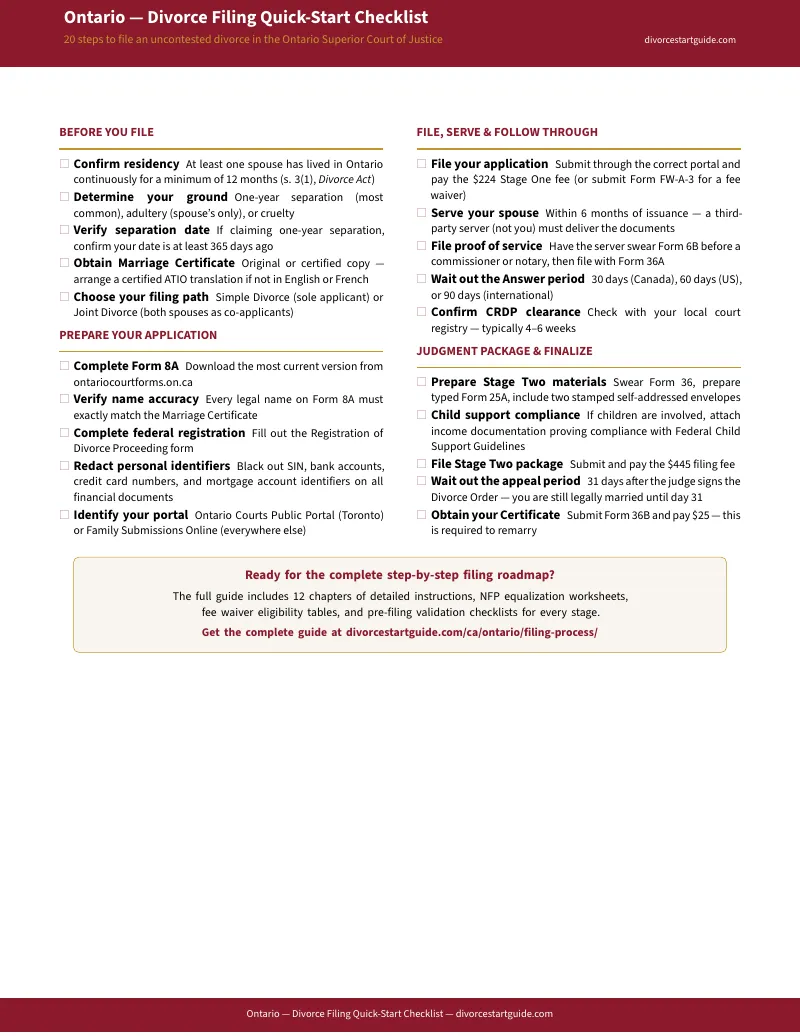
Download the free checklist to see the full filing sequence at a glance. If you want the complete guide — with 9 PDFs including fillable worksheets, the NFP calculator, the service decision tree, the pre-filing validation checklist, and the filing timeline tracker — get the full toolkit for less than what a court clerk charges to issue a single certified copy.
The free checklist shows you what to do. The full guide shows you how — with the worksheets, validation tools, and step-by-step instructions that keep your filing from becoming another rejected application.