The court forms are free. The filing sequence that keeps your application out of the rejection pile is not.
You've found the divorce forms on the Nunavut Court of Justice website. You've downloaded Forms 1 and 2, maybe Form 7 if your spouse is on board. And you've hit the part nobody warns you about: the Iqaluit registry sends your entire package to the Central Registry of Divorce Proceedings in Ottawa for a Clearance Certificate — a process that takes four to eight weeks. If the clerk spots a name mismatch with your marriage certificate, a missing Practice Directive #18 endorsement on your emailed PDF, or an affidavit that wasn't properly sworn, the whole package comes back. You fix the errors, refile, and restart the multi-week clearance queue from zero.
A family lawyer in Iqaluit charges $255 to $400 per hour. An uncontested retainer runs $1,500 to $3,500. Online document preparation services cost $150 to $500 — and they still don't tell you how to email-file from a fly-in community, pay the court fee by phone, or arrange service of process when there are no private process servers within 500 kilometres.
You don't need a lawyer to file for divorce in Nunavut. You need the filing sequence that gets your application accepted the first time the clerk opens it.
The Remote-Ready Filing Roadmap
This is a complete, step-by-step guide to filing for divorce in Nunavut — built around the territory's single-level Court of Justice, the Iqaluit Civil Registry's specific submission procedures, and the logistical realities of filing from remote communities accessible only by air. It is not legal advice, and it does not file your application for you. It is the structured sequence and administrative navigation that the free forms leave out.
At its core is the Remote-Ready Filing Roadmap — a method that takes you from "I think I'm eligible" to a successfully filed application, properly served documents, and a Certificate of Divorce in hand. It handles the part that trips up most self-represented filers: confirming your separation date with the reconciliation exception, choosing between joint and sole petitions, navigating Practice Directive #18 for email filing, coordinating service of process in communities with no process servers, and understanding the desk-order divorce sequence that most Nunavut divorces follow.
What's inside — 14-chapter guide, 9 standalone tools, 20-item checklist
- Eligibility and Residency Verification — the 12-month continuous residency rule under Section 3(1) of the Divorce Act, what counts for rotational mine workers and RCMP officers whose posting may be challenged, the separation-under-one-roof affidavit for communities with severe housing shortages, and the 90-day reconciliation window that lets you attempt reconciliation without resetting the clock.
- Nunavut's Single-Level Court System — why the Nunavut Court of Justice handles all divorce matters without the provincial/superior court split found everywhere else in Canada, what that means for your forms and your filing registry, and how the three judicial regions (Qikiqtaaluk, Kivalliq, Kitikmeot) connect to the single Iqaluit registry.
- Joint vs. Sole Petition Decision Framework — Form 7 (joint) eliminates service of process entirely and skips the response window, cutting months from the timeline. Form 1 + Form 2 (sole) lets you proceed even when your spouse won't cooperate. The guide maps out when each path is faster and cheaper, with a decision worksheet.
- Remote Filing Walkthrough — the exact email submission process for [email protected], the Practice Directive #18 endorsement you must add to every emailed PDF, phone payment instructions for the filing fee at 867-975-6102, and what to send by registered mail when email isn't an option.
- Service of Process in Remote Communities — the strict prohibition on serving papers yourself, using registered mail with an Acknowledgment of Service form, the Sheriff at $35 per attempt, coordinating a community member as a substitute server, the extended 60-day response window for spouses served outside Canada, and how to complete Form 3 (Affidavit of Service) without it being rejected.
- Financial Disclosure and Property Division — completing Form 8 (Financial Statement) and Form 9 (Statement of Property), the net family property equalization model, why common-law couples are automatically included after two years of cohabitation in Nunavut, and how pension valuations and real estate appraisals fit into the sworn financial exchange.
- Child Support and Parenting Arrangements — Federal Child Support Guidelines tables, the modern "parenting time" and "decision-making responsibility" language, what the court requires in Form 12 (sole) or Form 13 (joint), and the free government-funded family mediation program (Inuusirmut Aqqusiuqtiit) available across all communities.
- The Desk-Order Divorce Sequence — filing Form 11 (Request for Divorce Without Oral Hearing), swearing Form 12 or 13, and waiting for the judge to sign Form 14 (Divorce Judgment) — plus the mandatory 31-day appeal period and how to request Form 17 (Certificate of Divorce).
- Filing Costs and Fee Waivers — the $200–$255 court fee, the $10 federal registration fee, and the discretionary fee waiver process through the Civil Registry Manager at 867-975-6102.
- Common Mistakes Reference — name/date mismatches with the marriage certificate, missing Practice Directive #18 endorsements on email filings, outdated Federal Child Support tables, unsigned affidavits, and invalid service — the administrative errors that cause the most rejections at the Iqaluit registry.
Every major section comes with its own standalone printable tool — a petition decision worksheet, document gathering checklist, remote filing checklist, service of process planner, financial disclosure worksheet, fee schedule reference, common mistakes reference, timeline tracker, and forms quick reference. Print the ones you need, fill them in as you go.
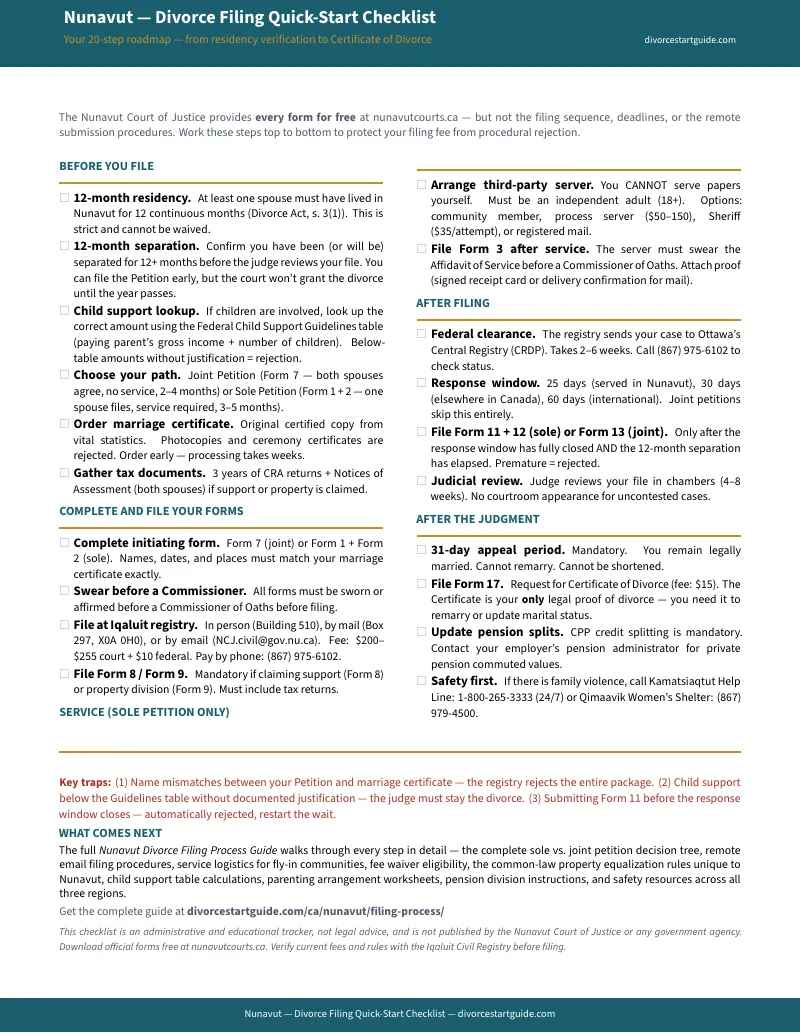
The free checklist gives you the 20-step filing sequence at a glance — print it, tick off each step as you go, and know exactly where you are in the process.
Who this is for
The person who just crossed the 12-month separation milestone and wants to file without paying a lawyer. The couple who agree on everything and want the fastest joint petition path. The sole petitioner in Rankin Inlet, Cambridge Bay, or Baker Lake who needs to file by email and serve papers on a spouse in another community. The parent who needs to get the child support affidavit right the first time. The person who downloaded all the court forms, opened Form 1, and closed the browser because nobody explained which box connects to which step.
Why not just use the free resources?
Because the free resources give you pieces, not a sequence. The Nunavut Court of Justice website provides 17 blank PDF forms — no filing instructions, no timeline, and no explanation of how they connect. The Legal Services Board helps with custody and support but restricts divorce assistance to income-qualifying cases. CompleteCase and OnlineDivorce charge $150 to $500 for document preparation — but they generate standard Canadian forms without addressing Practice Directive #18, email filing protocols, or remote-community service logistics.
None of them walk you through the desk-order sequence step by step, explain the remote filing protocols specific to the Iqaluit registry, or tell you how to arrange valid service from a community where the nearest process server is a charter flight away. They explain what divorce requires — they don't map out the order you do it in, for a territory where most of the administrative process happens by email and phone.
An honest guarantee
Work through the Remote-Ready Filing Roadmap. If the guide doesn't make the filing process clearer and more manageable than any free resource or government form page could — email us within 30 days for a full refund. The risk is a fraction of one lawyer consultation. The risk of filing incorrectly is a rejected application and months lost to the clearance queue.
For — less than ten minutes of lawyer time in Iqaluit — you get the filing sequence, the remote submission walkthrough, the service-of-process logistics, and the common-mistakes reference that the free forms leave out.
Stop guessing at which step comes next. Get the guide, follow the roadmap, and file your divorce correctly on the first attempt.