The government forms tell you what to disclose. They don't tell you how to calculate what goes in the boxes.
You've found the Financial Statement forms on Family Law Nova Scotia. You've downloaded the blank PDFs from the Supreme Court (Family Division). And you've hit the wall: the court requires you to exchange a complete, sworn financial disclosure — three years of income tax returns, bank statements for every account, pension valuations, real property appraisals — before a judge will consider your property claim. But the forms don't explain how to classify an inheritance that went into the joint mortgage. They don't explain how to value a Defined Benefit pension. And they don't warn you that Nova Scotia uniquely excludes business assets from the standard 50/50 split — a single classification error that can shift tens of thousands of dollars.
Meanwhile, a family lawyer in Nova Scotia charges $250–$800 an hour. A private mediator costs $300–$350 per hour. An uncontested divorce with agreed-upon terms runs $900–$1,500 before filing fees. Two or three hours of that goes to sorting your bank statements and pay stubs into the right disclosure categories — administrative work you could do yourself, if someone showed you how the pieces fit together.
You don't need someone to fill in the forms for you. You need to know what the numbers mean before you write them down.
The Equal Division Navigation System
This is a complete, step-by-step guide to dividing money and property in a Nova Scotia divorce — built for the specific rules that make this province different from every other jurisdiction in Canada. It is not legal representation and it does not file your papers. It is the calculation and sequencing intelligence that the blank forms leave out.
At its core is the Equal Division Navigation System — a structured method that walks you from "I have a pile of bank statements and no idea what's matrimonial vs. excluded" to a clean, organized financial inventory that meets the court's disclosure standard under the Matrimonial Property Act. It handles the part everyone gets wrong: classifying assets into Nova Scotia's three-tier system (matrimonial, excluded, and business), tracing excluded property through commingled accounts, valuing pensions under the Pension Benefits Act, splitting CPP credits through Service Canada (mandatory in Nova Scotia — you cannot waive it), and calculating the equalization payment that achieves a true 50/50 split.
What's inside — 15-chapter guide, 10 standalone worksheets, and the free checklist
- The Matrimonial Property Act Framework — how Nova Scotia's deferred community of property model works, the difference between married spouses and registered domestic partners, why unregistered common-law couples have no automatic property rights, and how Nova Scotia's aggressive inclusion rule captures assets acquired before the marriage.
- Three-Tier Asset Classification System — every asset you own falls into one of three categories: matrimonial (50/50 split), excluded (kept by owner), or business (unique Nova Scotia exemption). The guide walks through each category with real examples and the burden-of-proof rules that determine which side of the line an asset falls on.
- The Business Asset Exception and the Wolfson Rule — Nova Scotia is one of the few provinces that excludes business assets from the equal division pool. But Section 18 of the MPA lets a non-owning spouse claim a share if they contributed direct or indirect labour, money, or support that enhanced the business's value. The guide explains both sides of this equation.
- The Matrimonial Home Decision Framework — the home is always a matrimonial asset regardless of who purchased it or whose name is on the title. The guide covers the three paths: refinance and buy out the other's equity (including the Sagen/CMHC Spousal Buyout Program for up to 95% refinancing), sell and split net proceeds, or defer the sale. Includes a buyout calculation worksheet.
- Pension and Retirement Division — Defined Benefit pension division at source under the Nova Scotia Pension Benefits Act, Defined Contribution plan splits, RRSP rollovers using CRA Form T2220, TFSA division, and mandatory CPP credit splitting through Service Canada Form ISP1901. The guide covers every retirement asset type with step-by-step transfer instructions.
- Debt Allocation Strategy — matrimonial debts are subtracted from assets to calculate net equalization. But a separation agreement does not bind your bank — if a joint line of credit stays open, both parties remain liable. The guide covers joint debt strategy, credit protection, and restructuring during separation.
- Valuation Date Rules — different assets use different valuation dates in Nova Scotia. The guide explains exactly which date applies to each asset class so you don't under-value or over-value your position.
- Financial Disclosure Requirements — every document category the court requires for a sworn financial statement, organized into a single reference. Income, real property, vehicles, bank accounts, investments, pensions, business interests, debts, and personal property — each category lists exactly what to gather, where to find it, and what happens if it's incomplete.
- Spousal Support Framework — SSAG range modelling for compensatory, non-compensatory, and contractual entitlement under both the federal Divorce Act and the provincial Parenting and Support Act. Includes a support estimator worksheet.
- Master Equalization Worksheet — the core calculation. Input every asset and debt, apply the three-tier classification, and build a complete equalization picture to bring to mediation or your lawyer's office.
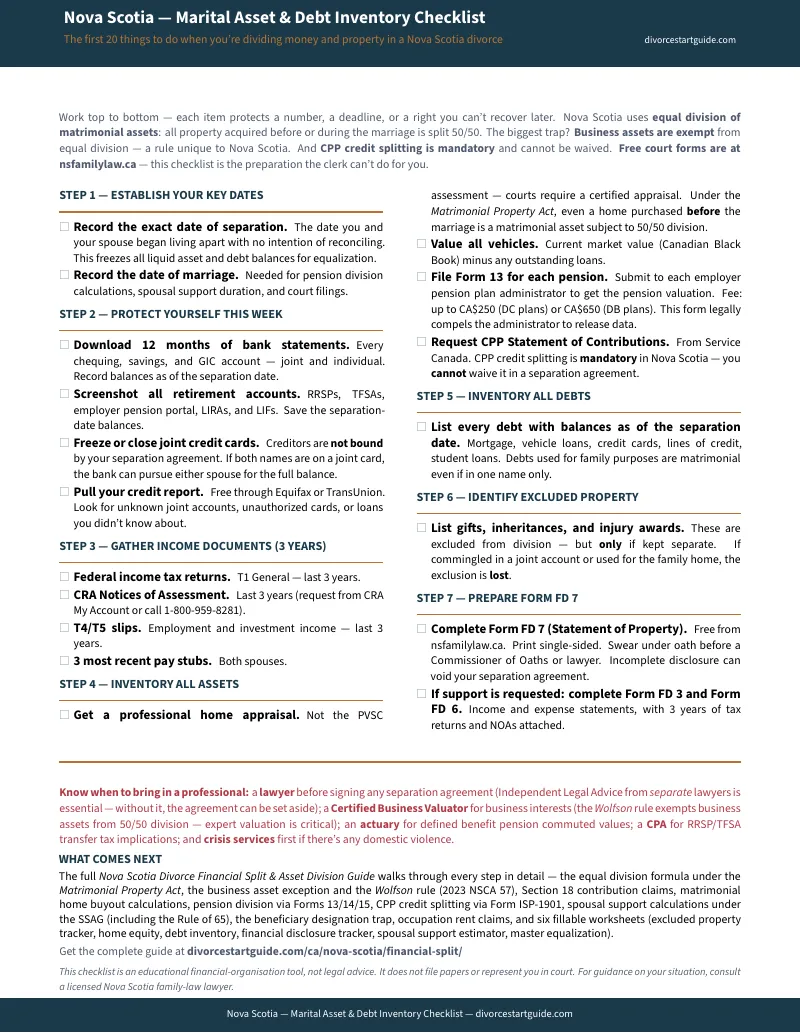
Every worksheet is included as a standalone printable PDF — print the ones you need and bring them to mediation, your lawyer review, or the kitchen table.
Who this is for
The spouse quietly gathering records before filing. The person staring at the court's Financial Statement form with a shoebox of bank statements and no idea how to organize them. The public servant wondering how their NSPS or municipal pension gets divided at source. The homemaker calculating whether they can afford to keep the house after refinancing. The cooperative couple who want to reach a fair agreement at mediation without spending $8,000 on billable hours — but need the math to prove the agreement is actually fair. And the spouse who already has a lawyer but wants to stop paying $400 an hour for document organization they can handle themselves.
Why not just use the free resources?
Because the free resources give you forms, not calculations. Family Law Nova Scotia and the Legal Information Society of Nova Scotia (LISNS) provide excellent legal explanations and blank PDFs. The LISNS Separation Agreement Pathway offers a guided digital pathway for simple, low-conflict separations. But none of them provide interactive worksheets, step-by-step pension division instructions, or structured property tracing logs. They explain the law — they don't help you calculate your specific financial division.
The national platforms — Untie The Knot at CA$499 for document preparation, LawDepot's generic templates — don't know about Nova Scotia's business asset exception, the Wolfson rule under Section 18, the mandatory CPP credit split, or the specific sections of the Matrimonial Property Act that determine how your assets get classified. Generic separation agreement templates can be set aside by a judge if they lack full financial disclosure or independent legal advice.
An honest guarantee
Work through the Equal Division Navigation System. If the guide doesn't make your financial split clearer and better organized than any blank form or free article could — email us at any time for a full refund. The risk of trying it is a fraction of one attorney billable hour. The risk of guessing on your asset division is measured in years of financial consequences.
For — less than fifteen minutes of attorney time — you get the classification system, the pension division instructions, the worksheets, and the step-by-step sequence that the free forms leave out.
Stop staring at blank boxes. Get the guide, build your inventory, and walk into your divorce with the numbers already done.