The court forms are free. Knowing what to do with them is the hard part.
Nova Scotia's court forms are available at no charge on nsfamilylaw.ca. But the forms don't come with a filing manual. They don't explain which pathway applies to your situation — Joint Application, Application by Written Agreement, or Petition. They don't tell you the difference between Form 59.46 and Form 59.45, or which supporting documents go with each. They don't explain how to coordinate personal service, or that the server must present the original "red seal" copy during hand-delivery. And they definitely don't warn you that submitting your second-stage motion before the federal Clearance Certificate arrives means your entire package comes back.
The result: roughly 15% of self-filed divorce applications in Nova Scotia are rejected by the court registry for administrative errors — wrong forms, missing signatures, incorrect copy counts, improper service procedures. Each rejection costs weeks. Some people never recover: they pay a lawyer $1,300 to $3,500 to untangle what went wrong, which is exactly the expense they were trying to avoid.
The Filing Sequence Navigator — every step, in the order the court expects it
The Nova Scotia Divorce Filing Process Guide is not a form pack. It's a process-navigation tool that walks you through every stage of filing in the exact order the Supreme Court Family Division expects — from confirming your residency eligibility under Section 3(1) of the Divorce Act through to receiving your Certificate of Divorce after the 31-day appeal window closes.
It covers all three filing pathways, includes step-by-step checklists for each one, and tells you exactly which forms, supporting documents, and copy counts belong at each stage. Where the free government website explains what the law says, this guide explains what you actually need to do — and in what order.
What's inside
- Three-pathway filing roadmap — clear decision logic for choosing between a Joint Application (Form 59.46), Application by Written Agreement (Form 59.45), or Petition for Divorce, with the exact forms required for each path
- Stage-by-stage filing checklists — document packages, copy counts, and completion sequences for your initial filing, service of process, and second-stage motion, organized in the order the court registry processes them
- Service of process tracker — who can serve, how the "red seal" presentation works, Affidavit of Service (Form 31.05) completion guide, substituted service applications, and the six-month service window
- Financial disclosure worksheets — organizers for assembling the data you need for Form FD3 (Income), Form FD6 (Expenses), and Form FD7 (Property) before you touch the official forms
- Fee breakdown and waiver guide — complete cost table by pathway, Schedule "C" eligibility thresholds, and the Form 1 fee waiver application process (including the $10 federal fee that cannot be waived)
- Parenting Information Program (PIP) checklist — registration, completion proof filing, and how PIP connects to your child support and parenting arrangement forms
- Post-filing timeline and deadline tracker — the 20-day Answer window, Central Registry Clearance wait, 31-day appeal period, and Certificate of Divorce request sequence
- Courthouse registry reference — filing locations, walk-in policies, and Commissioner of Oaths availability across Nova Scotia's court locations
Who this guide is for
- You and your spouse have agreed on the terms (or most of them) and you want to file without paying a lawyer $1,300+ for an uncontested divorce
- You've come out of mediation with a signed separation agreement and need to get it filed as a court order — your mediator handed you the agreement, not the filing instructions
- You've been separated for close to a year and want your documents ready to file the moment you're eligible
- You've already started gathering forms from nsfamilylaw.ca but can't figure out the correct filing sequence or which supporting documents go with which form
- You're the respondent spouse and need to understand your deadlines and response options
What free resources get wrong
The official portal (nsfamilylaw.ca) is the authoritative source for Nova Scotia family law information — it's maintained by the Department of Justice and the Barristers' Society, and its legal explanations are thorough and accurate. But it is structured as a reference library, not a filing manual. It explains the law by topic. It does not provide sequential checklists, filing-order guidance, or pre-filing audit tools.
The Family Law Information Program (FLIP) centres in Halifax and Sydney can answer general procedural questions and provide blank forms. But FLIP staff are legally barred from helping you fill out forms, telling you which forms you need, or giving any legal opinion on your case.
This guide fills the gap between understanding the law and successfully filing under it. It translates Rule 59's procedural requirements into action steps you can follow from your kitchen table.
The quick-start checklist (free)
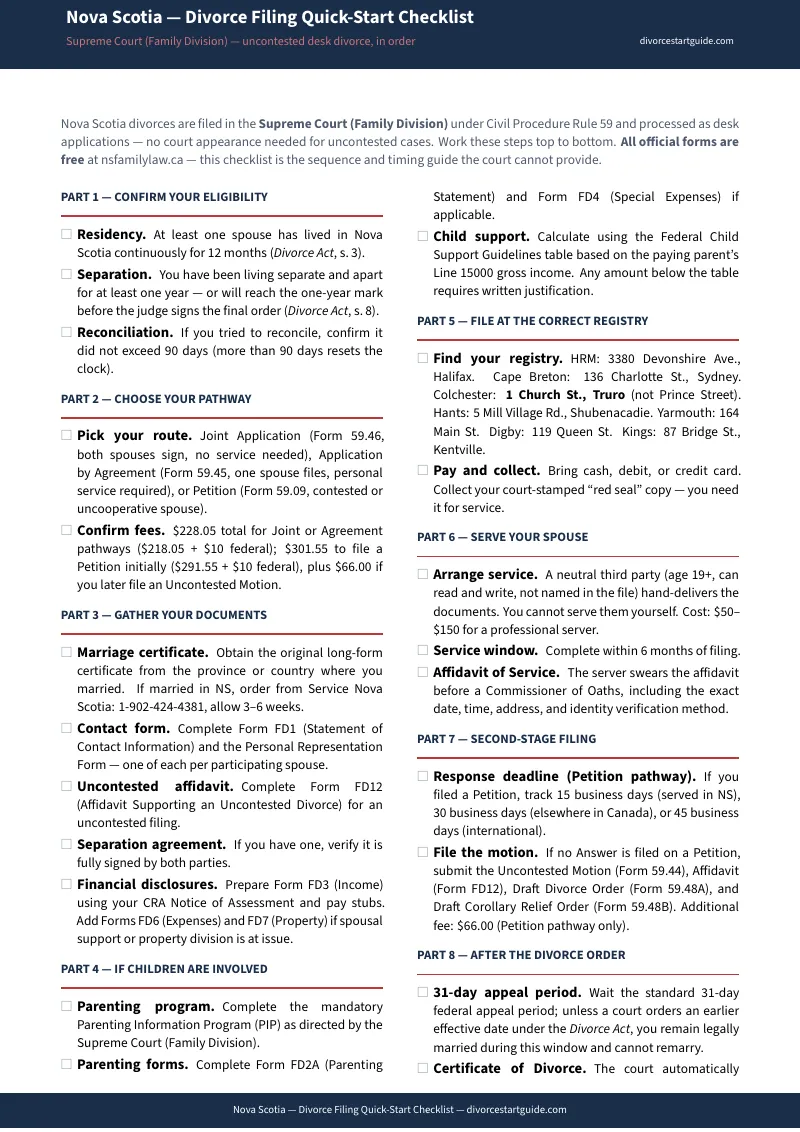
Not sure you're ready to file? Download the free Nova Scotia Divorce Filing Quick-Start Checklist — a one-page overview of residency rules, the three filing pathways, key deadlines, and a document-gathering checklist. It tells you what you need to have ready before you start filling out any forms.
The full filing guide
When you're ready for the complete process — every form, every deadline, every filing stage mapped out in order — the Nova Scotia Divorce Filing Process Guide is . It includes 13 chapters, four worksheets, and covers every administrative step from confirming your eligibility through receiving your Certificate of Divorce.
This is a process-navigation tool, not legal advice. It does not tell you what terms to put in your separation agreement or predict how a judge will rule on a contested issue. What it does is ensure that when you've made your decisions, you can file them correctly — on the first attempt, without paying someone else to do the paperwork.