The court forms ask for numbers. They don't tell you how to calculate them.
You've downloaded the Supreme Court Form 2 from the NWT Courts website. You've seen the sworn Statement of Property required under Rule 71 — three years of tax returns, twelve months of bank statements for every account, pension valuations, real estate appraisals. But the forms are blank boxes. They don't tell you how to classify an inheritance that went into the joint mortgage. They don't explain how to value a Defined Benefit pension from a mining employer. And they don't warn you that incomplete disclosure can get your settlement reopened up to six years later.
Meanwhile, NWT family lawyers charge CA$275 to $500 an hour. A $5,000 retainer buys roughly twelve hours. Two or three of those go to sorting your bank statements and pay stubs into categories. That's over $1,000 in document organization you could have handled yourself — if someone had shown you how the pieces fit together under the territorial Family Law Act.
You don't need someone to fill in the boxes for you. You need to know what the numbers mean before you write them down.
The NWT Property Equalization System
This is a complete, step-by-step guide to dividing money and property in a Northwest Territories divorce — built for the specific territorial rules that make this jurisdiction different from every province. It is not legal representation and it does not file your papers. It is the calculation and sequencing intelligence that the blank forms leave out.
At its core is the NWT Property Equalization System — a structured method that walks you from "I have a pile of bank statements and no idea what's excluded vs. family property" to a clean, organized financial inventory that meets Rule 71 disclosure standards. It handles the part everyone gets wrong: calculating Net Family Property under the Family Law Act, tracing excluded property through commingled accounts, splitting Defined Benefit pensions, transferring RRSPs tax-free using CRA Form T2030, executing mandatory CPP credit splitting, and preparing a disclosure package that won't trigger adverse cost awards.
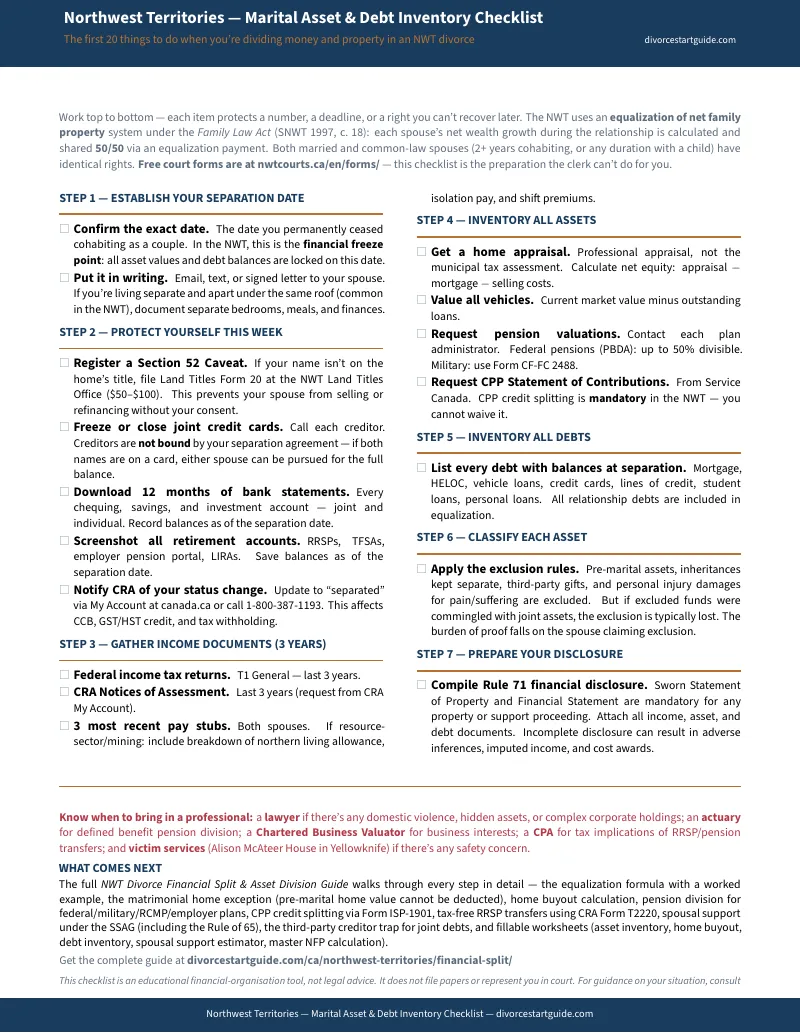
What's inside — 15-chapter guide, 9 worksheets, and the free checklist
- The Equalization Framework — how the NWT's net family property system works under the Family Law Act (SNWT 1997, c. 18), the difference between NWT equalization and BC/Ontario models, and why common-law partners who've lived together for two years get the same rights as married spouses.
- Separation Date Documentation + Worksheet — the separation date freezes asset values for equalization. In the NWT, where housing costs make living "separate and apart" under the same roof common, documenting this date with precision is critical. The worksheet creates a paper trail that holds up in court.
- Matrimonial Home Protection + Buyout Calculator — both spouses have equal possession rights regardless of whose name is on the title. The guide covers exclusive possession orders, filing a possessory caveat with the NWT Land Titles Office, and three resolution paths: buyout, sell, or deferred sale. The worksheet factors in appraised value, mortgage balance, and transaction costs.
- Family vs. Excluded Property + Tracing Log — pre-marital assets, inheritances, personal injury settlements, and third-party gifts are excluded under Section 36(3). But the burden of proof is on you. If excluded funds were deposited into a joint account, the exclusion can be lost. The tracing log documents the paper trail before evidence disappears.
- Pension and Retirement Division + Pension Worksheet — Defined Benefit division at source, Defined Contribution splits, RRSP rollovers via CRA Form T2030 (Section 146(16) tax-free transfer), TFSA division, and mandatory CPP credit splitting through Service Canada. Three different systems, three different processes — including the mining sector's complex compensation packages with isolation allowances and rotational premiums.
- Debt Allocation + Debt Inventory — family debt is divided equally regardless of whose name is on the account. A private separation agreement does not bind your bank — if a joint line of credit stays open, both parties remain liable. The guide covers joint debt strategy, credit freezes, and restructuring during separation.
- Tax Consequences + Tax-Adjusted Valuation Worksheet — RRSPs, pensions, and capital property all carry embedded tax liabilities. A $200,000 RRSP is not worth $200,000 after withdrawal taxes. The worksheet adjusts asset values for tax so your equalization payment reflects real purchasing power.
- Spousal Support + Support Estimator — SSAG range modelling for compensatory, non-compensatory, and contractual entitlement. Covers the Rule of 65 for indefinite support, child support priority rules, and the specific grounds of entitlement under both the federal Divorce Act and Part IV of the territorial Family Law Act.
- Master Net Family Property Worksheet — the final calculation. Input every asset and debt, apply the equalization formula, and build a complete property division picture to bring to mediation or your lawyer's office.
Every worksheet is included as a standalone printable PDF — print the ones you need and bring them to mediation, your lawyer review, or the kitchen table. Nine standalone printable worksheets in total: separation date documentation, home buyout calculator, excluded property tracing log, asset and debt inventory, pension division, debt inventory, tax-adjusted valuation, spousal support estimator, and the master NFP worksheet.
Who this is for
The spouse quietly gathering records before filing in Yellowknife. The person staring at the Rule 71 disclosure requirements with a shoebox of bank statements and no idea how to organize them. The mining worker's spouse wondering how isolation allowances and rotational premiums factor into equalization. The couple preparing for the NWT Family Law Mediation Program who need structured worksheets the government mediator can't provide. The person who already has a lawyer but wants to stop paying $400 an hour for document organization they can handle themselves. And the common-law partner who just learned they have the same property rights as a married spouse — and needs to act on it.
Why not just use the free resources?
Because the free resources give you definitions, not calculations. The NWT Department of Justice family law guide and the Families Change NWT site provide solid legal overviews and blank court forms. But none of them provide interactive worksheets, step-by-step pension division instructions, or structured excluded property tracing logs. They explain the law — they don't help you calculate your specific equalization payment.
The national platforms — Rocket Lawyer at CA$40 per month, LegalZoom's subscription service — don't know about the NWT Family Law Act, the Supreme Court's Rule 71 requirements, or the specific equalization formula that governs property division in the territory. Generic Canadian separation agreement templates can be set aside by a judge if they lack full financial disclosure or independent legal advice. And DIY kits from Self-Counsel Press and Legalease don't publish an NWT-specific edition at all.
An honest guarantee
Work through the NWT Property Equalization System. If the guide doesn't make your financial split clearer and better organized than any blank form or free article could — email us within 30 days for a full refund. The risk of trying it is a fraction of one attorney billable hour. The risk of guessing on your asset division is measured in years of financial consequences.
For — less than fifteen minutes of NWT attorney time — you get the equalization system, the pension division instructions, the worksheets, and the step-by-step sequence that the blank forms leave out.
Stop staring at blank boxes. Get the guide, build your inventory, and walk into your divorce with the numbers already done.