Your divorce is final. The paperwork is not.
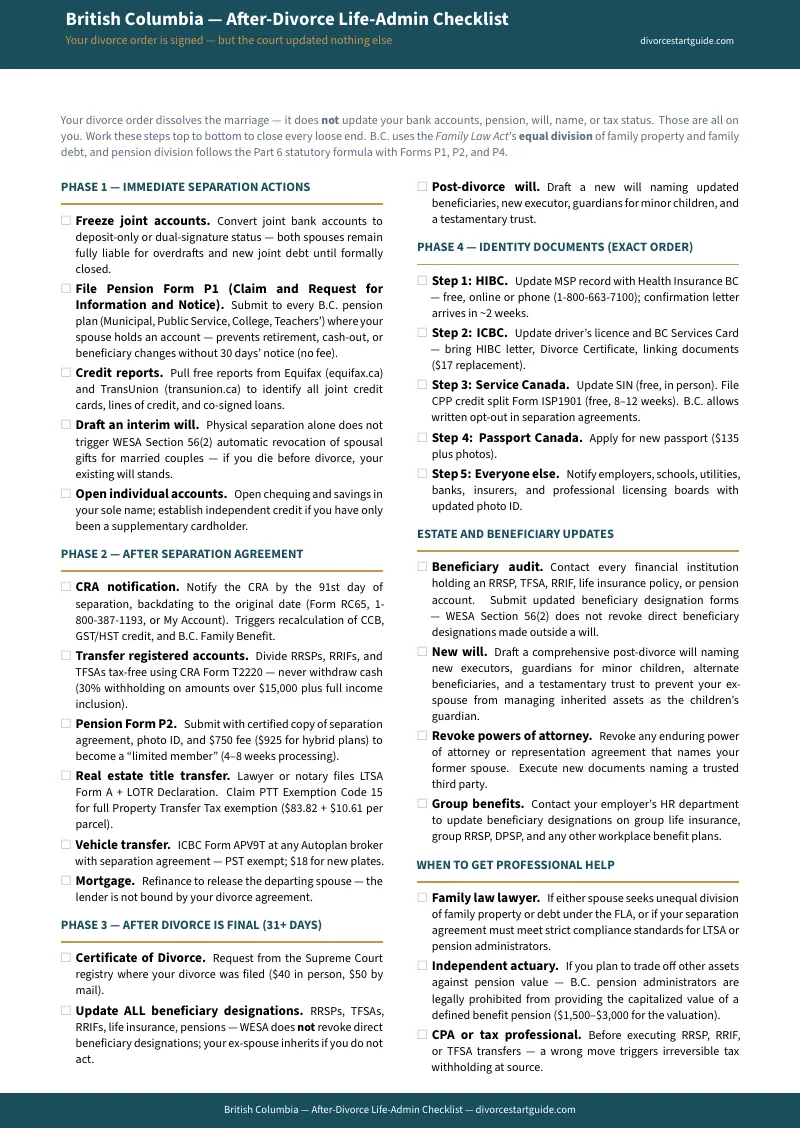
The Supreme Court entered your divorce order. You survived the 31-day appeal window. Maybe you have the Certificate of Divorce in hand. The legal proceeding is over — but now you are staring at a wall of administrative tasks the court never mentioned. Your ex-spouse is still the named beneficiary on your RRSP and life insurance. Your MSP record still carries their surname. The joint credit card is still open. Your CRA marital status is wrong, which means every Canada Child Benefit payment has been miscalculated since you separated. And the pension your separation agreement says you are entitled to? Without filing Form P1 with the plan administrator, your ex-spouse could withdraw, transfer, or commute that pension before you get a dollar.
British Columbia family lawyers charge $300 to $600 per hour. A single consultation to ask "what exactly do I do now?" will cost more than this entire guide — and most of that time will be spent listing the same administrative steps you could execute yourself, if someone put them in the right sequence.
The court gives you a decree. It does not give you a to-do list.
The Post-Divorce Navigation System
This is a step-by-step administrative guide for everything that happens after your British Columbia divorce is final — built specifically for the province's Family Law Act property division rules, the BC Vital Statistics name assumption procedure, the HIBC-before-ICBC identity update sequence, and the Wills, Estates and Succession Act provisions that most people only discover when it is too late.
At its core is the Post-Divorce Navigation System — a structured sequence that takes you from "the divorce order arrived and I don't know what to do next" to "every account, document, and beneficiary designation has been updated." It handles the parts everyone gets wrong: the difference between assuming a prior surname (free) and a legal name change under the Name Act ($137 plus 24-week wait), the HIBC-to-ICBC-to-SIN-to-passport update sequence that rejects your application if done out of order, the Form T2220 direct transfer that keeps your RRSP tax-free versus the cash withdrawal that destroys contribution room permanently, and the WESA provisions that revoke parts of your will but leave your RRSP, TFSA, and insurance beneficiary designations completely untouched.
What's inside — 13 chapters, worksheets, and the free checklist
- Post-Divorce Timeline and Certificate — the 31-day appeal window, how to request your Certificate of Divorce ($40 in-person or $50 by mail), and all four administrative phases mapped in chronological order so you know exactly what to do when.
- Name Change Navigation — the two BC pathways side by side: assuming a prior surname (free, with linking documents) versus a formal legal change under the Name Act ($137 plus criminal record check). Includes the child surname change process and the exact documents you need for each agency.
- Identity Document Update Sequence — the precise order that BC provincial systems require: HIBC first, then ICBC, then SIN, then passport. Do it out of sequence and ICBC will reject your application because the names do not match across systems. Includes the agency-by-agency checklist with fees, processing times, and document requirements.
- Joint Account Severance — freezing joint accounts during separation, converting to deposit-only, transitioning pre-authorized debits, closing joint credit cards, and rebuilding your individual credit profile. Covers the legal mechanics: both signatures are needed to close, and separation does not stop your liability for new overdrafts.
- Pension Division Under the Family Law Act — the full Part 6 process with Forms P1, P2, and P4. Form P1 protects your interest immediately. Form P2 creates your limited member account ($750 admin fee). Form P4 covers BC Public Service Pension Plan specifics. Includes out-of-province and federal pension handling.
- RRSP, RRIF, and TFSA Transfers — the Form T2220 tax-free direct transfer, the cash-out trap that destroys contribution room permanently, and how to coordinate the institution-to-institution transfer between registered accounts.
- CPP Credit Splitting — Form ISP1901, the unlimited deadline for divorced couples, BC's unusual opt-out provision, and the pension reduction dynamic where the higher earner's pension decreases by more than the lower earner gains.
- Real Estate Title Transfer — LTSA title transfer via Form A with a lawyer or notary, the Property Transfer Tax exemption under Section 14(4)(l), the $83.82 name-only correction through the BC Services Card app, and why your court order does not bind your mortgage lender.
- CRA Notification and Tax Status — Form RC65, the 90-day separation trigger, the notification deadline, and what happens to your Canada Child Benefit and GST/HST credit if you miss it. Includes spousal and child support tax treatment.
- Estate Planning After Divorce — what WESA Section 56(2) automatically revokes (gifts and executor appointments to your ex-spouse) and the four critical gaps it does not cover. Plus the post-divorce estate planning checklist.
- Beneficiary Designations — the outside-the-will trap explained: RRSPs, TFSAs, RRIFs, life insurance, and workplace pensions bypass your estate entirely. The named beneficiary on file with the institution overrides your will. Includes the account-by-account audit worksheet.
Every worksheet is included as a standalone printable PDF — Document Execution Tracker, Pension Division Worksheet, Beneficiary Audit Worksheet, Registered Account Transfer Checklist, and Identity Document Update Tracker. Print the ones you need.
Who this is for
The person who received their BC divorce order and does not know what to do next. The self-filer who handled the desk-order process alone and now faces a different kind of paperwork — banks, the CRA, HIBC, ICBC, pension administrators, and insurance companies. The cooperative couple who settled everything through mediation but never actually executed the property transfers or filed the pension forms. The parent juggling custody logistics while updating IDs and school records. And the person who got divorced months ago and is still administratively tied to their ex-spouse — their name on the mortgage, their beneficiary designations unchanged, their CRA status uncorrected.
Why not just use the free resources?
Because the free resources explain the law — they do not sequence your admin. People's Law School and Clicklaw Wikibooks provide excellent legal information, and BC's Justice Education Society covers your rights in clear language. But none of them give you a chronological action plan that connects the HIBC update to the ICBC appointment to the pension filing to the beneficiary audit to the will revision in the right order. Government websites list what forms exist. They do not tell you which forms to file first, which tasks have deadlines, or which mistakes are irreversible.
The document platforms — LawDepot at $30 to $40 per month — handle separation agreements and document generation. Their service ends when the agreement is signed. The administrative aftermath is yours to navigate.
An honest guarantee
Work through the Post-Divorce Navigation System. If the guide does not make your post-divorce admin clearer and better organised than any combination of free articles and government websites could — email us at any time for a full refund. The risk of trying it is a fraction of one lawyer consultation. The risk of guessing on your beneficiary designations, CRA deadlines, and pension filings is measured in years of financial exposure.
For — less than fifteen minutes of BC family lawyer time — you get the complete administrative sequence, the worksheets, the form references, and the trap-avoidance system that the court order leaves out.
Stop living with your ex-spouse on your insurance, your will, and your CRA file. Get the guide and close the loop.