The court forms are blank boxes. They don't tell you how to calculate what goes in them.
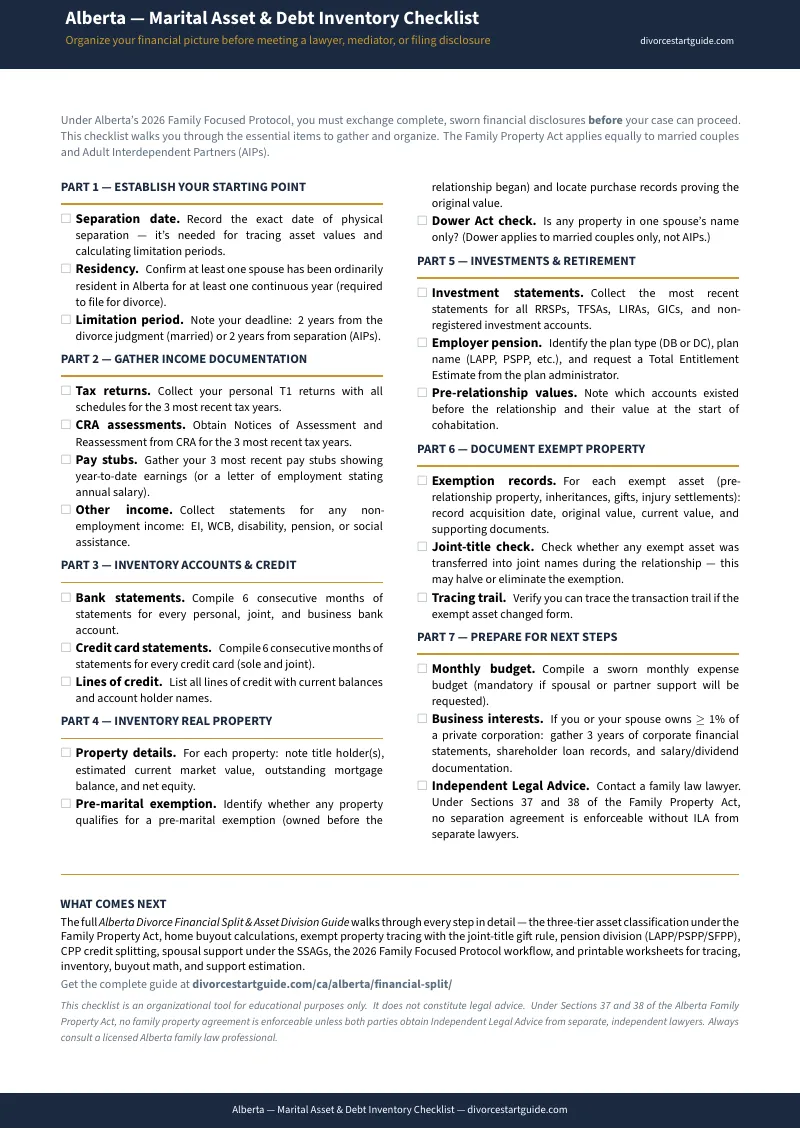
You've found the Statement of Claim and the Financial Disclosure Statement on the Court of King's Bench website. You've downloaded the blank forms. And you've hit the wall: the FFP requires you to exchange a complete, certified financial disclosure package — three years of tax returns, six months of bank statements for every account, pension valuations, corporate records — before the Case Management Officer will even look at your file. But the forms don't tell you how to classify an inheritance that went into the joint mortgage. They don't tell you how to value a Defined Benefit pension. And they don't explain that missing a single disclosure category can get your entire file rejected under the 2026 Family Focused Protocol.
Meanwhile, a family law attorney in Alberta charges CA$350–$600 an hour. A $5,000 retainer buys you roughly ten hours. Two or three of those go to sorting your bank statements and pay stubs into the right categories. That's over $1,500 in administrative work you could have done yourself — if someone had shown you how the pieces fit together.
You don't need someone to fill in the forms for you. You need to know what the numbers mean before you write them down.
The FFP Disclosure Navigation System
This is a complete, step-by-step guide to dividing money and property in an Alberta divorce — built for the specific rules that make this province different from every other jurisdiction in Canada. It is not legal representation and it does not file your papers. It is the calculation and sequencing intelligence that the blank forms leave out.
At its core is the FFP Disclosure Navigation System — a structured method that walks you from "I have a pile of bank statements and no idea what's exempt vs. family property" to a clean, organized financial inventory that meets the court's disclosure standard under the Family Property Act and the 2026 Family Focused Protocol. It handles the part everyone gets wrong: classifying assets into Alberta's three-tier system, tracing exempt property through commingled accounts, splitting Defined Benefit pensions at source under the EPPA, transferring RRSPs tax-free using CRA Form T2220, and preparing a disclosure package that won't get rejected by the Case Management Officer.
What's inside — 13-chapter guide, 4 worksheets, and the free checklist
- The Family Property Act Framework — how Alberta's three-tier division system works (equal split, exempt, just and equitable), the difference between married spouses and Adult Interdependent Partners, and why Alberta uses direct division rather than the net-worth equalization model used in Ontario.
- The 2026 Family Focused Protocol Roadmap — exactly what you must complete before the court will accept your file: the Parenting After Separation course, alternative dispute resolution, the 16-category financial disclosure exchange, and the Family Court Counsellor meeting. Step-by-step, with deadlines and the consequences of missing them.
- 16-Category Financial Disclosure System — every document category the FFP requires, organized into a single reference. Income, real property, vehicles, bank accounts, investments, pensions, business interests, debts, personal property, and more. Each category lists exactly what to gather, where to find it, and why the CMO needs it.
- Exempt Property and the Tracing Rule + Tracing Worksheet — pre-marital assets, inheritances, and third-party gifts are exempt under Section 7(2) of the FPA. But if you deposited an inheritance into a joint account or used it to pay down the mortgage, the exemption can be diminished or destroyed. The tracing worksheet walks you through documenting the paper trail before it goes cold.
- The Family Home Decision Framework — both spouses have Dower Act rights regardless of whose name is on the title. The guide walks through the three paths: refinance and buy out the other's equity, sell and split net proceeds, or defer the sale. The Home Buyout Calculation Worksheet factors in pre-marital equity, mortgage balance, refinancing costs, and CMHC insurance requirements.
- Pension and Retirement Division — Defined Benefit pension division at source under the Alberta Employment Pension Plans Act, LIRA transfer mechanics, Defined Contribution plan splits, RRSP rollovers using CRA Form T2220, TFSA division, and mandatory CPP credit splitting through Service Canada. Three different systems, three different processes, all in one chapter.
- Debt Allocation — family debt is divided regardless of whose name is on the account. But a private separation agreement does not bind your bank — if a joint line of credit stays open, both parties remain liable. The guide covers joint debt strategy, credit protection, and restructuring during separation.
- Spousal and Partner Support + Support Estimator Worksheet — SSAG range modelling for compensatory, non-compensatory, and contractual entitlement. Includes the three grounds of entitlement, duration formulas, the priority of child support, and the impact of the Wild v. Wild appellate ruling on how Alberta courts now treat the advisory guidelines.
- Business Interests and Corporate Assets — how the court values and divides corporate interests, shareholder loans, retained earnings, and the specific corporate disclosure requirements under the FFP. Covers both the business owner's and the non-owner spouse's positions.
- Asset and Debt Inventory Worksheet — the master calculation. Input every asset and debt, apply the three-tier classification (equal split, exempt, just and equitable), and build a complete property division picture to bring to mediation or your lawyer's office.
Every worksheet is included as a standalone printable PDF — print the ones you need and bring them to mediation, your lawyer review, or the kitchen table. Four worksheets in total: the exempt property tracing log, the asset and debt inventory, the home buyout calculator, and the spousal support estimator.
Who this is for
The spouse quietly gathering records before filing. The person staring at the FFP's 16-category disclosure list with a shoebox of bank statements and no idea how to organize them. The public servant wondering how their LAPP or Teachers' Pension gets divided at source. The homemaker calculating whether they can afford to keep the house after refinancing. The cooperative couple who want to reach a fair agreement at mediation without spending $8,000 on billable hours — but need the math to prove the agreement is actually fair. And the spouse who already has a lawyer but wants to stop paying $450 an hour for document organization they can handle themselves.
Why not just use the free resources?
Because the free resources give you forms, not calculations. CPLEA and the Court of King's Bench provide excellent legal explanations and blank PDFs. The Resolution and Court Administration Services office offers guidance. But none of them provide interactive worksheets, step-by-step pension division instructions, or structured tracing logs. They explain the law — they don't help you calculate your specific financial division.
The national platforms — LawDepot at CA$54 per month, Divorcepath for support-only calculations — don't know about Alberta's three-tier property system, the Dower Act, the FFP's 16-category disclosure requirements, or the specific sections of the Family Property Act that determine how your assets get classified. Generic separation agreement templates can be set aside by a judge under Section 38 if they lack full financial disclosure or independent legal advice.
An honest guarantee
Work through the FFP Disclosure Navigation System. If the guide doesn't make your financial split clearer and better organized than any blank form or free article could — email us within 30 days for a full refund. The risk of trying it is a fraction of one attorney billable hour. The risk of guessing on your asset division is measured in years of financial consequences.
For — less than fifteen minutes of attorney time — you get the classification system, the pension division instructions, the worksheets, and the step-by-step sequence that the free forms leave out.
Stop staring at blank boxes. Get the guide, build your inventory, and walk into your divorce with the numbers already done.