You Know the Relationship Is Over. But Who Gets What?
You've separated. Maybe you're still living under the same roof while you figure out logistics. Maybe one of you has already moved out. Either way, the question hanging over everything is the same: how do you divide a life you built together — the house, the super, the savings, the debts — without losing more than you have to?
You could search the Federal Circuit and Family Court website for answers. You'll find the Financial Statement Kit — a blank interrogatory that demands exact figures under penalty. You'll find factsheets explaining that the court uses a "just and equitable" framework. What you won't find is a single document that tells you how to calculate your actual share, what contribution arguments to make, how superannuation splitting works in practice, or when to push for Consent Orders versus a Binding Financial Agreement.
The forms are free. The calculations, strategy, and sequencing that protect your financial future are not included anywhere in them.
The Property Pool Method
The Northern Territory Divorce Financial Split & Asset Division Guide is a self-paced workbook that takes you through the federal Family Law Act's property settlement framework step by step — not as a legal textbook, but as a practical operating manual you can use to prepare your own analysis before negotiation, mediation, or court.
It follows the same analytical structure a family lawyer would use to advise you, built around the post-June 2025 statutory reforms: identify everything in the pool, calculate net value, assess contributions, factor in future needs, and test whether the result is just and equitable. The difference is that instead of paying a solicitor to walk you through this at $400–$700 per hour, you do it yourself with worksheets, decision frameworks, and worked examples written specifically for Northern Territory separations.
What's Inside
- Property Pool Mapping Framework — a systematic inventory process for every asset class (real estate, bank accounts, vehicles, investments, personal property) and every liability (mortgages, credit cards, tax debts, personal loans), whether held jointly or individually
- Contribution Analysis Worksheets — structured frameworks for documenting financial contributions, non-financial contributions (renovations, business support), and homemaker/parenting contributions, following the factors the court actually weighs
- Superannuation Splitting Guide — how to request valuations, the difference between splitting and offsetting, the 28-day trustee notice requirement, and step-by-step instructions for both defined-benefit and accumulation fund splits
- Family Home Decision Map — the three main options (sole buyout, immediate sale, deferred sale) analysed by financial outcome, with refinancing capacity checks and the practical steps for removing a name from a joint mortgage
- Debt Allocation Framework — how joint and individual debts are treated in the property pool, the critical risk of joint mortgages after separation (banks are not bound by court orders), and strategies for managing liability exposure during negotiations
- Spousal Maintenance Assessment — the two-part threshold test under the Family Law Act (financial need versus capacity to pay), how to calculate a supportable claim, and the difference between interim and final maintenance
- Consent Orders vs. BFA Decision Flowchart — a one-page decision tool that helps you choose the right formalisation pathway based on your situation, with cost comparisons and enforcement implications
- Tax and Stamp Duty Exemption Protocols — Capital Gains Tax rollover relief under the ITAA 1997, the Territory Revenue Office stamp duty exemption process, and the 60-day lodgement deadline you cannot miss
- De Facto Evidence Log — a structured template for NT residents who need to establish their relationship existed on a "genuine domestic basis" under Section 4AA, since the Northern Territory does not offer de facto relationship registration
- Complete Settlement Workflow — the full chronological sequence from separation through financial disclosure, alternative dispute resolution, agreement drafting, to sealed Consent Orders and post-settlement admin
Who This Is For
- Separating couples who agree on a fair split but need to document it properly and turn it into legally binding Consent Orders
- Anyone preparing for mediation who wants to arrive with a calculated position based on actual asset values and contribution evidence
- People who suspect their former partner may not be disclosing everything and need a systematic framework for identifying what should be in the pool
- De facto partners in the Northern Territory who need to prove their relationship status before they can begin property discussions
- Anyone facing the 12-month post-divorce or 2-year post-separation deadline and needing to move quickly
Why Not Just Use Free Government Resources?
The Federal Circuit and Family Court website publishes every form, every factsheet, and every practice direction — all free. Legal Aid NT and the Top End Women's Legal Service provide excellent community legal education materials. The government-backed platform Amica will even suggest a percentage split based on your inputs.
Here's the gap: free resources give you the what (forms to fill, rules to follow, definitions to understand) but not the how (calculate your pool, assess your contributions, structure a settlement offer that will actually survive the court's scrutiny). Amica requires both parties to cooperate in a shared portal and excludes any split involving trusts, private companies, overseas assets, or bankruptcy. The Financial Statement Kit is a blank document that assumes you already know what to put in each field.
This guide fills the operational gap between "I know I need to divide our property" and "I have a documented, defensible analysis of what a fair split looks like."
What About Hiring a Lawyer?
If your situation involves family violence, complex trust structures, international assets, or a partner who refuses to negotiate — hire a family lawyer. That's not a hedge; it's a genuine recommendation. Some situations require professional representation.
But if your separation is relatively straightforward and you're trying to resolve things without spending $15,000–$100,000 on litigation, this guide gives you the analytical tools to prepare your own position. Many people use it to get organised before their first legal consultation — which typically runs $295–$500 for an hour — so they spend that expensive hour on strategy, not basic explanations of how property pools work.
Satisfaction Guarantee, No Time Limit
If the guide doesn't give you a clear, usable framework for calculating and documenting your property settlement, email us at any time for a full refund. No questions, no forms.
Get Started Today
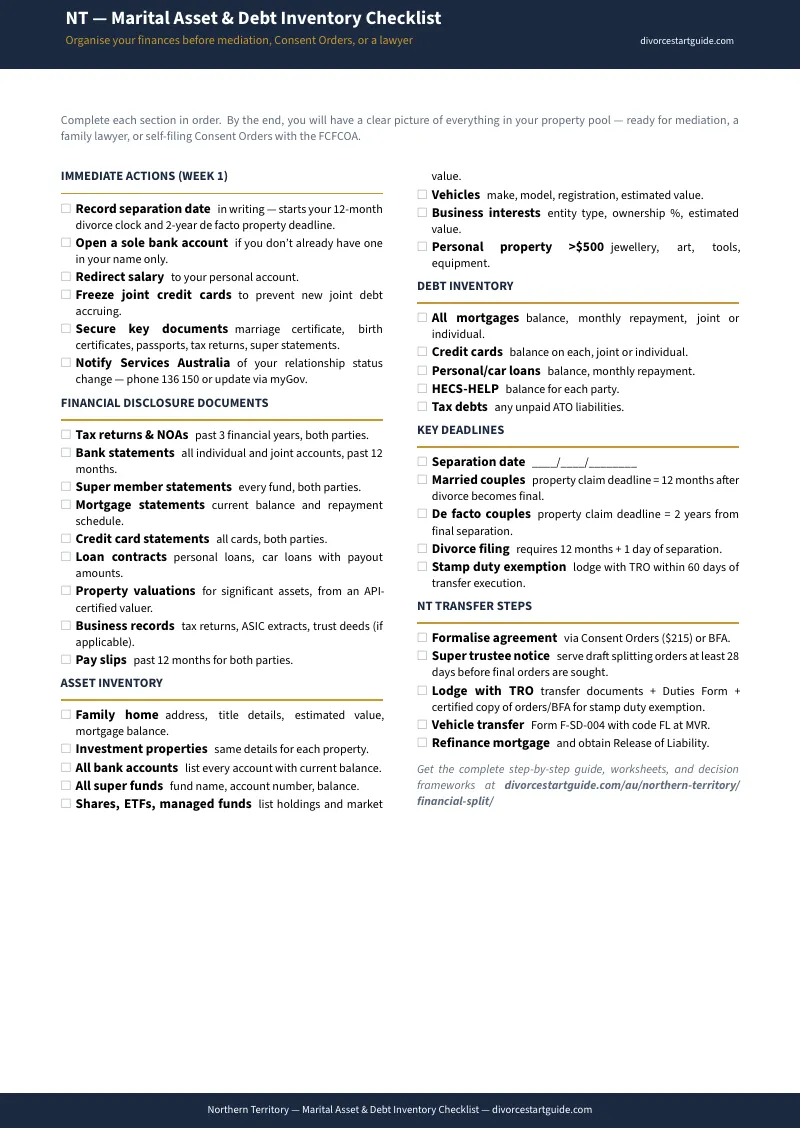
Download the free Marital Asset & Debt Inventory Checklist to start mapping what's in your property pool — or get the full guide with contribution analysis worksheets, superannuation splitting instructions, decision flowcharts, and the complete settlement workflow included.
The Family Law Act gives you the right to a just and equitable division. This guide gives you the tools to calculate what that actually looks like for your situation.