
You Know the Marriage Is Over. You Don't Know Who Gets What.
You've made the hardest decision. Now comes the part nobody warned you about: sitting across from the person you used to trust with everything and dividing every dollar, every asset, every debt you built together.
The court forms are free — but they're blank. They ask for numbers you don't have, in categories you don't understand, using a framework that changed when the Family Law Amendment Act 2024 took effect in June 2025. The FCFCOA wants a complete net asset pool valuation, a contribution analysis, and a future needs adjustment — all before they'll seal your consent orders. Free government resources tell you what the law says. They don't show you how to do the maths.
The Property Settlement Method
This guide is the calculation and negotiation layer that sits between your separation and a binding court order. It translates the codified four-step statutory framework into plain-English worksheets you can fill in together — or on your own if your ex isn't cooperating.
You start by building a complete financial inventory: every bank account, property, vehicle, super fund, business interest, crypto holding, and debt. Then you work through the contribution analysis — financial and non-financial, direct and indirect, including the expanded family violence provisions in the 2024 amendments. Then future needs. Then the just-and-equitable check. By the time you open Form 11, you already know what numbers go where.
What's Inside — 12 PDFs
The complete guide plus 10 standalone printable worksheets and reference cards you can bring to mediation, your conveyancer meeting, or your solicitor appointment.
- Four-step framework worksheets — the codified statutory sequence from the 2024 amendments, broken into fillable pages that walk you through asset pool identification, contribution evaluation, future needs adjustment, and the final fairness test
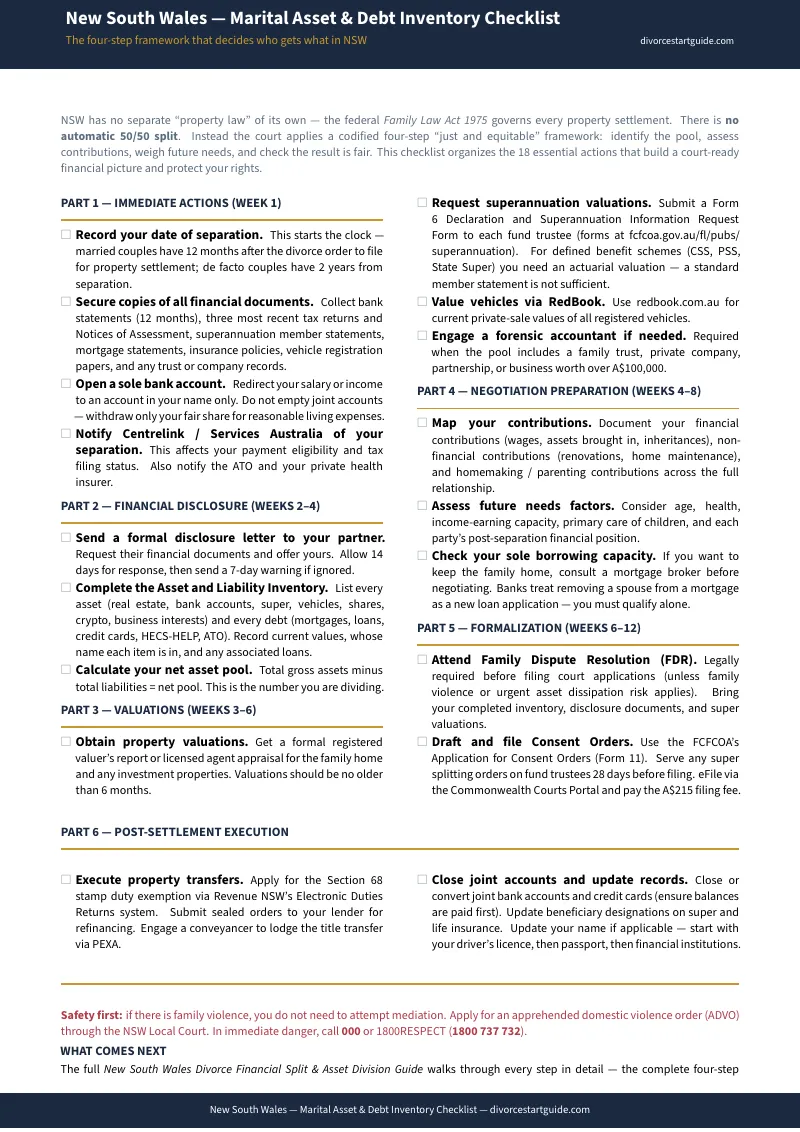
- Full financial disclosure inventory — a structured asset-and-debt tracker covering real property, bank accounts, vehicles, business interests, superannuation, crypto, and contingent liabilities, aligned with the court's mandatory disclosure requirements so nothing falls through the cracks
- Superannuation splitting roadmap — how to request a Family Law Valuation from your fund trustee, calculate the splitting percentage, serve the 28-day procedural fairness notice, and lodge the splitting order — including SMSF-specific steps most free guides ignore
- Family home decision matrix — model a buyout, immediate sale, or deferred sale, including what happens when the remaining partner can't pass the bank's borrowing-capacity assessment for mortgage assumption
- Revenue NSW stamp duty exemption walkthrough — the Section 68 Duties Act 1997 process that eliminates transfer duty on property transfers under court orders, with the exact documentation Revenue NSW requires and the common mistakes that trigger a full duty assessment
- CGT rollover relief checklist — the Subdivision 126-A conditions for tax-free asset transfers, cost-base reset rules, and the specific scenarios where rollover relief doesn't apply (spoiler: informal handshake agreements don't qualify)
- Consent orders vs BFA comparison — when each formalisation route is appropriate, what the court checks before sealing consent orders, why the 90-day execution window matters, and what independent legal advice a BFA actually requires
- Spousal maintenance analysis framework — the statutory threshold test (need vs capacity to pay), how maintenance interacts with the property split, and the strict application deadlines that most people discover too late
- Debt allocation framework — classify joint vs individual debts, understand why the bank isn't bound by your court order on the joint mortgage, and build a post-separation account closure sequence that protects your credit
- 90-day execution timeline — a week-by-week preparation schedule built around the FCFCOA's strict rule that consent orders must be lodged within 90 days of the first signed Statement of Truth
- Settlement master checklist — six-phase tracker covering the entire process from separation through post-settlement actions, with every critical deadline marked
Who It's For
- Self-represented filers who need to calculate the actual figures before populating the court's Application for Consent Orders
- Amicable separators who want to reach a fair agreement and formalise it without paying solicitors to negotiate — the worksheets give both parties a shared financial baseline
- The lower-information spouse who didn't manage the household finances and needs a structured audit tool to verify disclosures and trace commingled assets
- De facto partners navigating the same federal property settlement framework as married couples, with the added urgency of the strict 2-year limitation period
- Mediation-bound parties who want to arrive with a complete asset inventory and contribution analysis rather than spending billable hours on basic fact-gathering
Why Not Just Use the Free Court Kit?
The FCFCOA's self-help resources are excellent — for the filing stage. They give you blank templates and tell you what the law requires. But they don't help you calculate your net asset pool, negotiate a percentage split, or figure out whether you should keep the house or sell it.
Amica — the government's AI tool — is a solid option for simple separations with no trusts, companies, or complex super. But it can't handle discretionary trusts, business interests, SMSFs, or situations where one party isn't cooperating. And at $270+ GST for a basic agreement or $900+ GST for draft consent orders, it's not free either.
This guide fills the gap between blank forms and expensive professionals. It's the preparation layer that turns a pile of bank statements into an organised, court-ready financial case — for a fraction of a single hour of a family lawyer's time.
The Stakes Are Real
Transfer a property without formal court orders and Revenue NSW will charge you the full stamp duty — potentially tens of thousands of dollars on a standard family home. Miss the 12-month deadline after your divorce order (or the 2-year deadline for de facto couples) and you'll need the court's permission to proceed, which is rarely granted. File your consent orders more than 90 days after the first Statement of Truth and the court will reject them outright.
This guide helps you hit every deadline, avoid every avoidable tax bill, and get to a sealed consent order without paying a solicitor to fill in forms you could fill in yourself — once someone shows you how.
Satisfaction Guarantee
If the guide doesn't give you a clear, actionable path through your property settlement, email us for a full refund. No deadline, no questions.
— Less Than One Hour of Legal Advice
Family lawyers in NSW typically charge $300–$600 per hour. A straightforward consent order through a solicitor runs $2,000–$5,500. This guide gives you the preparation framework, worksheets, and execution checklists to handle the process yourself — for less than a single billable unit.
Download the free checklist to start your asset inventory tonight. When you're ready for the full framework, the complete guide is waiting.