You've decided to file for divorce in Vermont. You've found the forms on vtcourts.gov. You've even run through the VTCourtForms guided interview at vtlawhelp.org. Now you're staring at five auto-generated documents and a Family Division clerk's office that will reject your paperwork without telling you why — because they're legally prohibited from giving legal advice.
Here's the part nobody warns you about: Vermont's free tools give you every blank form you'll ever need, but not one of them explains what to write on them, which packet to choose based on whether you have minor children, what happens when your spouse ignores the 21-day response window, or how the dual residency rule — six months to file, one full year before the court can grant a final decree — actually plays out on a calendar. Get the sequence wrong and you're not just delayed. You're paying the $295 contested fee instead of the $90 stipulated rate. You're blowing a 30-day service deadline. You're waiving the nisi period without understanding what it costs you in health insurance and taxes.
The problem isn't the forms. It's the filing sequence.
People filing for divorce in Vermont don't fail because the court is hiding paperwork. They fail because nobody maps the chronological order — which document triggers which deadline, which path unlocks the $90 fee, which service method to choose when your spouse won't sign the Acceptance of Service form, and which financial disclosures to prepare before you ever open the court's online tool. The free resources hand you the building blocks. This guide shows you how they fit together.
Introducing the Filing Sequence Navigator
This is the Vermont Divorce Filing Process Guide — a step-by-step execution manual that starts where the free forms leave off. Not a set of blank PDFs. Not a generic "how to file for divorce" article. A chronological roadmap built around Vermont's actual statutes (15 V.S.A. Chapters 11 and 16), Family Division rules, and filing procedures, organized so every action builds on the one before it and every deadline is mapped to a calendar you control.
It's built on one idea we call the Filing Sequence Navigator: every decision, form, fee, and deadline placed in the exact order the Vermont Family Division requires — so the clerk accepts your paperwork the first time and you never pay more than you have to.
What's inside
- The Dual Residency Calculator. Vermont's biggest trip hazard: six months of continuous residence to file, one full year before the court can hold the final hearing. This worksheet maps both timelines to your specific dates, so you know exactly when to file and when to expect the final hearing — and how temporary absences for work or illness affect the clock under 15 V.S.A. § 592. For anyone who needs to know whether filing now is worth it or whether waiting saves them a wasted trip to the clerk's office.
- The Four-Path Decision Tree. Stipulated without children ($90, fastest). Stipulated with children ($90, requires COPE class and parenting plan). Contested without children ($295). Contested with children ($295, six-month minimum before final hearing). A printable worksheet that identifies your path, your filing packet, your fee, and your expected timeline — in five minutes. For anyone overwhelmed by the branching options who needs a single clear answer.
- The Service-of-Process Playbook. Four methods, four cost tiers, one 30-day deadline. Voluntary Acceptance of Service (free). First-class mail with waiver request ($3). Certified restricted delivery ($18.50). Sheriff or private process server ($40–$100). Plus what to do when your spouse is missing and you need to petition for service by publication. Each method explained with the exact form, exact fee, and exact deadline math. For the filer whose spouse won't cooperate and needs a backup plan before the clock runs out.
- The VTCourtForms Co-Pilot. The state's guided interview tool generates your five-form filing packet — but it doesn't explain what the legal terms mean, which answers trigger which follow-up forms, or how to spot errors before the clerk does. This section walks you through each screen so you enter the right information the first time. For anyone who opened VTCourtForms, got confused by the third question, and closed the tab.
- The Financial Division Workbook. Vermont is an equitable distribution state — the court divides property fairly, not equally, and it can reach all property owned by either spouse regardless of title or timing. These worksheets help you inventory assets, classify debts, estimate spousal maintenance using the statutory factors under 15 V.S.A. § 752, and calculate child support using the state guidelines — before you ever open the official Financial Affidavit forms. For the spouse who wants to negotiate from a position of knowledge, not guesswork.
- The Nisi Period Decision Matrix. Vermont's mandatory 90-day cooling-off period after the judge signs your decree. You're still legally married during nisi — which means your employer-sponsored health insurance stays active, your tax filing status might still be "married filing jointly," and you cannot remarry. A structured decision tool that weighs the financial impact of waiving nisi versus keeping it. For anyone who doesn't want to lose health coverage or trigger unexpected tax consequences by waiving too quickly.
- The Same-Roof Separation Guide. Can't afford two households? Vermont courts accept same-roof separations — separate bedrooms, separate finances, separate daily lives — but the burden of proof is on you. A documentation worksheet and evidence log that helps you build the record a Family Division judge needs to see. For couples living under the same roof who need to prove they're separated without separate addresses.
- Deadline Timeline Tracker. Every critical deadline mapped on a printable timeline: the 6-month separation period, the 30-day service window, the 21-day response deadline, the financial disclosure exchange, the COPE class deadline (if children), the 1-year residency threshold, and the 90-day nisi period. So you never miss a deadline you didn't know existed.
Who this is for
You're filing for divorce in the Vermont Family Division of the Superior Court — or you're seriously thinking about it. You don't qualify for Vermont Legal Aid's direct representation, and you're not ready to spend $285 an hour on a family attorney for a case you believe you can manage yourself. You want a clear, honest roadmap that tells you what to file, when to file it, what it costs, and what happens next — without the anxiety of guessing whether you've missed a form or blown a deadline.
Why not just use the free court resources?
Because they end at the individual form. The Vermont Judiciary at vtcourts.gov publishes every form. VTCourtForms generates your initial filing packet through a guided interview. Vermont Legal Aid's Divorce Roadmap explains your legal rights in plain language. None of these resources map the chronological sequence — which form to file before which other form, how to choose between service methods when your spouse is uncooperative, how the dual residency rule interacts with the nisi waiting period, or how to organize your financial information before opening the court's online tool. LegalZoom charges $150–$2,000 for document preparation that lacks Vermont-specific procedural nuance. 3 Step Divorce charges $299 for form assembly that leaves you alone for the hearing. This guide fills the gap between "I have the forms" and "I filed correctly the first time."
A quick, honest boundary
This is a process-navigation and organization tool, not legal advice and not a law firm. It complies with the exceptions in Vermont Administrative Order 41 — providing general legal information and procedural roadmaps through a published self-help resource. It helps you gather the right documents in the right order before you contact the clerk's office, a mediator, or an attorney. For cases involving domestic violence, hidden assets, complex business valuations, or pension plans requiring a QDRO, it will tell you plainly when to bring in a professional — and save you money on everything else.
Our guarantee
If this guide doesn't make your Vermont divorce filing process clearer and calmer, email us at any time for a full, no-questions-asked refund. The risk is entirely ours.
— less than one hour with a Vermont family attorney
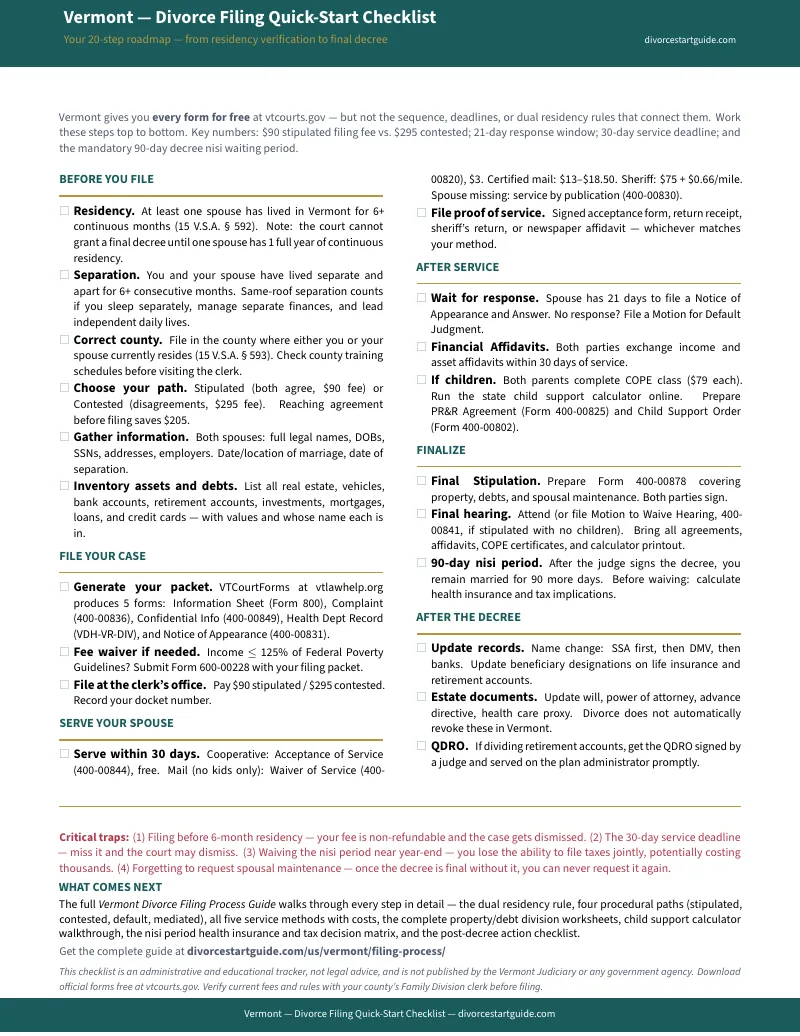
Not sure yet? Start with the free Vermont — Divorce Filing Quick-Start Checklist — a 20-step action plan covering the filing sequence from residency confirmation through post-decree tasks. When you're ready for the full Filing Sequence Navigator — the decision trees, financial worksheets, service playbook, nisi decision worksheet, deadline timeline tracker, and 9 standalone printable worksheets — the paid guide is waiting.
Get the Vermont Divorce Filing Process Guide →
Vermont gives you every form for free. This guide tells you what to write on them — and what order to file them in.
Frequently Asked Questions
What if the rules change after I buy?
We update the guide when the rules change. Email us any time, even years later, and we'll send you the current edition free.