
Your Divorce Lawyer Bills by the Hour. This Is the Client Efficiency System That Cuts the Bill.
The average family law attorney charges $314 per hour. A contested divorce costs $15,000 to $50,000 in legal fees. And the single biggest factor in what you'll pay isn't your lawyer's rates or your spouse's behaviour — it's how organised you are as a client.
Every disorganised email costs a billing increment. Every question you could have batched into one call becomes three separate charges. Every document you fail to bring to the first meeting is a task your lawyer delegates to a paralegal — on your dime. The retainer you paid last month? Gone. The "replenishment retainer" request just hit your inbox. And nobody explained how the trust account actually works before you signed the fee agreement.
The legal system has no incentive to teach you how to be an efficient client. Your attorney's revenue increases when you're confused. Court self-help pages hand you blank forms with zero strategy. And the $500 "free" consultation you just booked? You'll walk in with no framework for evaluating whether this person is right for your case.
The Client Efficiency System
This playbook turns you from a passive, bill-generating client into an organised participant in your own case. It's not legal advice — it's the administrative prep manual that makes your lawyer more effective, your communication more efficient, and your invoices auditable.
Jurisdiction-neutral. Works whether your divorce is amicable or contested. Pays for itself if it saves you a single six-minute billing increment.
What You Get
The Decision Matrix
A diagnostic worksheet that tells you whether you need full representation, limited-scope help, or just a one-time document review. Not everyone needs a $5,000 retainer — but the legal industry won't tell you that. This framework maps your case complexity (custody disputes, pension division, business assets, domestic violence) to the minimum effective level of legal help.
10 Consultation Question Scripts
Organised into three evaluation buckets: strategic methodology (their litigation-to-settlement ratio, typical timeline), operational communication (paralegal delegation, response-time policy), and fee mechanics (billing increments, retainer lifetime, replenishment thresholds). You'll know in 20 minutes whether this attorney is a fit — instead of discovering six months and $8,000 later that they're wrong for your case.
Fee Agreement Audit Checklist
A clause-by-clause walkthrough of what to look for — and what to push back on — before you sign. Covers hourly rates by staff level, billing increment parameters, retainer replenishment triggers, expense pre-approval clauses, and the "security interest" trap that lets some attorneys place a lien on your home to guarantee payment.
Billable Hour Tracker & Audit Worksheets
A printable system for monitoring every invoice against your fee agreement. Track billing entries by task type. Flag suspicious charges: travel time billed at partner rate, clerical tasks charged at attorney rate, minimum-increment padding on two-minute emails. This is how you catch the $400 charges for "reviewing your email" that took 90 seconds.
Communication Efficiency Templates
Pre-structured email templates that replace five reactive messages per week (five billing increments) with one organised weekly update. Includes decision frameworks for routing tasks to paralegals instead of partners, saving $150–$200 per task without your attorney noticing or caring.
Retainer Mechanics Explainer
Plain-English breakdown of client trust accounts, how hourly charges are deducted, why your retainer isn't a flat fee, what triggers the replenishment cycle, and your legal right to a full refund of unearned fees if you terminate. Includes a projection worksheet for estimating when your retainer will deplete based on case type and communication frequency.
Red Flags & Exit Strategy
How to identify an attorney who's inflating your bill, promising outcomes they can't guarantee, or just not answering your calls. Plus the step-by-step process for switching attorneys mid-case — Substitution of Attorney filing, file transfer logistics, and unearned retainer recovery. You are never locked in.
Limited-Scope & Unbundled Services Guide
A framework for hiring an attorney for specific tasks only — document review, mediation coaching, settlement agreement drafting — instead of full representation. Comparison worksheet showing typical costs: full-scope ($10,000+) versus limited-scope ($1,500–$4,000) for common case types. This is how amicable couples avoid spending $15,000 when $2,000 would do.
Who This Is For
- Deciding whether to hire: The decision matrix gives you a clear, non-fearmongering framework — so you're not overpaying for full representation when a $300 document review is all you need.
- About to book your first consultation: The prep scripts ensure you evaluate the attorney instead of just describing your situation — so you hire right the first time.
- Bills are spiralling: The audit worksheets and communication templates give you immediate cost-containment tools — without damaging the attorney-client relationship.
- Considering firing your lawyer: The exit strategy section walks you through switching mid-case — file transfer, substitution filing, retainer refund — so fear of starting over doesn't trap you.
- Choosing between mediation and litigation: The comparison framework maps each option to your budget, case complexity, and co-parenting situation.
Why Free Tools Don't Solve This
Court self-help pages give you blank forms. They don't teach you how to prepare for a consultation, audit a retainer invoice, or distinguish between tasks that require a $350/hour attorney and tasks a $120/hour paralegal can handle.
Legal blogs and Reddit threads offer fragments — a scattered list of "10 questions to ask" here, a vague "how to save money" post there. None of it connects the decision of whether to hire with the mechanics of how billing works with the strategy of managing the relationship through your entire case.
Attorney directories (Avvo, FindLaw, Justia) match you with attorneys who pay for placement. They don't teach you how to evaluate whether that attorney is right for your case, how their fee structure works, or how to contain costs once you've hired them.
Document prep services (LegalZoom, 3StepDivorce) generate paperwork for simple uncontested cases. If your divorce involves anything beyond basic form-filling — custody, real property, pension, business assets — you need an attorney. And once you have one, you need this playbook to manage the relationship efficiently.
Satisfaction Guarantee
If the playbook doesn't give you a clearer framework for selecting, hiring, and managing your divorce attorney than anything else you've found online, email us and we'll refund you immediately. No time limit, no questions.
Get Started Today
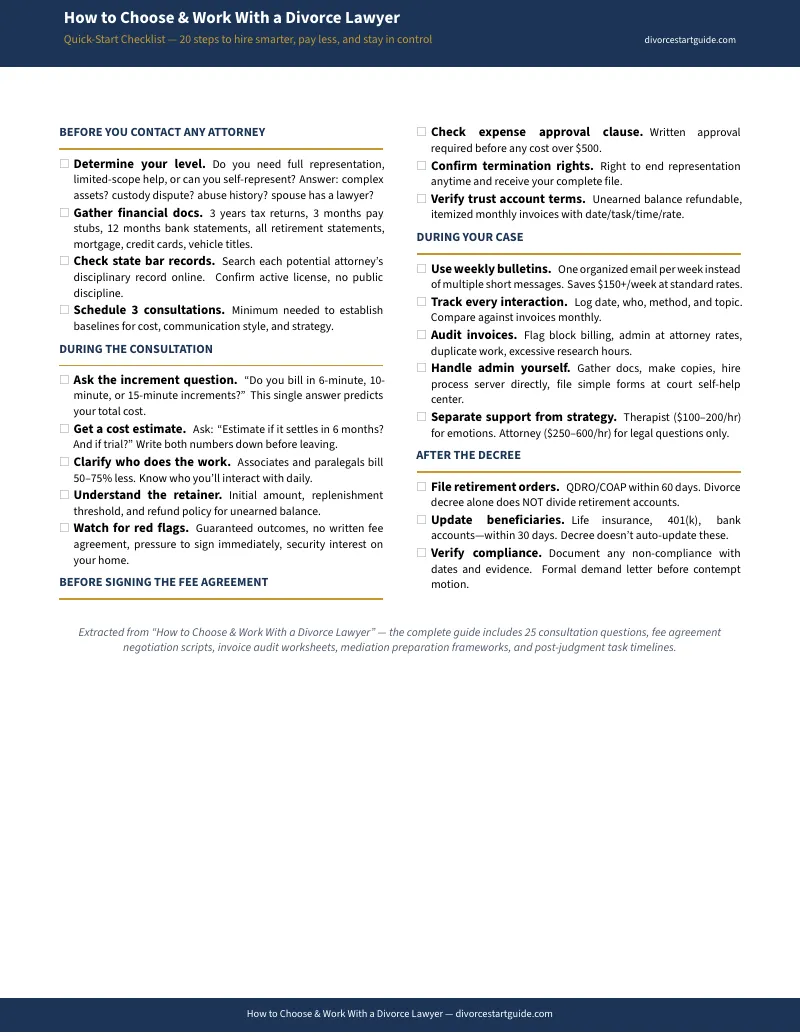
Download the free Quick-Start Checklist — a one-page summary of the critical steps — or get the complete Client Efficiency System with all worksheets, scripts, and audit tools for .
The families who spend the least on divorce aren't the ones with the cheapest lawyers. They're the ones who show up prepared. This is the preparation.