
Your Divorce Has Enough Uncertainty. Your Deadlines Shouldn't.
You open one email and find a hearing date. Another deadline is buried in the papers on your counter. The financial records are in three different accounts, the proof of service is with someone else, and you are no longer sure whether the reminder in your phone is the real due date or the day you meant to start preparing.
That is how capable people miss critical steps. Not because they do not care. Because divorce turns one life crisis into dozens of administrative handoffs, and no one gives you a single place to manage them.
The court gives you forms. A lawyer gives you legal advice. A calendar stores dates. None of them connects the whole chain: what started the clock, where the rule came from, what you must do, and which document proves you did it.
The Source-to-Proof Deadline System
The Divorce Timeline & Deadline Planner is built around a simple rule: a date does not enter your calendar without a source, and a task does not count as finished without proof.
That is the Source-to-Proof Deadline System. Instead of giving you another generic divorce timeline, it gives you a working control center you can adapt to your court's rules. Every deadline row ties together the trigger event, official source, due date and time, reminders, status, and completion record.
You stop trying to hold the case in your head. You can see where you are, what needs attention next, what must be verified locally, and what is already safely closed.
What's Inside
Your paid bundle includes 14 PDFs: the 42-page guide.pdf, the 20-item checklist.pdf, and 12 standalone printables you can open without searching through the full guide.
Master Deadline Register — because a reminder is not a legal deadline
Track filing dates, service windows, response dates, disclosures, hearings, mediation, and post-order obligations in one place. The source field forces you to distinguish a date confirmed by the court from a date you heard in conversation or found in a generic article.
Local-Rule Verification Audit — because “20 days” can still produce the wrong date
Divorce rules vary by country, state or province, county, court, case type, and method of service. The audit gives you the exact administrative questions to verify: what starts the clock, whether days are calendar or court days, what weekends and holidays change, whether the service method adds time, and when the filing portal closes.
Post-Service 72-Hour Action Plan — because panic needs a sequence
If papers have just arrived, you do not need fifty pages of theory. You need to record how they arrived, scan every page and envelope, identify the court and case number, find any stated response information, check for standing orders, and verify the rule from an official source. This plan shows you where to start.
Service and Filing Control Sheets — because “sent” is not the same as accepted
Log who is authorized to serve, which papers must be delivered, the permitted method, the service window, the returned proof, filing confirmation, fee or waiver, and accepted copy. These sheets focus on the handoffs most likely to stall a self-represented case.
Financial Disclosure Tracker — because a missing statement can stop the whole process
Organize tax, income, bank, investment, retirement, property, debt, insurance, and business records. Record the period required, recipient, delivery method, proof, and missing items so an incomplete file does not hide behind a folder labeled “finances.”
Status Quo Expense Log — because months of shared bills blur together
Track post-separation mortgage or rent, utilities, insurance, child costs, healthcare, repairs, and debt payments by date, amount, account, period covered, and receipt. The planner organizes the facts without pretending to decide whether a payment creates a legal claim.
Parenting-Plan Preparation Worksheet — because a checked box is not a workable week
Think through school weeks, weekends, holidays, exchanges, transportation, medical and education decisions, records access, travel, emergencies, and future disagreements before you open the official form. You arrive at mediation or professional advice with practical questions already answered.
Chronological Communication Log — because facts are stronger than “always” and “never”
Record the date, people, channel, neutral summary, related file, and follow-up for each relevant communication or event. It helps you give a mediator or lawyer a clean chronology instead of a phone full of disconnected screenshots.
Hearing and Final-Order Trackers — because the decree creates new work
Prepare each hearing with its own date, location or link, issues, documents, pre-hearing filings, and next action. When the final order arrives, turn every paragraph into an assigned task with a due date, third-party contact, and completion proof for deeds, titles, pensions, accounts, insurance, and name changes.
The standalone files are case-snapshot.pdf, master-deadline-register.pdf, local-rule-verification-audit.pdf, post-service-action-plan.pdf, filing-service-control.pdf, response-deadline-worksheet.pdf, financial-disclosure-tracker.pdf, parenting-plan-worksheet.pdf, communication-log.pdf, hearing-negotiation-prep.pdf, final-order-execution-tracker.pdf, and closing-audit.pdf.
Who This Is For
- You were recently served and need to replace a spinning list of fears with a verified next-action sequence.
- You are representing yourself and need an administrative workspace to use alongside your court's free forms and self-help resources.
- You already have a lawyer but want your paid time spent on judgment and strategy, not sorting receipts and screenshots.
- You are preparing for mediation and need one factual record of dates, assets, debts, parenting proposals, communications, and open questions.
- Your divorce is almost final but you still need to execute the order and close every account, transfer, and follow-up task.
This is not legal advice, a deadline calculator, or a document-generation service. If a deadline may already have passed, default is threatened, jurisdiction is disputed, parenting is highly contested, assets may be hidden, or safety is at risk, seek qualified help promptly.
Why Free Forms and Generic Apps Leave the Hard Part to You
Court forms are essential—and free. You should use them. But a blank financial form does not gather your bank statements. A response form does not verify how your court counts days. A final order does not automatically create a checklist for the lender, pension administrator, registry, insurer, and licensing authority.
Document-preparation platforms concentrate on producing forms. Co-parenting apps concentrate on messages and custody calendars. General planning apps can remind you of a date, but they do not ask what event triggered it, which official source confirms it, or where you saved the accepted filing.
The Divorce Timeline & Deadline Planner covers the administrative space between those tools—from preparation and service through disclosure, mediation, hearings, and post-decree execution. It does not compete with your court or lawyer. It helps you use both with a cleaner record and better questions.
Use It Once. Keep Control for the Whole Case.
There is no recurring subscription and no new system to learn halfway through your divorce. Print the pages you need, duplicate the trackers as the case grows, and keep one source of truth from the first filing through the last transfer.
If the planner does not make your next steps clearer and calmer, email us at any time for a full refund. You should feel more in control after opening it, not less.
Start Small or Build the Full Control Center
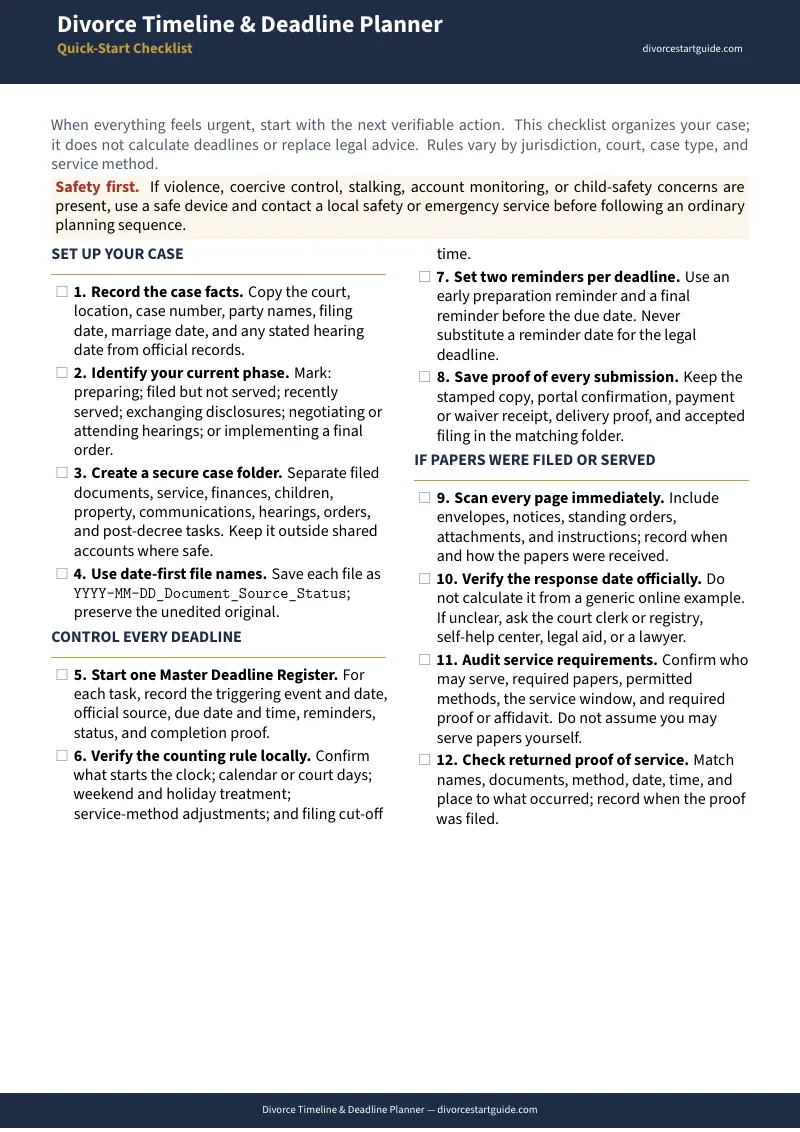
Not ready for the complete planner? Begin with the free 20-Item Quick-Start Checklist and set up the basics today.
Ready to stop chasing dates across papers, portals, and conversations? Get the full Divorce Timeline & Deadline Planner with the Source-to-Proof Deadline System, verification prompts, logs, and worksheets for the whole case.