
The Conversation You're Dreading Is the One That Matters Most
You've made the decision. Now you're lying awake at 2 a.m., rehearsing sentences in your head, terrified of saying the wrong thing. You know your children will remember this conversation for the rest of their lives. You know that how you handle the next thirty days will shape whether they adjust in months or struggle for years. And every parenting blog gives you the same useless advice: "Reassure your children that it's not their fault."
You already know that. What you don't have is a plan — the actual sequence of what to do before, during, and after the conversation. When exactly to tell them. What to say to a five-year-old versus a thirteen-year-old. How to handle the moment your child asks "Why?" and you freeze. What to do when your co-parent refuses to participate. How to track whether your children are adjusting normally or need professional help. And how to manage the daily logistics of two homes without turning your kids into messengers.
The Conversation Scaffolding System
This is not a collection of tips from a therapist's blog. It's a structured conversation and transition system — preparation worksheets, word-for-word scripts for every age group, a 30-day stability roadmap, and behavioral tracking tools — designed so you walk into the hardest conversation of your life with a plan, not a prayer.
Research consistently shows that your child's long-term adjustment is not determined by the divorce itself. It's determined by the level of conflict they witness and how the transition is communicated. That means the conversation you're preparing for and the thirty days that follow it are the highest-leverage parenting moments you will ever have. This guide gives you the tools to get them right.
What's Inside
The Complete Guide + 10 Standalone Printables (12 PDFs)
- Safety Planning Protocol — a separate pathway for situations involving domestic violence, coercive control, or threats. Includes emergency bag checklist, protective order guidance across six countries, and safe exit sequencing. Because the standard "sit down together" model is dangerous when it doesn't apply.
- Age-Specific Conversation Scripts — word-for-word scripts for five developmental stages: toddlers (2–5), early school age (6–8), preteens (9–12), teenagers (13–17), and adult children (18+). Each script includes the exact phrases to use and the phrases to avoid, calibrated to how that age group processes loss.
- Solo-Parent Announcement Pathway — because not every separation involves two cooperative adults. Dedicated scripts and strategies for telling children when you're doing it alone, including what to say about the absent parent without damaging the child's relationship with them.
- Parental Alignment Worksheet — a fillable planning tool for both parents to agree on what to say, what not to say, and how to handle the questions that will follow. Eliminates the risk of contradictory messages that confuse children and escalate conflict.
- Hidden Distress Detection Protocol — children rarely tell you directly that they're struggling. This chapter maps the behavioral signals by age (sleep regression in toddlers, grade drops in school-age children, social withdrawal in teenagers) with a tracking worksheet so you notice patterns instead of dismissing isolated incidents.
- 30-Day Stability Roadmap — a day-by-day plan for the month after the conversation, including check-in prompts, routine anchoring strategies, and escalation triggers that tell you when it's time to call a child psychologist.
- Two-Home Transition Toolkit — packing checklists, visual parenting calendars, bedroom personalization strategies, and logistics scripts that prevent children from becoming the go-between for two households.
- Tough Questions Field Guide — prepared responses for the questions that catch parents off guard: "Do you still love each other?", "Whose fault is it?", "Will you get back together?", "Can I live with [other parent]?", and the reconciliation fantasy that can persist for years.
- Legal Scaffolder — a jurisdiction-neutral reference table mapping where to find your local rules on mandatory parent education courses, court-ordered mediation, custody evaluation standards, and child testimony requirements. Not legal advice — a lookup guide so you know which questions to ask your attorney.
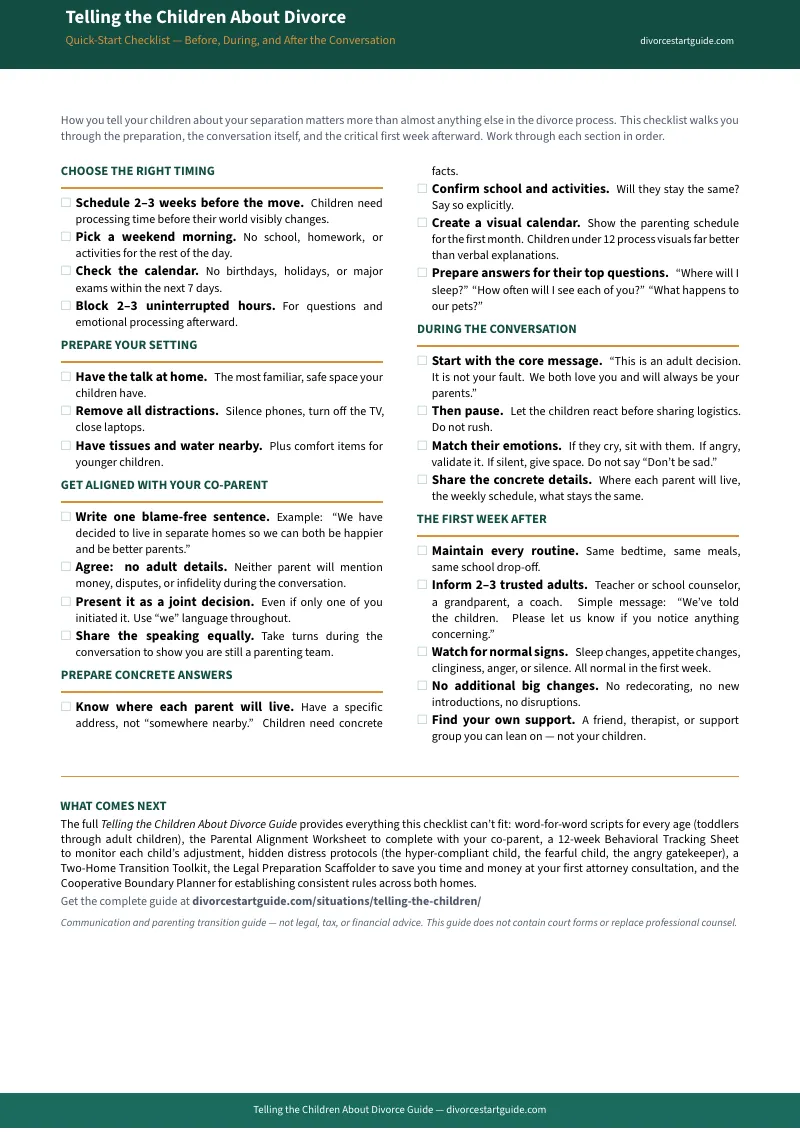
Quick-Start Checklist (Free Download)
A printable one-page checklist covering the 20 most critical preparation steps — conversation timing, environment setup, sibling coordination, immediate post-conversation actions, and the first week's stability anchors.
Who This Is For
- You haven't told the children yet and the move-out date is approaching — you need a preparation sequence, not another article telling you to "stay calm"
- Your children are different ages and you need separate scripts for a five-year-old and a twelve-year-old without the older child overhearing something that scares the younger one
- Your co-parent won't cooperate — you need a solo-parent pathway that protects your children without badmouthing the other parent
- You're in a high-conflict or unsafe situation and the standard "present a united front" advice doesn't apply to your family
- You've already had the conversation and your child's behavior has changed — you need the behavioral tracking tools and escalation framework to decide whether this is normal adjustment or a signal that professional help is needed
- You're a therapist, mediator, or family law professional looking for a structured resource to recommend to clients facing this conversation
Why Blog Posts and Generic Advice Don't Work
A Google search for "how to tell kids about divorce" returns pages of articles that all say the same three things: reassure them it's not their fault, don't badmouth the other parent, and keep routines consistent. That's useful for about ninety seconds.
None of those articles give you the actual script for a four-year-old who doesn't understand what "living apart" means. None of them tell you what to do when your nine-year-old blames you in front of their sibling. None of them provide a tracking system for the behavioral changes that unfold over weeks, not hours. And none of them address the parent who has to do this alone because the other parent is absent, hostile, or unsafe.
Meanwhile, a family therapist charges $150–$350 per session, and a divorce coach runs $100–$300 per hour. This guide delivers the same structured preparation — scripts, worksheets, decision trees, and monitoring tools — at .
100% Satisfaction Guarantee
If this guide doesn't give you a clearer, calmer path into the conversation, email [email protected] and we'll make it right. No hoops, no time limit.
Give Your Children the Conversation They Deserve
Download the free Quick-Start Checklist to see the preparation sequence, or get the full guide for every script, worksheet, and tracking tool you need — from the moment you start planning through the thirty days that follow.