
The Divorce Is Final. The Recovery Has Not Started.
You signed the papers or you are about to. The legal process has a timeline: filing, discovery, settlement, decree. The emotional process does not. There is no hearing date for when the insomnia stops, no court order for when you stop replaying the same conversation at 2 AM, no filing deadline for rebuilding a life you did not plan to live alone.
Most divorce resources stop at the legal finish line. They tell you how to file. They tell you how to divide assets. They do not tell you what to do on the first Tuesday night when the house is empty and the panic sets in.
The Daily Recovery System for Getting Through — Then Getting Past — Divorce
The Emotional Recovery After Divorce Guide is a structured daily workbook — not therapy, not self-help platitudes, not a list of things to "try." It is the operational framework that bridges the gap between what your therapist covers in a one-hour session and the 167 other hours in the week when you need to function, parent, work, and sleep.
The difference between this guide and free articles about "coping with divorce": free articles tell you to "practice self-care" and "lean on friends." This guide hands you the actual daily schedule, the grounding exercises, the co-parenting scripts, and the financial worksheets — structured, printable, and designed to be used when you cannot think straight.
What's Inside the Guide
- Neuroscience of Divorce Grief — Why your brain is treating this like a physical injury, what cortisol does to your sleep and decision-making, and what the research says about realistic timelines. Understanding the biology makes the experience less terrifying.
- 40 Nights Emotional Integration Journal — A prompt-driven daily journal for the first 40 days of acute grief. Ten minutes before bed, structured prompts, grounding exercises. Not "write about your feelings" — specific cognitive exercises drawn from grief research.
- Digital Security Protocol — A complete checklist for separating shared passwords, cloud accounts, family phone plans, location sharing, and financial logins. Most people forget at least three of these. The checklist covers all of them in the right order.
- Distress Tolerance Toolkit — DBT-based STOP and PLEASE skills adapted for divorce-specific triggers: custody handoffs, court appearances, your ex's social media, late-night spiraling. These are clinical-grade techniques in a format you can use without a therapist in the room.
- Progressive Muscle Relaxation Script — A guided body-scan routine for the nights when anxiety makes sleep impossible. Print it, put it on your nightstand, follow it step by step.
- Communication Scripts — Word-for-word templates for telling the children, handling intrusive questions from extended family, and responding to a high-conflict co-parent. Not "tips for communicating" — actual sentences you can copy, adapt, and send.
- Mental Load Matrix — A household task tracker that maps every daily, weekly, and monthly obligation you are now handling alone. Cooking, school pickups, bill payments, home maintenance — all in one place so nothing drops.
- Co-Parenting Planner — Schedule templates, handoff protocols, and boundary-setting frameworks for parallel parenting. Includes scripts for when your co-parent does not follow the agreement.
- Rumination Management Tools — The 10 AM Rule (no analysis after dark), thought-logging worksheets, and cognitive reframing exercises for breaking the "what if" and "if only" loops that keep you stuck at 3 AM.
- Self-Care Infrastructure — A structured daily and weekly routine covering sleep hygiene, nutrition tracking, movement, and social connection. Not "take a bubble bath" — a real schedule with prompts, tracking, and accountability built in.
- Financial Recovery Worksheets — Post-divorce budget builder, QDRO preparation workbook for retirement asset division, and a step-by-step administrative checklist for name changes, insurance updates, and beneficiary switches.
- Professional Help Decision Framework — Clear clinical markers for when self-guided recovery is not enough: persistent insomnia beyond 4 weeks, inability to function at work, destructive coping patterns. Includes guidance on evaluating therapists, coaches, and support groups.
- Holidays and Trigger Dates Planner — Concrete strategies for the first birthday alone, the first holiday season without the kids, anniversaries, and other dates that ambush you. Includes logistics and emotional preparation, not just "be gentle with yourself."
Who This Guide Is Built For
- The person who cannot sleep, cannot eat, and cannot think — You are in the acute phase. Everything feels like an emergency. The guide's first three chapters are designed for exactly this state: short, structured, actionable. No 40-page chapters to read when you cannot focus for 10 minutes.
- The parent carrying everything alone — The school runs, the laundry, the bills, the emotional weight of keeping it together for the kids. The mental load matrix and co-parenting planner turn chaos into a system.
- The person stuck in the loop — You are replaying the same conversations, bargaining with the past, analyzing what you could have done differently. The rumination management chapter gives you clinical tools to interrupt the cycle — not advice to "let it go."
- The person whose therapist covers an hour but not the other 167 — Therapy handles the deep processing. This guide handles the daily infrastructure: what to eat, when to sleep, how to respond to your ex's text, what to say when your mother asks if you are "okay yet."
Why Not Free Articles?
There are thousands of free articles about coping with divorce. They all say the same five things: practice self-care, lean on your support network, give it time, see a therapist, focus on what you can control. They are not wrong. They are also not useful when you are standing in an empty kitchen at 11 PM wondering how to stop crying long enough to fall asleep.
The guide turns those ideas into tools you can hold. "Practice self-care" becomes a daily schedule with sleep prompts, meal planning, and movement tracking. "Lean on your support network" becomes a structured social connection plan with specific contact cadences. "See a therapist" becomes a decision framework with clinical markers and a list of questions to ask potential therapists before your first session.
The Free Checklist vs. the Full Guide
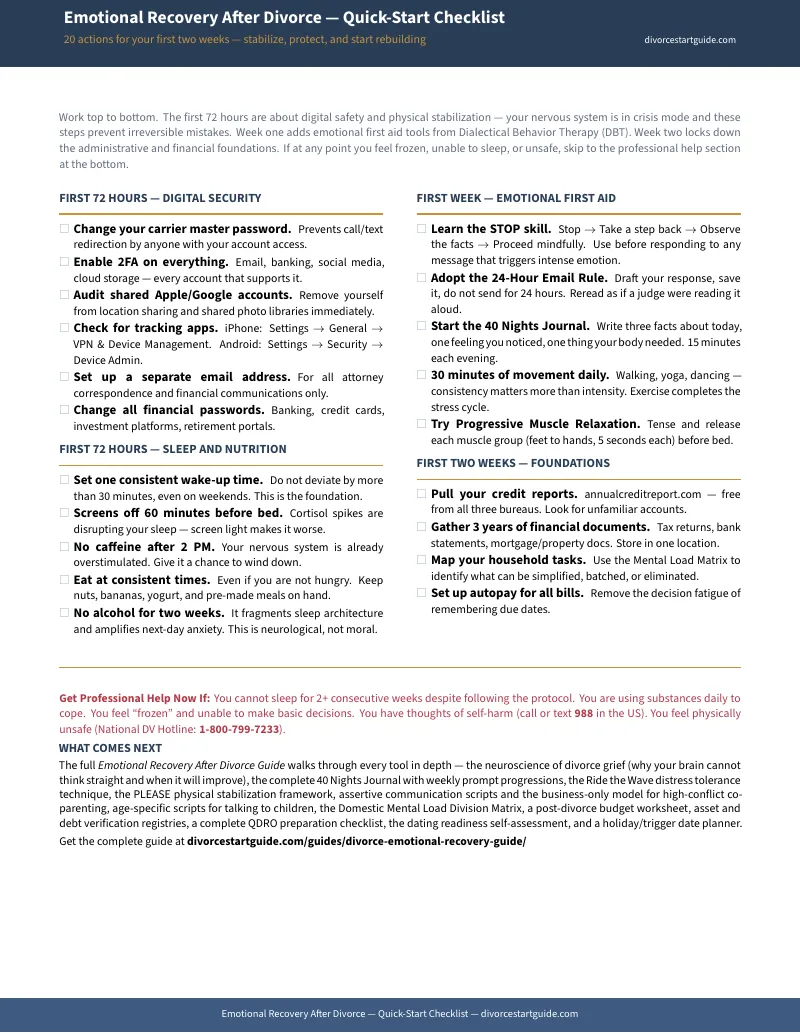
The free Quick-Start Checklist gives you the first 20 actions to take — from the first 72 hours through the first two weeks. It is a triage tool: immediate digital security, sleep basics, one grounding exercise, and the three people to call first.
The full guide is the long-term recovery system: 18 chapters of structured frameworks, worksheets, scripts, and daily tools that carry you from the first shock through identity reconstruction — plus 14 standalone printable worksheets you can pin to the fridge, bring to meetings, or fill in at the kitchen table. The checklist tells you what to do this week. The guide walks you through the next year.
— Less Than One Therapy Co-Pay
A single therapy session runs $100 to $250. A full divorce recovery course costs $400 or more. A specialized co-parenting platform costs $150 per year, per parent. This guide costs less than one therapy co-pay and covers the daily operational work that therapy does not touch.
One-time purchase. Instant download. No subscription, no recurring fee, no upsells.