
Utah's court forms ask for your parenting plan. They don't tell you how to build one.
You've found MyPaperwork on utcourts.gov. You've seen the blank fields: residential schedule, decision-making allocation, dispute resolution method, relocation provisions. And you've discovered the problem — the system generates documents, but it doesn't explain how to draft a schedule that crosses the 111-overnight joint physical custody threshold without accidentally shifting your child support calculation. It doesn't tell you how to structure decision-making across education, healthcare, and religion so you don't end up back in court six months later. And it doesn't explain whether a 5-2-2-5 rotation or an alternating-week schedule fits your child's developmental stage and your work pattern.
Meanwhile, a family law attorney in Salt Lake City charges $250–$450 per hour. A $5,000 retainer buys you roughly fifteen hours. Three or four of those hours go to your attorney asking you questions you could have answered yourself — if someone had told you what the questions were and how to think through the answers.
You don't need someone to write your parenting plan for you. You need to know what the court requires, how to calculate the numbers that matter, and how to build a plan that survives its first real-world test.
The Overnight Navigation System
This is a complete, step-by-step guide to building a parenting plan in Utah — designed for the specific rules that make this state different from every other. It is not legal representation and it does not file your papers. It is the planning and structuring intelligence that blank court forms leave out.
At its core is the Overnight Navigation System — a structured method that walks you from "I know we need a parenting schedule but I don't know what the court expects" to a comprehensive, child-focused agreement that meets the best-interests standard under Utah Code Title 81. It handles the part everyone gets wrong: understanding the 111-overnight threshold that separates sole from joint physical custody and changes your entire child support calculation. Mapping age-appropriate schedules for children under five using Utah's progressive parent-time guidelines. Building communication protocols and dispute resolution clauses that prevent small disagreements from becoming $300-per-hour court motions.
What's inside — the 16-chapter guide, 8 standalone worksheets, and the free checklist
- Custody Types Explained — a clear breakdown of legal vs physical custody under Utah Code Title 81, the joint legal custody presumption, the 111-overnight joint physical custody threshold, and what the court is legally prohibited from considering (gender, medical cannabis, beliefs on gender identity).
- Parenting Plan Builder — step-by-step instructions to draft every required component under Utah Code § 81-9-202: dispute resolution method, complete residential schedule covering every night of the year, decision-making allocation, relocation provisions, and military deployment clauses.
- Parent-Time Schedule Reference — a standalone printable card covering Utah's 5 statutory schedules: progressive stages for children under 5, standard minimum for ages 5–18, expanded alternative, equal parent-time (50/50), and long-distance relocation — with overnight counts and a decision table for choosing the right one.
- Overnight Counting Worksheet — a standalone fillable worksheet to map your proposed schedule and count each parent's overnights across every time period. Determines whether you cross the 111-overnight threshold that changes your custody classification and child support calculation.
- Child Support Calculation Guide — how to determine which worksheet applies (Sole Physical Custody vs Joint Physical Custody), how the combined adjusted gross income table works, and where to run your estimate using the ORS online calculator.
- Cost Summary Worksheet — a standalone fillable tracker for every expense from filing fees through mediation costs, attorney retainers, custody evaluations, and co-parenting apps. Includes benchmarks for uncontested vs contested case totals.
- Court Process Roadmap — a standalone reference card with the complete chronological walkthrough from filing through final decree: the filing fee, 120-day service deadline, Rule 109 automatic injunction, mandatory courses, temporary orders, mediation, the 30-day waiting period, and the contested vs uncontested fork.
- Best-Interests Factor Worksheet — a standalone fillable worksheet covering all statutory factors under Section 81-9-204, organized into parental conduct, parent-child relationships, stability, and safety categories. Document your evidence with specific dates and examples before mediation.
- Mediation Preparation Checklist — a standalone printable checklist of everything to complete and bring before your mediation session: courses, proposed plan, overnight calculations, financial disclosures, priorities, compromise positions, and safety considerations.
- Pre-Filing Preparation Checklist — a standalone printable checklist covering residency verification, financial record gathering, caregiving documentation, and planning steps to complete before you file anything and trigger the Rule 109 injunction.
- Holiday Rotation Worksheet — a standalone fillable planner for alternating every holiday, school break, birthday, Mother's Day, Father's Day, and summer period between parents, with specific pickup and drop-off times and Utah's priority hierarchy.
- Emergency and Special Situations — how to request emergency custody orders (ex parte motions when a child is at risk), supervised parent-time, protective orders under the Cohabitant Abuse Act, and what to do when one parent violates the existing order.
- Relocation and Modification — the 60-day, 150-mile notice rule, how to propose a revised schedule, and the "material change in circumstances" standard for modifying an existing custody order after it's been entered.
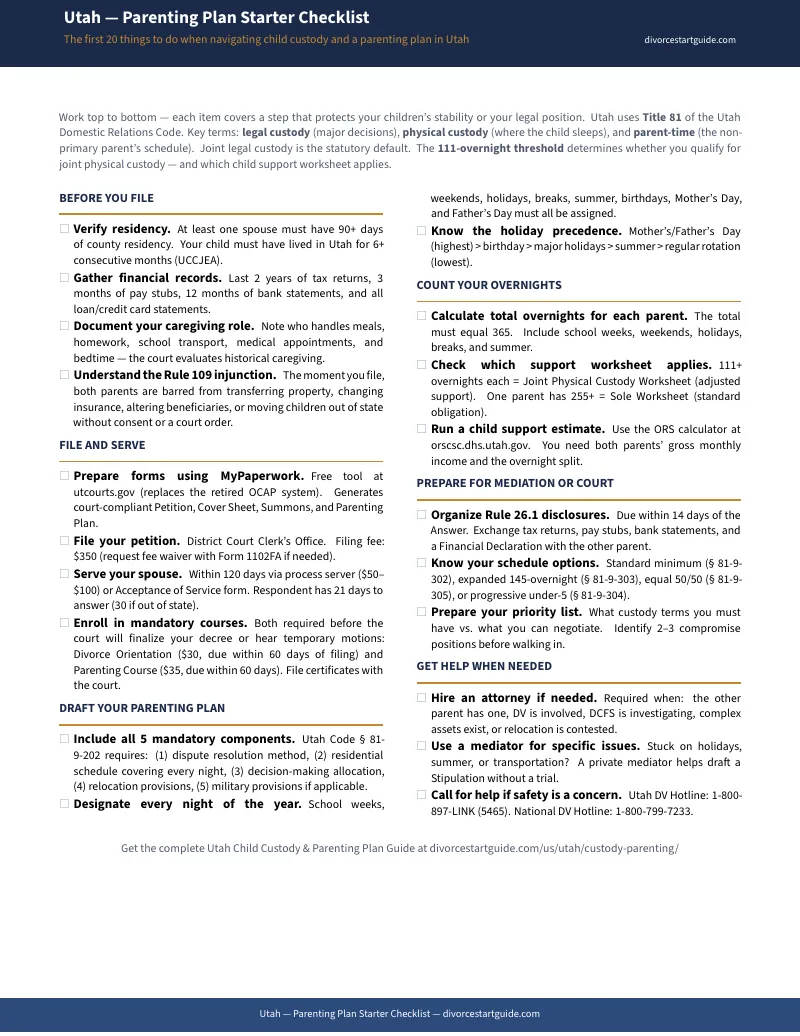
- Utah Parenting Plan Starter Checklist (free download) — a 20-item checklist covering residency verification, financial records, caregiving documentation, mandatory courses, parenting plan components, overnight calculations, mediation preparation, and filing requirements.
Who this is for
The parent who just learned that Utah uses the term "parent-time" instead of "visitation" — and needs to understand what that actually means for their schedule. The self-represented filer who wants to use MyPaperwork but needs to know how to fill in the parenting plan fields before opening the system. The parent heading into mediation at $100–$300 per hour who wants to arrive with a draft schedule already mapped so the mediator's clock doesn't start at zero. The parent calculating whether a proposed schedule puts them above or below 111 overnights — and what that means for child support. The unmarried parent navigating a parentage action who needs custody guidance designed for Utah's specific statutory framework under Title 81. And the parent with an existing order that no longer works because the children are older, one parent needs to relocate, or circumstances have changed.
Why not just use the free resources?
Because free resources give you definitions, not decisions. MyPaperwork generates blank forms — it doesn't explain how to calculate overnights, choose between custody schedules, or draft dispute resolution language. The Utah Courts self-help website defines legal and physical custody in a few paragraphs. The Legal Information Society provides overviews. None of them give you a worksheet that maps your specific week across two households and calculates whether your proposed schedule qualifies as joint or sole physical custody. None provide templates for holiday rotations that prevent the annual December argument. None walk you through the progressive parent-time schedules for children under five — or explain why offering a standard school-age schedule for a two-year-old is the fastest way to get your plan rejected.
The co-parenting apps — OurFamilyWizard at $110–$300 per year per parent, Custody X Change at $72–$288 per year — are built for ongoing communication logging, not initial plan drafting. They require both parents to pay, both parents to participate, and they don't address Utah's specific filing requirements, the MyPaperwork system, mandatory education courses, or the 111-overnight calculation. They are useful tools after you have an agreement. This guide helps you write the agreement.
An honest guarantee
Work through the Overnight Navigation System. If the guide doesn't make your parenting plan clearer and better organised than any free government page or blank court form could — email us at any time for a full refund. The risk of trying it is a fraction of one mediator session. The risk of filing an incomplete parenting plan is a rejected submission and months of delay.
For — less than fifteen minutes of attorney time — you get the scheduling worksheets, the overnight calculations, the court process roadmap, and the step-by-step planning system that the blank forms leave out.
Stop guessing what the court expects. Get the guide, build your parenting plan, and walk into your next step — whether that's mediation, a lawyer's office, or the courthouse — with the work already done.
Frequently Asked Questions
What if the rules change after I buy?
We update the guide when the rules change. Email us any time, even years later, and we'll send you the current edition free.