Your Divorce Is Legal. Your Life Admin Isn't Done.
The South Dakota court helped you end the marriage. It did not help you separate the bank accounts, transfer the car titles, divide the pension, or update the will that still leaves everything to your ex.
Every agency you need to deal with — the Social Security Administration, the Department of Public Safety, your county treasurer, private banks, the South Dakota Retirement System in Pierre — has its own forms, its own required documents, and its own deadlines. Get the order wrong and you're turned away at the DPS counter because SSA hasn't processed your name yet. Miss the 45-day vehicle title window and you're paying late fees plus interest on the excise tax. Forget to update a private 401(k) beneficiary form and federal law ensures your ex-spouse inherits — regardless of what your decree says.
This is the After-Divorce Administrative Transition Workbook — the chronological roadmap that picks up where the UJS self-help portal stopped. It coordinates every state agency, every county office, and every private institution into one sequence you can work through at your own pace.
What's Inside
The Identity Restoration Blueprint
Step-by-step name updates across the SSA, South Dakota DPS, your passport, employer HR, and the IRS — in the exact order that prevents rejections. Includes the precise documents the DPS requires (hint: they reject digital signatures and need two original proof-of-address documents dated within 60 days), plus the difference between decree-based name restoration under SDCL 25-4-47 and a separate name change petition that costs $70, requires a court hearing, and takes 4+ weeks of newspaper publication.
The Joint Liability Exit Guide
Your divorce decree assigned joint debts, but creditors don't care — they're not parties to the divorce. Both names stay on every joint account, and both parties remain 100% liable. This guide walks you through freezing joint credit lines, closing joint accounts, and redirecting your payroll in the safe order that prevents your ex from running up balances on cards you're still on the hook for.
The 45-Day Vehicle Title Playbook
South Dakota gives you exactly 45 days from the decree to transfer vehicle titles into your individual name. After that: $1/week for 26 weeks, then a flat $50 penalty, plus 1% monthly interest on the 4% excise tax. But here's what most people don't know — Exemption Codes 03 and 04 under SDCL 32-5B-2 can eliminate the 4% excise tax entirely. This section includes Form 1001 instructions, the exemption codes, county-specific mail-in fees (Lincoln County charges $25; Minnehaha takes two weeks for mail-in processing), and every document your county treasurer needs to see.
The Retirement & SDRS Division Worksheets
Your divorce decree does not divide retirement accounts. Federal law requires a separate court order — a Qualified Domestic Relations Order (QDRO) — and your plan administrator won't touch the account without one. These worksheets explain how to request the plan's free Model QDRO before paying an attorney thousands to draft from scratch, plus the specific steps for SDRS defined benefit pensions through the Pierre office. Covers the pre-approval protocol, valuation date specifications, and the exact division parameters that prevent first-submission rejections.
The ERISA Beneficiary Trap Briefing
South Dakota's SDCL 29A-2-804 automatically revokes your ex-spouse's beneficiary status on wills, trusts, and state plans like SDRS — the state Supreme Court confirmed this in Buchholz v. Storsve. But private-sector 401(k)s, 403(b)s, and group life insurance are governed by federal ERISA, which overrides state law. Under Egelhoff v. Egelhoff, if you never update that beneficiary form, the plan administrator must pay your ex-spouse. This briefing flags every account type and tells you exactly which forms to file.
The Estate Plan Revision Blueprint
SDCL 29A-2-804 revokes bequests to your ex in your existing will, but it doesn't rewrite the rest. Without named executors, trustees, or healthcare agents, your estate falls into contested probate and critical medical decisions go to a state-appointed default. This section walks through rebuilding your will, powers of attorney, and trust documents from the ground up.
The Agency Execution Tracker
A single printable chart covering all five post-decree phases — from Day 1 identity protection through the 90+ day estate restructuring — so you can schedule and tick off every application without losing track.
Who It's For
- You filed pro se through the UJS portal or the WORKS Clinic and now need the administrative roadmap that court self-help doesn't provide.
- Your attorney handled the divorce but their representation ended with the signed decree — leaving you with a stack of certified copies and no instructions for what comes next.
- You're a public employee participating in SDRS and need to navigate the Pierre office for pension division without paying a specialist $350–$700.
- You have minor children and need to align insurance, beneficiaries, child support filings, and estate documents to protect them financially.
- You want to handle the 85%+ of post-divorce tasks that are purely administrative — on your own, without paying hourly legal fees for work that doesn't require a lawyer.
Why Free Court Self-Help Isn't Enough
The UJS self-help portal provides the forms to get a divorce. It does not provide a single form, checklist, or instruction for what happens after the decree is signed. That's not a gap — it's by design. The court's administrative responsibility ends the moment the judge signs.
What you need next lives across a dozen separate agencies, each with its own forms, fees, and documentation requirements: the SSA, the DPS, your county treasurer, private banks, retirement plan administrators, insurance companies, the Register of Deeds. No single government website coordinates them. Generic document kits from LegalZoom or eForms give you blank templates but no South Dakota-specific guidance — no county treasurer fee schedules, no excise tax exemption codes, no DPS documentation requirements.
This workbook does the coordination. It translates your signed decree into the exact action items each agency requires, in the order that prevents rejections and missed deadlines.
What This Workbook Is — and Isn't
This is process navigation, not legal advice. It does not draft legal documents, replace an attorney for contested matters, or provide counsel. Every official court and government form in South Dakota is free, and this guide points you to them.
What it adds is the sequence, timing, and practical coordination the free forms leave out — the difference between knowing you need to file a title transfer and knowing that your county treasurer wants Form 1001, a certified copy of the decree, a $10 fee, and the Exemption Code 04 citation to avoid the 4% excise tax, submitted within 45 days or you'll pay $1/week in penalties.
If it doesn't work for you, email us and we'll make it right.
— Less Than One Missed Deadline
A single late vehicle title transfer costs more in penalties and excise tax interest than this entire workbook. One forgotten beneficiary form can send a retirement account to an ex-spouse. One rejected DPS application means another day off work, another trip, another set of documents.
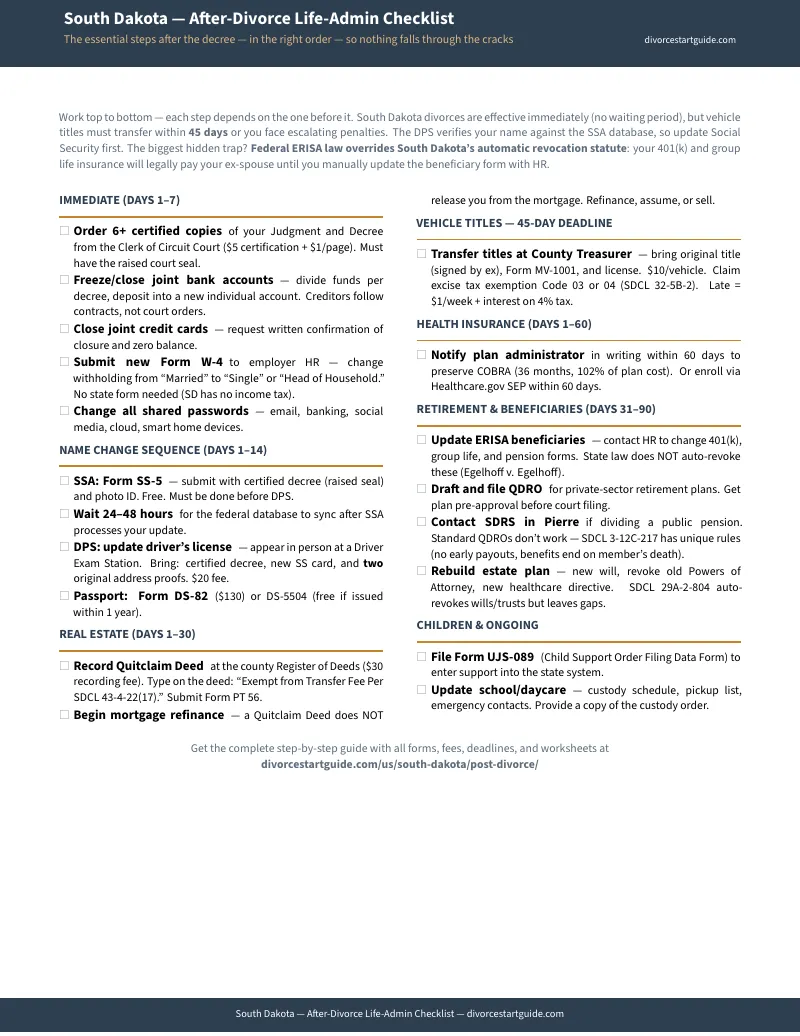
The free checklist covers the first seven days — identity protection, account freezes, and the name change order of operations. The full workbook covers the entire transition: every agency, every deadline, every form, from Day 1 through the 90-day estate restructuring.
Download the free checklist to get started, or get the full workbook to handle the whole transition in one pass.
Frequently Asked Questions
What if the rules change after I buy?
We update the guide when the rules change. Email us any time, even years later, and we'll send you the current edition free.