
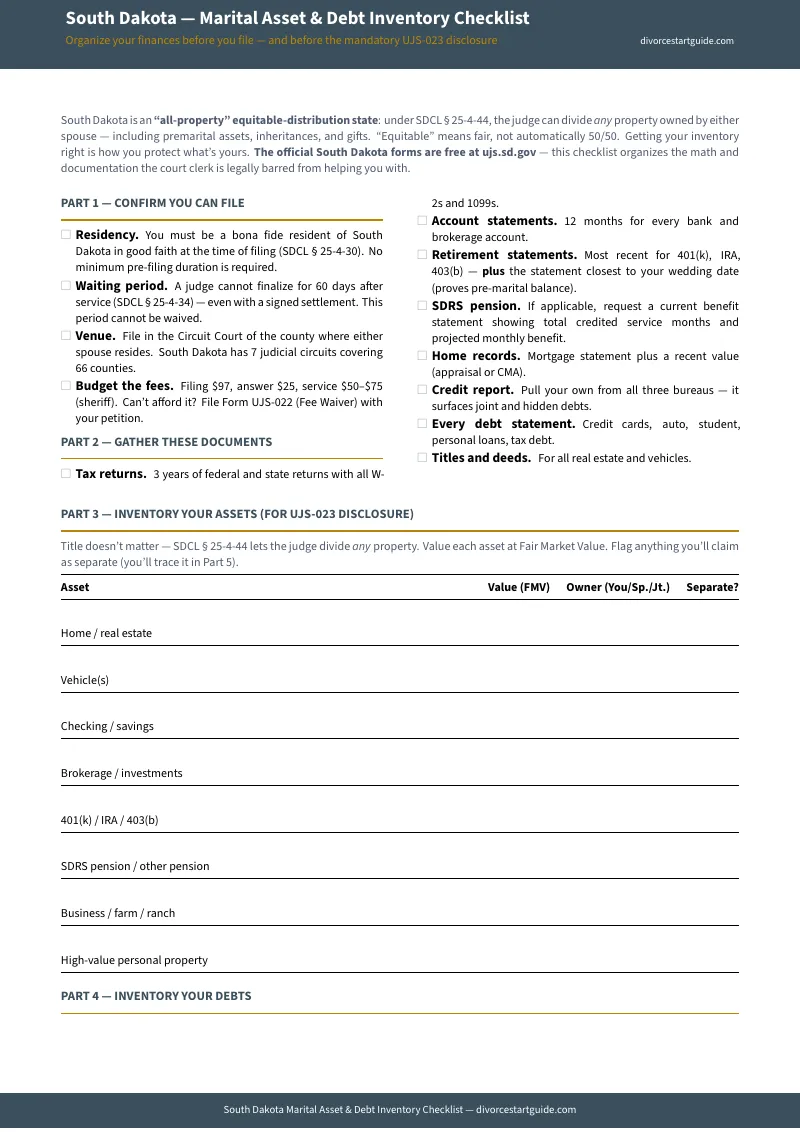
The free court forms are blank boxes. They don't tell you how to calculate what goes in them.
You've found the forms on the UJS Self-Help website — the Complaint, the Financial Statement, the Stipulation and Settlement Agreement. And you've hit the wall: Form UJS-023 demands seven categories of income, itemized monthly expenses, and a full liability schedule with creditor names and outstanding balances. But it doesn't tell you how to figure out whether the inheritance your grandmother left you is still yours after it sat in a joint account for eight years. It doesn't tell you how to calculate the marital share of an SDRS pension. And it doesn't explain that in South Dakota, a judge can divide any asset either spouse owns — including everything you brought into the marriage.
That last part stops people cold. South Dakota is an "all-property" equitable distribution state under SDCL § 25-4-44. Unlike traditional equitable distribution states that shield premarital assets by default, South Dakota courts have the authority to reach anything — your savings account from before the wedding, the farmland your family transferred to you, the 401(k) you started at 22. "Equitable" doesn't mean equal; it means fair under the circumstances. And what a judge considers fair depends on seven factors established through decades of South Dakota Supreme Court case law.
A family law attorney in South Dakota charges $200–$400 an hour. A $1,500 retainer buys you roughly five hours. Two of those go to sorting your bank statements and retirement summaries into categories. That is administrative work you could have done yourself — if someone had shown you which categories matter and why.
The All-Property Division Navigator
This is a complete, step-by-step guide to dividing money and property in a South Dakota divorce — built for the specific rules that make this state different from every other jurisdiction. It is not legal representation and it does not file your papers. It is the calculation and sequencing method that the blank forms leave out.
At its core is the All-Property Division Navigator — a structured method that walks you from "I have a pile of bank statements and no idea what's mine vs. ours" to a clean, defensible asset-and-debt inventory ready for Form UJS-023 and your Stipulation and Settlement Agreement. It handles the part everyone gets wrong: classifying assets under an all-property regime where nothing is automatically protected, tracing separate property using the Field v. Field standard, splitting SDRS pensions and military retirement correctly, preparing a spousal support estimate without a statutory formula, and building a complete financial picture before the mandatory 60-day waiting period expires.
What's inside — 12-chapter guide, standalone worksheets, and the free checklist
- Chapter 1: How South Dakota Divides Property — the all-property equitable distribution framework, the seven Supreme Court factors from Kressly through Endres, why fault is excluded from property division (with one narrow exception for dissipation), and the opt-in community property trust trap under SDCL Chapter 55-17.
- Chapter 2: Urgent First Actions — confirming residency under SDCL § 25-4-30 (no minimum duration required), filing in the correct Circuit Court county, understanding the strict 60-day waiting period under SDCL § 25-4-34, and securing your financial records before the Automatic Temporary Restraining Order takes effect.
- Form UJS-023 Walkthrough — line-by-line preparation for the mandatory Financial Statement: the seven income categories, employment verification, itemized monthly expenses, tax-based annual income tracking, and the complete liability schedule. Because court clerks are legally barred from helping you fill it out.
- Separate Property Tracing + Tracing Worksheet — under Field v. Field, you need contemporaneous evidence of donative intent and proof that the non-recipient spouse made no or merely de minimis contributions. The worksheet walks you through documenting the origin, title history, commingling analysis, and contribution record for every asset you want to protect.
- Home Equity Division Calculator — the three pathways for the marital home: buyout with refinancing, sell and split net proceeds, or deferred sale until minor children graduate. Includes the mortgage liability trap — your divorce decree assigning the house to your spouse does not release you from the bank's contract.
- Retirement and Pension Division — 401(k)s, 403(b)s, IRAs, SDRS public pensions, and military retirement under USFSPA. The marital-share calculation formula, the QDRO process step by step (contacting the plan administrator, requesting the model QDRO, choosing between shared-payment and separate-interest approaches), and timing the order alongside your final decree.
- Debt Allocation Framework — classifying joint vs. individual debts, the creditor non-binding rule (creditors can still pursue both of you regardless of what the decree says), post-separation debt lines, and a credit protection sequence for closing joint accounts and converting shared obligations.
- Spousal Support Estimator — South Dakota has no statutory alimony formula. The guide walks through the three recognized types (permanent, rehabilitative, restitutional), the discretionary factors under SDCL § 25-4-41, a temporary support estimation worksheet, and the tax treatment of alimony post-2018.
- Post-Decree Administration Checklist — title transfers, beneficiary updates, account closures, new tax filing status, Social Security record requests, and every document change needed after the judge signs the decree.
Every worksheet is included as a standalone printable PDF — eight separate files you can print individually and bring to mediation, your attorney review, or the kitchen table:
- Separate Property Tracing Worksheet — landscape-format tracing tables plus a documentation checklist for every asset you want to protect
- Form UJS-023 Prep Worksheet — income, deductions, expenses, and asset/liability summaries organized by Financial Statement section
- Home Decision Worksheet — equity calculation, three-option comparison (sell, buyout, deferred sale), and cash-out refinance feasibility check
- Spousal Support Estimator — temporary support baseline formula, monthly budget comparison, discretionary factor self-assessment, and alimony type determination
- Debt Protection Planner — joint debt inventory, creditor exposure analysis, and post-decree credit monitoring plan
- Retirement Division Matrix — division mechanism by plan type, marital share calculations for SDRS/military/401(k), and the complete QDRO process checklist
- Master Balance Sheet — landscape estate valuation worksheet with asset and liability tables and net marital estate summary
- Post-Decree Transfer Tracker — every deed, title, beneficiary, and account change needed after the judgment is signed
Who this is for
The spouse quietly gathering records before filing. The person staring at Form UJS-023 and a stack of bank statements with no idea how to connect the two. The rancher wondering whether the family land they inherited is really up for grabs. The public servant calculating how their SDRS pension gets divided. The cooperative couple who want to reach a fair deal during the 60-day waiting period without spending thousands on billable hours — but need the math to prove the deal is actually fair. And the spouse who already has a lawyer but wants to stop paying $200–$400 an hour for document organization they can handle themselves.
Why not just use the free resources?
Because the free resources give you forms, not calculations. The UJS Self-Help Center provides excellent procedural checklists and blank PDFs. East River Legal Services and Dakota Plains Legal Services offer guidance for qualifying individuals. But none of them provide interactive tracing worksheets, step-by-step pension division instructions, or a spousal support estimation method. They explain the law — they don't help you calculate your specific financial division.
The national platforms — 3StepDivorce at $199–$299, OnlineDivorce, Hello Divorce starting at $499 — generate state-compliant forms through questionnaires. But they don't explain the Field v. Field tracing standard, the SDRS pension division process, or why South Dakota's all-property rule means your premarital assets need active protection. Generic form generators cannot model the seven Supreme Court factors that determine your specific equitable split.
An honest guarantee
Work through the All-Property Division Navigator. If the guide doesn't make your financial split clearer and better organized than any blank form or free article could — email us at any time for a full refund. The risk of trying it is a fraction of one attorney billable hour. The risk of guessing on your asset division is measured in years of financial consequences.
For — less than fifteen minutes of attorney time — you get the tracing worksheets, the pension division instructions, the spousal support estimator, and the step-by-step sequence that the free forms leave out.
Stop staring at blank boxes. Get the guide, build your inventory, and walk into your divorce with the numbers already done.
Frequently Asked Questions
What if the rules change after I buy?
We update the guide when the rules change. Email us any time, even years later, and we'll send you the current edition free.